Food Versus Fuel: What’s Happening With Centre’s Ethanol Blending Scheme
Relevance: GS3 - Major crops-cropping patterns in various parts of the country, - different types of irrigation and irrigation systems storage, transport and marketing of agricultural produce and issues and related constraints; e-technology in the aid of farmers, Food security, Infrastructure: Energy
(Source: Indian Express, 12/13/2023)
Why in the news?
- Recently, the Union Ministry of Consumer Affairs, Food and Public Distribution directed all mills and distilleries to stop using sugarcane juice to produce ethanol with immediate effect.
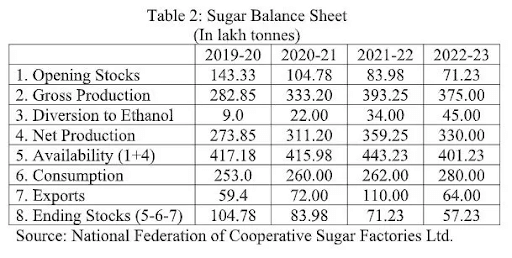
- The 2022-23 sugar year ended with stocks of just over 57 lakh tonnes, the lowest since 2016-17 (39.4 lt).
Table of Contents
What were the recent directives of the Union government to sugar mills?
- Ban on the use of sugar for ethanol production: On December 7, the Union Ministry of Consumer Affairs, Food and Public Distribution directed all mills and distilleries not to use sugarcane juice or syrup to make any ethanol with immediate effect.
- Export restrictions: Earlier in October, the Union government had extended the restriction on sugar exports until it issued new orders.
- These restrictions had been in place since May 2023.
- The combination of the restriction on ethanol production and sugar exports is a further reflection of the government's prioritization of domestic supply over exports.
Impact of the move
- The move has adversely impacted the sugar industry, particularly those companies that had built the capacity to produce ethanol directly from sugarcane syrup.
- Oil marketing companies (OMCs) have floated tenders for the supply of 825 crore liters of ethanol for 2023-24, i.e. a 15% blending target.
- In the first cycle of bids, the OMCs received offers for 559 crore liters of which ethanol produced from sugarcane accounted for 135 crore liters.
- The recent directive of the government could impact the supply of ethanol and impact their capacities.
- Although the Centre has stated that the supply of ethanol from B-heavy molasses against existing offers received by OMCs will continue it has not announced prices payable to mills in 2023-24.
- The government had shifted the sugar year to November-October making it closer to the sugar year which starts in October.
What was the reason for the directions?
- The moves were aimed at increasing the availability of sugar in the domestic market.
- In the 2022-23 sugar year, stocks of just over 57 lakh tonnes (lt) were recorded.
- This was the lowest since 2016-17 (39.4 lt) and less than half of the record year of 2018-19 (143.3 lt).
- According to the National Federation of Cooperative Sugar Factories, output has been estimated at 291.50 lt in 2023-24.
- In comparison, output was 330.9 lt in 2022-23 and 359.25 lt in 2021-22.
- Sub-par rain and low levels of water in reservoirs are the major reasons behind the drop in production of sugarcane in Maharashtra and Karnataka.
- As a result of the order, around 15 lt of sugar, which would otherwise have been used for ethanol production, will be available.
- The availability of an extra amount of sugar will boost the physical availability of sugar in the market and counter bullish price fluctuations.
Ethanol production
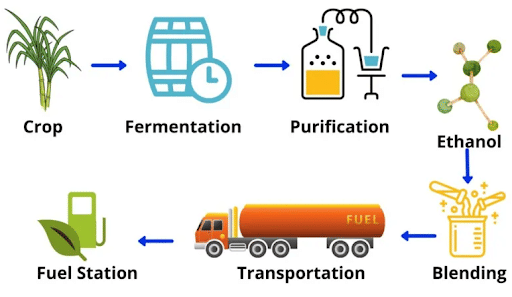
- Ethanol is an agricultural by-product obtained by processing sugarcane as well as sugars from other sources like rice husk or maize.
- It is considered a renewable form of energy since ethanol is produced from plants that harness the power of the sun.
- Ethanol is 99.9% pure alcohol that can be blended with petrol.
- The all-India average blending of ethanol with petrol has risen from 1.6% (2013-14) to 11.8% (2022-23).
- Distilleries in UP like TIEL use multiple feedstocks
- B-heavy molasses during the cane crushing season (November-April)
- Grain (mainly FCI rice, broken rice, and maize) in the off-season (May-October).
From sugar
- Ethanol – or even 94% pure industrial-grade rectified spirit and 96% extra neutral alcohol for potable liquor – is normally produced from C-heavy molasses.
- Cane is typically crushed with 13.5-14% total fermentable sugars (TFS) by mills with around 11.5% of it recovered from the juice as sugar.
- The uncrystallized and non-recoverable 2-2.5% of TFS is in the form of C-heavy molasses.
- Each tonne of this liquid (40-45% sugar) produces 220-225 liters of ethanol through fermentation and distillation.
- However, mills recover just 9.5-10% sugar and divert the remaining 1.5-2% to the B-heavy stage molasses.
- This molasses has 50%-plus sugar and yields 290-320 liters of ethanol per tonne.
- Another option for mills is to ferment the entire 13.5-14% TFS into ethanol instead of producing sugar.
- This option allows them to obtain 80-81 liters of ethanol from one tonne of cane versus 20-21 liters through the B-heavy and 10-11 liters through the C-heavy routes.
From grains
- India’s ethanol production rose sharply after 2017-18 due to the production of ethanol from B-heavy molasses and concentrated sugarcane syrup.
- Ethanol production was boosted by the use of new substrates such as surplus rice from the FCI’s stocks, broken foodgrains, and maize.
- Grains contain starch which can be converted into sucrose and simpler sugars (glucose and fructose) before fermentation by yeast.
- Although the process to obtain ethanol from foodgrains is longer, the yields are higher at 380-340 liters per tonne.
- Differential pricing: Ethanol production was further boosted by the higher price offered for ethanol production from feedstocks other than C-heavy molasses.
- For 2022-23, the ex-distillery price of ethanol payable by state-owned OMCs was fixed at ₹49.41 per liter (from C-heavy molasses) and ₹60.73 (B-heavy molasses), ₹ 65.61 (sugarcane juice), ₹58.50 (surplus FCI rice), ₹55.54 (broken or damaged grain) and ₹56.35 (maize).
- In August, the Union government raised the procurement price of ethanol produced from damaged grain and maize to ₹64 and ₹66.07 per liter.
- Up to 2017-18, OMCs paid a uniform price for ethanol regardless of the feedstock from which it was produced.
Ethanol Blending Programme
- The Ethanol Blending Programme was launched by the Ministry of Petroleum and Natural Gas in 2003 to promote the use of renewable fuels in the country.
- The programme has been extended to the whole of India (except UTs of Andaman Nicobar and Lakshadweep islands) since 2019.
- It was initially started with a target of 5% blending, then 10% ethanol blending by 2022.
- The goal was to achieve 20% blending (E20) by 2030 which was shifted to 2025-26 in the Ethanol Roadmap released by the Niti Aayog.
- Benefits of the EBP programme:
- Reduction in the country’s import bill.
- Reduction in environmental pollution.
- Increased farm income.
- In comparison to other fuels, biofuels involve the lowest incremental investments
- Challenges faced by the EBP programme
- Reconfiguration of engines would be necessary to process ethanol-blended petrol.
- Although ethanol burns without emitting CO2, there is no reduction in the emission of nitrous oxide.
- Concerns have been raised about inefficient land usage and unsustainable use of water to cultivate ethanol-producing crops
- Increased production of ethanol from food grains like rice and maize could lead to food security concerns.
- According to industry experts, the success of the EBP program was due to the government’s differential pricing policy.
- As a result, the EBP programme was not dependent on a single crop or feedstock.
- Previously, 100% of ethanol was obtained from sugarcane-based feedstocks.
- This fell to 76% in 2022-23 and is projected to drop to below 50% in the coming year accompanied by an equivalent rise in ethanol production from grains.
To know more, click the link.
Conclusion
The recent directives by the Union government to halt sugarcane-based ethanol production aim to address the sugar shortage in the domestic market. This is however likely to impact the sugar industry and the Ethanol Blending Programme’s targets.
(*Click this link to read prelims specific weekly current affairs articles)
FAQs
Question: What is ethanol?
Answer:
Ethanol is an organic compound made by fermenting sugarcane molasses or sugar. Ethanol is the active ingredient in alcoholic beverages and is also used in the chemicals and cosmetics industries. In the transport sector, the use of ethanol-blended petrol (EBP) significantly reduces harmful emissions, such as of carbon monoxide and various hydrocarbons, from vehicles.
Question: What is E20 fuel?
Answer:
It is a 20–80 ethanol–petrol blend that can be used in automobiles, trucks, and motorbikes that was introduced by the Prime Minister at the E20 fuel at the India Energy Week 2023 event in February 2023. It reduces emissions, promotes the use of renewable energy, and enhances engine efficiency.
UPSC Mains Practice Question:
|
MCQs
Question: Among the following, which one is the least water-efficient crop? (2021)
(a) Sugarcane
(b) Sunflower
(c) Pearl millet
(d) Red gram
Answer: (a) See the Explanation
Sugarcane is the least water-efficient crop that requires 1800-2200 mm/season water. Sugarcane which is a Kharif crop is the world’s largest crop in terms of production. India is regarded as a sugar superpower due to its massive sugarcane and sugar output, cane growers, sugar consumers, more than 500 sugar mills, and one of the largest sugar exporters.
Therefore, option (a) is the correct answer.
Question: Consider the following statements ; [2010]
- The Union Government fixes the Statutory Minimum Price of sugarcane for each sugar season
- Sugar and sugarcane are essential commodities under the Essential Commodities Act.
Which of the statements given above is/are correct?
(a) 1 only
(b) 2 only
(c) Both 1 and 2
(d) Neither 1 nor 2
Answer: (c) See the Explanation
- The Statutory Minimum Price for sugarcane was replaced by the Fair and Remunerative Price which is fixed by the government of India on the recommendation of the Commission on Agricultural Costs and Prices (CACP). Hence statement 1 is correct.
- The Essential Commodities Act was introduced in 1955 to ensure the delivery of certain commodities or products, the supply of which, if obstructed due to hoarding or black marketing, would affect the normal life of the people.
- The list of items under the Act includes drugs, fertilizers, pulses, edible oils, sugarcane and sugar, petroleum and petroleum products. Hence statement 2 is correct.
Therefore, option (c) is the correct answer.
Question: Consider the following statements:[2003]
- Molasses is a by-product of sugar production process.
- Bagasse obtained in the sugar mills is used as a fuel in the boilers to generate steam for the sugar factories.
- Sugar can only be produced from sugarcane as the raw material.
Which of these statements are correct?
(a) 1 and 2
(b) 2 and 3
(c) 1 and 3
(d) 1, 2 and 3
Answer: (a) See the Explanation
- Molasses is a by-product of the sugar production process. It is a thick, dark syrup-like substance that remains after sugar has been extracted from sugarcane or sugar beets. It is used as a sweetener. Hence statement 1 is correct.
- Bagasse is the fibrous residue left after extracting juice from sugarcane in sugar mills. It is commonly used as a fuel in the boilers to generate steam which powers various processes within the sugar factories. Hence statement 2 is correct.
- Sugar can also be produced from sugar beets, which are processed to extract sugar similar to sugarcane, which is the major source of sugar. Hence statement 3 is incorrect.
Therefore, option (a) is the correct answer.
Download the PREPP App and attempt FREE IAS Exam Mock Tests and get complete study material!

Full Test - 04: UPSC CSE Prelims CSAT (Paper-II)
Full Test - 03: UPSC CSE Prelims CSAT (Paper-II)
UPSC CSE Prelims 2026 GS Paper 1 Question Paper (24-May-2026)
UPSC CSE Prelims 2026 CSAT Paper 2 Question Paper (24-May-2026)

17 February 2025 | The Hindu Must Read Articles | Current Affairs

16 February 2026 | The Hindu Must Read Articles | Current Affairs

13 February 2026 | The Hindu Must Read Articles | Current Affairs









Comments