Food Production Accounts For 15% Fossil Fuel Use, As Big Oil Locks in Dependence on Petroleum-Based Pesticides
Primary Source: Down To Earth
Click here for Daily Current Affairs
Why in the news?
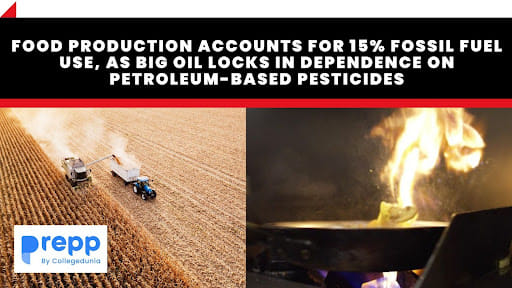
The article highlights the significant reliance of global food production on fossil fuels, accounting for 15% of annual fossil fuel use, which is on par with the emissions of the European Union and Russia combined.
Table of Contents
Overview of the Issue
- High Carbon Footprint: Food production contributes significantly to global fossil fuel consumption and associated carbon emissions, rivalling the combined emissions of substantial geopolitical entities like the EU and Russia.
- Shifting Dependency: As traditional sectors like transport and power generation increasingly move towards renewables, the fossil fuel industry is pivoting to entrench its presence in the food sector through petrochemicals for pesticides and fertilizers.
- Integrated Role of Fossil Fuels: Fossil fuels are deeply woven into the fabric of the industrial food value chain, from input production to waste management.
Fossil Fuel Dependency in the Global Food Sector
The global food sector remains significantly dependent on fossil fuels. This dependence spans the entire food value chain, from the production of inputs like fertilizers and pesticides, which are heavily reliant on fossil fuels, to agricultural production, processing, packaging, and distribution.
1) Input Production
- Fertilizers and Pesticides: The manufacturing of synthetic fertilizers and pesticides is one of the most energy-intensive parts of the food system. It relies heavily on natural gas and other fossil fuels not just as energy sources but also as feedstocks.
- Natural gas, for instance, is a key component in the production of ammonia, which is a building block for nitrogen fertilizers.
- Machinery: The production of agricultural machinery and equipment also consumes fossil fuels, both in the manufacturing process and in the operation of the machinery itself.
2) Land Use and Agricultural Production
- Machinery Operation: The operation of machinery for planting, tilling, harvesting, and other farm operations is largely powered by diesel fuel.
- Irrigation: Systems that require energy to pump water also depend on electricity, often generated by fossil fuels, especially in regions without substantial renewable energy infrastructure.
3) Processing and Packaging
- Food Processing: This stage involves the transformation of raw agricultural products into goods suitable for consumption. This process often requires significant amounts of energy for operating machinery, heating, cooling, and refrigeration.
- Packaging: The production of packaging materials, particularly plastics, is another fossil fuel-intensive process. Plastics are typically derived from petrochemicals, which are produced using oil and natural gas.
4) Retail, Consumption, and Waste
- Transportation: The movement of food from producers to consumers—whether it’s to processing facilities, warehouses, retailers, or the end consumer—is heavily reliant on transportation that uses diesel and gasoline fuels.
- Retail Operations: Retail outlets like supermarkets use a substantial amount of energy for lighting, heating, and cooling. Refrigeration in particular is a major consumer of energy, often powered by electricity generated from fossil fuels.
- Consumption: In the home, cooking is a significant user of energy, typically from natural gas or electricity, which, depending on the region, may be generated from fossil fuels.
- Waste Management: The collection, transportation, and processing of food waste also consume fossil fuel energy.
Future Projections Related to Fossil Fuel Usage
- Increase in Global Food Demand: By 2050, food demand is projected to increase by 35-56%. This heightened demand will put more pressure on food production systems and could result in increased fossil fuel consumption unless sustainable practices are adopted.
- Rise in Fossil Fuel Usage: If the current trend continues without any significant changes, the reliance on fossil fuels for food production, particularly in the areas of fertilizers, pesticides, and food packaging, is expected to rise in line with the increased demand for food.
- Increased Energy Intensity in Supply Chains: As supply chains lengthen and become more complex, there will be an increase in the energy required for food processing, packaging, and transportation, which traditionally relies heavily on fossil fuels.
- Growth in Fertilizer Production: The production of fertilizers, which is already a major consumer of fossil fuels, is expected to increase significantly, further contributing to greenhouse gas emissions unless alternative energy sources are used.
Need for Food System Transformation
- High Carbon Footprint: The food system accounts for an estimated 15% of global fossil fuel use, equating to substantial carbon dioxide emissions.
- Dependency on Fossil Fuels: Fossil fuels are integral to various stages of food production, such as manufacturing fertilizers and pesticides, powering agricultural machinery, processing, packaging, and transportation.
- Increasing Demand: As global food demand is projected to rise significantly by 2050, a corresponding increase in fossil fuel usage is expected, worsening the carbon footprint if changes are not made.
- Energy-Intensive Processes: Processing and packaging consume the most energy, followed by retail and waste management, due to refrigeration, storage, and long-distance transport needs.
- Corporate Interests: A few large multinational corporations dominate the agri-food and energy sectors, which may perpetuate the current fossil fuel-dependent system.
Way Forward
- Overhaul of Food Systems: There is a need to fundamentally change the way food is produced and consumed to break the dependency on fossil fuels.
- Renewable Energy Adoption: Shifting towards renewable energy sources for transport and power can be mirrored in the food production processes.
- Investing in Alternatives: There is a need for investment in non-petroleum-based alternatives for fertilizers, pesticides, and packaging materials.
- Efficiency Improvements: Enhancing the efficiency of energy use in processing, packaging, and transportation to reduce the carbon footprint.
- Shorter Supply Chains: Localizing food production and consumption can reduce the distance food travels, decreasing emissions from transportation.
- Addressing Corporate Power: Encouraging diversification and reducing the concentration of power in agri-food and energy sectors to allow for more sustainable practices.
- Empowering Local Actors: Enhancing the participation of smallholder farmers, small-scale fishers, and local communities can lead to more sustainable and equitable food systems.
- Waste Reduction: Improving food consumption patterns and reducing waste in high-income countries can significantly lower the energy used in the 'retail, consumption, and waste' stage.
Conclusion
The report from the Global Alliance for the Future of Food and Dalberg Advisors calls for a dramatic restructuring of food systems to break the fossil fuel dependency amid rising demands projected by 2050. Concerns are raised about the consolidation of power by a few multinational firms in maintaining this high-carbon energy reliance in food systems, with a push for more involvement from small-scale producers to drive real change.
(*Click this link to read prelims specific weekly current affairs articles)
FAQs
Question: What are fossil fuels?
Answer:
Fossil fuels are natural substances made from the decomposed remains of ancient plant and animal life, primarily consisting of carbon and hydrogen. These remains, subjected to heat and pressure over millions of years beneath the Earth's surface, transform into fuels such as coal, oil, and natural gas. Fossil fuels are non-renewable resources, meaning they exist in finite amounts and are not replenished on a human timescale.
Question: What are the stages in the industrial food production value chain?
Answer:
The four stages in the industrial food production value chain are:
- Input production
- Land use and agricultural production
- Processing and packaging
- Retail, consumption, and waste
UPSC Mains Practice Question:
|
MCQs
Question: In the context of India, which of the following is/are considered to be of practice(s) of eco-friendly agriculture? (UPSC 2020)
- Crop diversification
- Legume intensification
- Tensiometer use
- Vertical farming
Select the correct answer using the code given below:
(a) 1, 2 and 3 only
(b) 3 only
(c) 4 only
(d) 1, 2, 3 and 4
Answer: (d) See the Explanation
Crop diversification is the technique of cultivating multiple crops in the same field in a predetermined order. This approach decreases crop failure risk, ensures soil fertility, and aids in the conservation of natural resources. It also allows farmers to increase their income by producing diverse crops. Hence, statement 1 is correct.
Legume intensification is the practice of cultivating legumes in the same field as other crops, such as pulses and beans. Legumes may fix nitrogen from the atmosphere, reducing the need for chemical fertilizers. This method also benefits soil health and offers farmers an additional source of revenue. Hence, statement 2 is correct.
A tensiometer is a device that measures soil moisture levels. This approach enables farmers to apply water just when it is required, resulting in water conservation and reduced irrigation water use. It also aids in agricultural yield and quality improvement. Hence, statement 3 is correct.
Vertical farming is the process of cultivating crops in vertically stacked layers utilizing artificial light and temperature and humidity control. This approach conserves land and water while providing a year-round supply of fresh produce. It also saves money on transportation and minimizes carbon emissions. Hence, statement 4 is correct.
Therefore, option (d) is the correct answer.
Question: In India, markets in agricultural products are regulated under the (UPSC 2015)
(a) Essential Commodities Act, 1955
(b) Agricultural Produce Market Committee Act enacted by States
(c) Agricultural Produce (Grading and Marking) Act, 1937
(d) Food Products Order, 1956 and Meat and Food Products Order, 1973
Answer: (b) See the Explanation
The registered agricultural produce and animals are regulated by the Agricultural Produce Market Committee (APMC) of the State Government. Agriculture is classified as a state topic in Schedule 7 of the Indian Constitution.
The entire geographical region of the state has been partitioned and declared as a market area (Yard Mandis), with the markets controlled by Market Committees formed by the State Governments.
When a specific area is designated as a market area and falls under the jurisdiction of a Market Committee, no person or agency is free to engage in wholesale marketing operations. Buyers must also obtain unique licenses from each APMC in order to transact. It is part of government policy aimed at ensuring food security, fair pricing for farmers, and fair prices for consumers.
Therefore, option (b) is the correct answer.
Download the PREPP App and attempt FREE IAS Exam Mock Tests and get complete study material!

Full Test - 04: UPSC CSE Prelims CSAT (Paper-II)
Full Test - 03: UPSC CSE Prelims CSAT (Paper-II)
UPSC CSE Prelims 2026 GS Paper 1 Question Paper (24-May-2026)
UPSC CSE Prelims 2026 CSAT Paper 2 Question Paper (24-May-2026)

17 February 2025 | The Hindu Must Read Articles | Current Affairs

16 February 2026 | The Hindu Must Read Articles | Current Affairs

13 February 2026 | The Hindu Must Read Articles | Current Affairs









Comments