Far-right Turn
(*Click this link to read prelims specific weekly current affairs articles)
Why in the news?
The article discusses Geert Wilders' victory in the Netherlands' parliamentary elections. This election result signifies a significant shift for the Netherlands, traditionally a socially liberal country.
Table of Contents
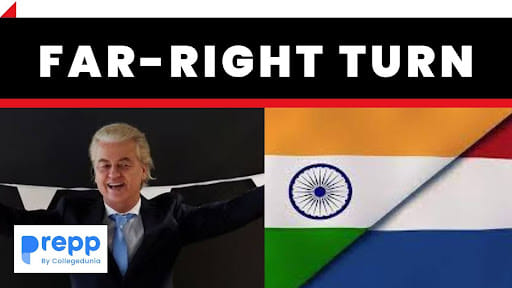
What are the Election Results and its Impact?
- Geert Wilders' Party for Freedom (PVV) emerged as the largest party in the lower house with 37 seats out of 150.
- The Labour-Green coalition won 25 seats, and the incumbent People’s Party for Freedom and Democracy (VVD) secured 24 seats.
- Despite not achieving a majority, PVV's performance positions Wilders to initiate coalition talks and potentially become the Prime Minister.
Rise of Far-Right Populism
- Geert Wilders’s Political Stance: Wilders is known for his radical far-right populism. He advocates for "de-Islamising" the Netherlands, including proposals to shut down mosques, ban the Koran, and close borders to migrants from Muslim-majority countries. He has successfully made migration a significant political issue.
- PVV’s Political Journey: Wilders has been a member of the House of Representatives since 1998. He split from the conservative VVD in 2004 to form the PVV, pushing his brand of populism in Dutch politics since then.
- Broader European Context: The rise of the PVV aligns with a wider trend across Europe, where far-right parties and populists are gaining ground.
- Examples include Marine Le Pen in France, a party with neo-fascist origins in Italy, and the AfD in Germany, which has neo-Nazi roots.
Impact on Dutch Politics
- Challenge to Traditional Parties: The rise of the PVV under Wilders challenges the established political parties in the Netherlands.
- These parties may need to reassess their strategies and policies, particularly regarding immigration and integration, to address the concerns that have contributed to the PVV's rise.
- Call to Action for Establishment Parties: The establishment parties need to develop clear economic agendas and political visions to counter the rise of far-right politics.
- The success of parties like the PVV could be a wake-up call, indicating the need for more effective responses to issues like immigration and the cost of living crisis.
India-Netherlands Relations
- Historical Ties: The relationship between India and the Netherlands dates back several centuries, with the Dutch East India Company establishing trading posts in India in the 17th century. These historical ties have laid a foundation for modern bilateral relations.
- Diplomatic Relations: India and the Netherlands established diplomatic relations soon after India's independence in 1947.
- Trade and Economic Relations: The Netherlands is one of India's leading trading partners in the European Union. The trade relationship encompasses a wide range of goods including machinery, electronic equipment, chemicals, textiles, and agricultural products.
- Investments: The Netherlands is a significant source of foreign direct investment (FDI) for India. Dutch companies have a substantial presence in various sectors in India, including banking, energy, logistics, and technology. Similarly, Indian companies are also increasingly investing in the Netherlands, using it as a gateway to Europe.
- Science and Technology Cooperation: India and the Netherlands have a strong partnership in science and technology, with collaborative research programs and exchanges. Areas of cooperation include water management, sustainable agriculture, healthcare, and renewable energy.
- Cultural and Educational Exchange: The two countries have vibrant cultural exchange programs. These include academic exchanges, scholarships, and collaborative projects between universities and cultural institutions.
- Environmental and Water Management: The Netherlands, known for its expertise in water management and environmental technology, has been a key partner for India in these areas. The countries have collaborated on various projects related to river cleaning, water conservation, and urban planning.
- Global and Regional Issues: India and the Netherlands often collaborate on global and regional issues such as climate change, counter-terrorism, and peacekeeping.
- People-to-People Ties: There is a strong people-to-people connection, with a sizeable Indian diaspora living in the Netherlands. This community plays a significant role in fostering deeper mutual understanding and cultural exchange.
Way Forward
- Addressing Underlying Concerns: Establishment parties should focus on understanding and addressing the underlying concerns that are driving voters towards far-right parties. This includes issues related to immigration, economic instability, and the cost of living crises.
- Clear Economic and Political Agenda: Establishment parties need to formulate and communicate a clear economic and political vision that resonates with the public, especially addressing the issues exploited by far-right parties, like job security, affordable living, and social welfare.
- Inclusive Policies: Developing and promoting policies that are inclusive and cater to the diverse needs of the population, while countering the exclusive, ethno-nationalist rhetoric of far-right parties.
- Promoting Social Cohesion: Work towards promoting social cohesion and understanding among different communities, emphasizing the values of diversity and tolerance.
- Strengthening Democratic Institutions: Ensuring that democratic institutions remain strong and capable of withstanding the challenges posed by extremist ideologies.
- International Collaboration: Countries experiencing similar political shifts should collaborate and share strategies to effectively address the rise of far-right politics.
- Engagement and Dialogue: Engaging in open dialogue with different segments of society, including those who feel alienated or unheard, to better understand their perspectives and grievances.
Conclusion
The article highlights the significant and growing influence of far-right politics in Europe. Establishment parties need to develop clear economic and political strategies to counter this rise, mindful of Europe's troubled past with similar ideologies. The situation serves as a wake-up call regarding the shifting political landscape and the appeal of ethno-nationalist politics amid immigration and economic crises.
(*Click this link to read prelims specific weekly current affairs articles)
FAQs
Question: What is Ethno-nationalist politics?
Answer:
Ethno-nationalist politics refers to a political ideology or movement that emphasizes the interests, culture, and identity of a specific ethnic group, often to the exclusion or detriment of other ethnic groups.
Question: What is Far-Right Populism?
Answer:
Far-right populism is a political ideology that combines elements of far-right politics with a populist approach. A central theme in far-right populism is a strong focus on national identity and sovereignty. This often takes the form of nativism, where the rights and interests of the native-born or dominant ethnic group are prioritized over those of immigrants and minority groups.
Download the PREPP App and attempt FREE IAS Exam Mock Tests and get complete study material!

Full Test - 04: UPSC CSE Prelims CSAT (Paper-II)
Full Test - 03: UPSC CSE Prelims CSAT (Paper-II)
UPSC CSE Prelims 2026 GS Paper 1 Question Paper (24-May-2026)
UPSC CSE Prelims 2026 CSAT Paper 2 Question Paper (24-May-2026)

17 February 2025 | The Hindu Must Read Articles | Current Affairs

16 February 2026 | The Hindu Must Read Articles | Current Affairs

13 February 2026 | The Hindu Must Read Articles | Current Affairs









Comments