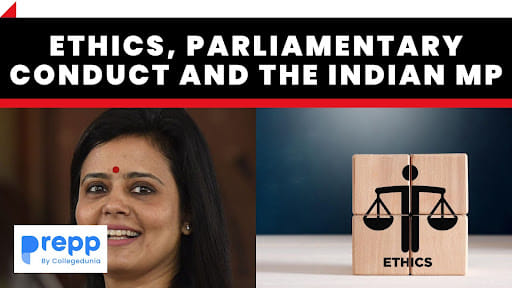
Ethics, Parliamentary Conduct and the Indian MP
Primary Source: The Hindu
Click here for Daily Current Affairs
Prepp Prelims Booster: Ethics Committee, Committee of Privileges, Parliamentary procedures
Prepp Mains Booster: Parliament & State Legislatures – Structure, Functioning, Conduct of Business, Powers & Privileges and Issues Arising out of these
Why in the news?
- The article discusses the ethical conduct of Indian Members of Parliament (MPs), specifically focusing on the recent proceedings by the Lok Sabha Ethics Committee against an MP from West Bengal.
- The said MP is alleged to have received money from a businessman for asking questions in Parliament, which is considered a breach of privilege and contempt of the House.
Table of Contents
Background of the Case
- Allegations have been made against a Member of Parliament (MP) regarding unethical conduct.
- The allegation involves receiving money from a businessman.
- In exchange for the money, the MP is accused of raising questions in Parliament to benefit the businessman’s interests.
- A senior Member of Parliament has initiated the complaint.
- Following this allegation, the Speaker of the Lok Sabha referred the matter to the Lok Sabha Ethics Committee for further investigation and to produce a report on the matter.
The Dilemma of Online Question Submission
- Members of Parliament are often too busy to personally write out questions for submission, leading to a practical need for assistance.
- MPs commonly delegate the task of writing and submitting questions to their personal assistants, which involves sharing passwords and login details.
- There are currently no established Lok Sabha rules regulating the online submission process of questions by MPs.
- MPs have the liberty to hire any individual to assist with their parliamentary duties without the requirement to disclose their information sources.
- Under Article 105 of the Indian Constitution, MPs have the right to express themselves freely in the House, which by extension, includes freedom in their methods of gathering information for parliamentary duties.
- Investigating the sources of an MP’s information might lack legal backing, given the protections afforded by the Constitution.
- Despite these freedoms, Parliament retains the authority to discipline its members as it sees fit.
Past Instances of Ethical Breaches and Parliamentary MisconductH.G. Mudgal Case (1951)
Sting Operation (2005)
Misrepresentation on Official Tour
Passports Act Violation
|
What is the Ethics Committee?
- The Ethics Committee of the Lok Sabha is a key body within the Indian parliamentary system responsible for maintaining and overseeing the ethical conduct of Members of Parliament (MPs).
- The Lok Sabha Ethics Committee was established in 2000, underscoring the parliamentary commitment to upholding the highest standards of ethical conduct within its ranks.
- Its primary mandate is to examine complaints related to the unethical behavior of MPs and to recommend suitable actions. Additionally, the committee is charged with formulating a code of conduct for the members.
- The committee operates on complaints referred to it concerning the behavior of MPs that could be considered unethical. However, the term "unethical conduct" has not been strictly defined, giving the committee a broad scope to interpret actions on a case-by-case basis.
- While the Ethics Committee does not handle criminal investigations—such activities are within the purview of law enforcement agencies—it does have the authority to scrutinize the actions of MPs and recommend actions that the House might take to preserve its integrity and discipline members.
- The Ethics Committee has considerable discretion in deciding what is considered unethical conduct and the appropriate actions to be taken.
- Their decisions are based on examinations of evidence and do not follow the formal rules of evidence as in a judicial court.
- The Ethics Committee plays a crucial role in preserving the sanctity of parliamentary proceedings by ensuring that members adhere to expected ethical standards and by acting as a deterrent to misconduct.
Ethics Committee vs. Privileges Committee
| Aspect | Ethics Committee | Privileges Committee |
|---|---|---|
| Establishment | Established in 2000. | An older committee, integral to the parliamentary system from early on. |
| Purpose | To examine complaints of unethical behavior and formulate a code of conduct. | To investigate complaints of breach of parliamentary privilege and contempt. |
| Scope of Issues | Broadly covers unethical conduct, not strictly defined. | Specifically deals with breaches of parliamentary privileges and contempt. |
| Definition of Mandate | "Unethical conduct" is not explicitly defined; left to committee discretion. | Focuses on specific breaches of privilege and instances of contempt. |
| Types of Investigations | Examines a wide range of ethical issues and personal conduct. | Investigates specific allegations of privilege breaches and contempt of the House. |
| Authority | Can recommend actions to maintain ethical standards among MPs. | Has the power to recommend punitive measures for breaches of privilege. |
| Legal Involvement | Does not involve legal/criminal investigations. | Can lead to legal consequences, especially in cases of criminal acts. |
| Outcome of Processes | Recommendations can lead to censure or suspension from House sittings. | Can lead to serious repercussions, including expulsion from the House. |
| Precedents | Relatively newer, with fewer past precedents. | Has a long history of addressing various issues, with many precedents. |
What are Parliamentary Committees?
|
Nature of Investigation and Probe
- The investigation into the MP's conduct is a parliamentary probe, not a judicial one.
- The probe is carried out by a parliamentary committee, in this case, the Lok Sabha Ethics Committee, which is different from a court of law.
- The committee's members are fellow MPs, not legally trained judges or lawyers.
- The Ethics Committee is tasked with investigating allegations of unethical conduct.
- However, if the allegations against the MP involve illegal gratification for parliamentary work, then it becomes a matter of breach of privilege, which is typically handled by the Committee of Privileges.
- The committee investigates by examining written documents, taking oral evidence from witnesses, and possibly hearing from experts.
- MPs under investigation have certain rights, such as appearing before the committee, potentially through an advocate, and cross-examining witnesses with permission.
- The findings of the committee are based on a preponderance of probabilities rather than the strict legal standards of evidence required in a court of law.
- They apply common sense and the principles of natural justice to arrive at their conclusions.
- The committee can recommend actions to the House based on its findings. While the committee does not impose legal penalties, its recommendations can lead to disciplinary measures such as suspension from the House or expulsion in severe cases.
- If the allegations also involve criminal activity, such as accepting a bribe, those aspects are investigated by law enforcement and the MP could face criminal charges separately from any parliamentary discipline.
Parliamentary Probe vs. Judicial Probe
| Feature | Parliamentary Probe | Judicial Probe |
|---|---|---|
| Authority | Conducted by parliamentary committees made up of MPs. | Conducted by the judiciary, with legally trained judges and magistrates. |
| Purpose | To ensure adherence to parliamentary ethics and privileges. | To adjudicate legal rights and responsibilities, determine guilt, and impose legal sanctions. |
| Procedures | Follows parliamentary rules and procedures. | Governed by laws, legal procedures, and rules of evidence. |
| Legal Binding | Recommendations are not legally binding but can lead to parliamentary action. | Decisions are legally binding and enforceable by law. |
| Representation | MPs can represent themselves or be represented by an advocate with permission. | Parties are usually represented by lawyers. |
| Scope of Investigation | Limited to matters of parliamentary ethics and privilege. | Can cover any matter within the scope of law. |
| Standards of Proof | Based on preponderance of probabilities and parliamentary norms. | Based on legal standards such as "beyond a reasonable doubt" or "preponderance of evidence". |
| Outcomes | Recommendations to the House, such as reprimands, suspensions, or expulsions. | Legal judgments, including fines, injunctions, or imprisonment. |
| Public Access | Generally conducted in private. | Generally conducted in public, except for some sensitive cases. |
| Evidence | Parliamentary rules determine the relevance of evidence. | Bound by the Rules of Evidence as per the law. |
| Appeal Process | Typically, there is no formal appeal process within the parliamentary system. | Allows for appeals to higher courts. |
| Investigative Focus | Focus on maintaining the integrity and functioning of the parliamentary institution. | Focus on determining legal liability and justice. |
Conclusion
The integrity of the parliamentary system depends on its members' conduct. Allegations against MPs raise questions about the efficacy and clarity of current guidelines and committees. While MPs have some privileges, there is also a need to ensure transparency, ethical conduct, and adherence to the rules, making it essential for Parliament to continue to evolve and improve its systems for checks and balances.
(*Click this link to read prelims specific weekly current affairs articles)
FAQs
Question: What is the role of the Ethics Committee in the Lok Sabha?
Answer:
The Ethics Committee of the Lok Sabha is tasked with examining complaints related to the unethical conduct of MPs. Formed in 2000, it has the mandate to oversee the ethical norms of Members of Parliament and recommend actions. It also has the responsibility to formulate a code of conduct for MPs. The committee evaluates the actions of MPs and decides on the appropriateness of their conduct.
Question: Has the term 'unethical conduct' been defined by the Lok Sabha Ethics Committee?
Answer:
No, the term 'unethical conduct' has not been explicitly defined by the Lok Sabha Ethics Committee. It is up to the discretion of the committee to assess each case on its merits and determine whether an MP's conduct falls under unethical practices based on precedent and the standards expected by the Parliament.
Question: How does the process of a parliamentary probe differ from a judicial probe?
Answer:
A parliamentary probe is conducted by Parliamentary committees consisting of MPs who may not be legally trained, while a judicial probe is carried out by judicially trained professionals as per the statutes and Rules. Parliamentary committees investigate by examining documents, witnessing oral examinations, and analyzing evidence based on the Rules of the House and common sense. In contrast, judicial probes follow the rules of evidence under the Evidence Act.
UPSC Mains Practice Question:
|
MCQs
Question: With reference to the Parliament of India, which of the following Parliamentary Committees scrutinizes and reports to the House whether the powers to make regulations, rules, sub-rules, by-laws, etc. conferred by the Constitution or delegated by the Parliament are being properly exercised by the Executive within the scope of such delegation? (UPSC 2018)
(a) Committee on Government Assurances
(b) Committee on Subordinate Legislation
(c) Rules Committee
(d) Business Advisory Committee
Answer: (b) See the Explanation
The Committee on Subordinate Legislation, established in 1953, investigates and reports to the House on whether the powers bestowed by the Constitution or delegated by Parliament to make rules, regulations, bye-laws, schemes, or other statutory instruments are being properly exercised.
The committee has 15 members from both Houses. The Chairman of the Committee shall be chosen by the Chairman from among the Committee's members.
The Deputy Chairman shall be named Chairman of the Committee if he is a member of the Committee. A quorum of five is required to hold a meeting of the Committee.
Therefore, option (b) is the correct answer.
Question: Which one of the following is the largest Committee of the Parliament? (UPSC 2014)
(a) The Committee on Public Accounts
(b) The Committee on Estimates
(c) The Committee on Public Undertakings
(d) The Committee on Petitions
Answer: (b) See the Explanation
The Estimates committee has 30 members, all of whom are Lok Sabha members. This committee strives to report on expenditure economy and efficiency.
Every year, Lok Sabha members are elected from among themselves using proportional representation principles and a single transferable vote, ensuring that all parties have a fair representation.
A minister cannot be elected to the Estimates Committee as a member or Chairman.
Therefore, option (b) is the correct answer.
Question: Which committee is typically responsible for investigating MPs accused of taking money for parliamentary work?
(a) The Ethics Committee
(b) The Committee of Privileges
(c) The Finance Committee
(d) The Public Accounts Committee
Answer: (b) See the Explanation
The Committee of Privileges is the body generally tasked with investigating complaints against MPs who are accused of taking illegal gratification for parliamentary work. This committee examines cases of breach of privilege and contempt of the House and recommends suitable action.
Therefore, option (b) is the correct answer.
Question: What power does Article 105 of the Constitution grant to Members of Parliament?
(a) The power to regulate the online submission of questions.
(b) The power to exercise freedom of speech in the House.
(c) The power to receive foreign grants for constituency development.
(d) The power to appoint judges to the Supreme Court.
Answer: (b) See the Explanation
Article 105 of the Constitution of India grants Members of Parliament the freedom to say "anything" in the House, which underlines their right to speech and expression within the legislative framework. This right is crucial for MPs to conduct their parliamentary duties, including posing questions and framing bills or resolutions without fear of legal repercussions.
Therefore, option (b) is the correct answer.
Download the PREPP App and attempt FREE IAS Exam Mock Tests and get complete study material!

Full Test - 04: UPSC CSE Prelims CSAT (Paper-II)
Full Test - 03: UPSC CSE Prelims CSAT (Paper-II)
UPSC CSE Prelims 2026 GS Paper 1 Question Paper (24-May-2026)
UPSC CSE Prelims 2026 CSAT Paper 2 Question Paper (24-May-2026)

17 February 2025 | The Hindu Must Read Articles | Current Affairs

16 February 2026 | The Hindu Must Read Articles | Current Affairs

13 February 2026 | The Hindu Must Read Articles | Current Affairs









Comments