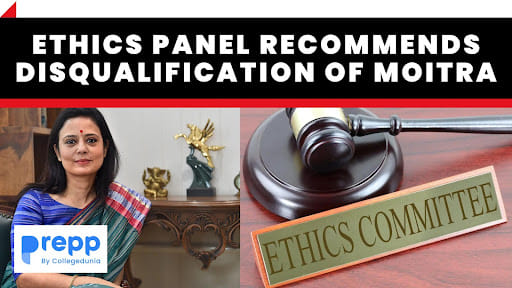
Ethics Panel Recommends Disqualification of Moitra
Primary Source: The Hindu
Click here for Daily Current Affairs
Why in the news?
- Lok Sabha Ethics Committee has recommended the expulsion of Trinamool Congress MP Mahua Moitra from the Lower House based on allegations of a "cash for query" scandal.
- The committee's report, which will be tabled in the Lok Sabha during the Winter Session starting December 4, suggests that Moitra's expulsion is contingent on a House vote.
Table of Contents
What were the Allegations against MP Mahua Moitra?
- Cash for Query Allegation: Moitra was accused of being involved in a "cash for query" scandal, which implies exchanging money for raising certain questions in the Parliament.
- Alleged Quid Pro Quo: The Ethics Committee report highlighted a supposed exchange of cash transactions between Mahua Moitra and Darshan Hiranandani, suggesting a quid pro quo arrangement.
- Unauthorized Access and National Security Concerns: The Ministry of Home Affairs (MHA) submitted a note indicating concerns about the leakage of sensitive material that could jeopardize national security.
- Repeated Login Access from Dubai: The Ministry of Electronics and Information Technology (MeitY) reported that Moitra's Lok Sabha login was accessed from Dubai 47 times, which was considered unauthorized access and raised potential cybersecurity threats.
What is the Ethics Committee's Decision?
- Expulsion Recommendation: The Lok Sabha Ethics Committee adopted a report and recommended the expulsion of Mahua Moitra from the Lower House over a “cash for query” allegation.
- Voting Outcome: Six members of the committee voted in favor of the report, while four opposition MPs opposed it. The opposing members filed dissent notes, criticizing the complaint for lacking evidence.
- Next Steps: The report will be tabled before the Lok Sabha on the first day of the Winter Session of Parliament. For the expulsion to occur, the House must vote in favor of the panel’s recommendation.
- Historical Context: This is the first instance since the Ethics Committee's establishment in 2000 that it has recommended the expulsion of a Parliamentarian.
- Further Investigations Recommended: The panel suggested an “intense, legal, institutional inquiry by the Government of India (GOI)” to investigate the alleged money trail involving Mahua Moitra and Darshan Hiranandani.
What is the Ethics Committee?
- The Ethics Committee of the Lok Sabha is a key body within the Indian parliamentary system responsible for maintaining and overseeing the ethical conduct of Members of Parliament (MPs).
- The Lok Sabha Ethics Committee was established in 2000, underscoring the parliamentary commitment to upholding the highest standards of ethical conduct within its ranks.
- Its primary mandate is to examine complaints related to the unethical behavior of MPs and to recommend suitable actions. Additionally, the committee is charged with formulating a code of conduct for the members.
- The committee operates on complaints referred to it concerning the behavior of MPs that could be considered unethical. However, the term "unethical conduct" has not been strictly defined, giving the committee a broad scope to interpret actions on a case-by-case basis.
- While the Ethics Committee does not handle criminal investigations—such activities are within the purview of law enforcement agencies—it does have the authority to scrutinize the actions of MPs and recommend actions that the House might take to preserve its integrity and discipline members.
- The Ethics Committee has considerable discretion in deciding what is considered unethical conduct and the appropriate actions to be taken.
- Their decisions are based on examinations of evidence and do not follow the formal rules of evidence as in a judicial court.
- The Ethics Committee plays a crucial role in preserving the sanctity of parliamentary proceedings by ensuring that members adhere to expected ethical standards and by acting as a deterrent to misconduct.
What are Parliamentary Committees?
|
What are the National Security Concerns in the Matter?
- Leakage of Sensitive Material: The Ministry of Home Affairs (MHA) pointed out that several documents posted on the Lok Sabha website, which are not available to the public, could be leaked.
- This leakage of sensitive material poses a risk as it could be exploited by hostile elements, detrimental to national security.
- Risk of Foreign Agencies Accessing Sensitive Material: The MHA expressed concern about foreign agencies potentially accessing sensitive information.
- This concern is heightened by the fact that Mr. Hiranandani, allegedly involved with Ms. Moitra, has many foreign relatives, increasing the risk of sensitive information reaching foreign entities.
- Potential for Serious Cyber Attacks: Unauthorized access to sensitive information could lead to serious cyber threats. These could include disabling the Parliament's system entirely, crippling its functioning, which represents a significant threat to national security.
- Login Access from Foreign Location: The Ministry of Electronics and Information Technology (MeitY) reported that Ms. Moitra's Lok Sabha login was accessed from Dubai 47 times, indicating unauthorized access from a foreign location, which is a significant security concern.
Conclusion
The situation is significant due to its unprecedented nature and the potential implications for parliamentary conduct and national security. The Lok Sabha's decision on the expulsion and further governmental investigation will be crucial in determining the outcome of these allegations.
(*Click this link to read prelims specific weekly current affairs articles)
FAQs
Question: What is the role of the Lok Sabha Ethics Committee?
Answer:
The Lok Sabha Ethics Committee is responsible for overseeing the moral and ethical conduct of Members of Parliament (MPs). It investigates allegations of misconduct, unethical behavior, or any violation of the code of ethics and can recommend actions, including suspension or expulsion, based on its findings.
Question: What is the meaning of the term 'unethical conduct' as per the Lok Sabha Ethics Committee?
Answer:
The term 'unethical conduct' has not been explicitly defined by the Lok Sabha Ethics Committee. It is up to the discretion of the committee to assess each case on its merits and determine whether an MP's conduct falls under unethical practices based on precedent and the standards expected by the Parliament.
UPSC Mains Practice Question:
|
MCQs
Question: With reference to the Parliament of India, which of the following Parliamentary Committees scrutinizes and reports to the House whether the powers to make regulations, rules, sub-rules, by-laws, etc. conferred by the Constitution or delegated by the Parliament are being properly exercised by the Executive within the scope of such delegation? (UPSC 2018)
(a) Committee on Government Assurances
(b) Committee on Subordinate Legislation
(c) Rules Committee
(d) Business Advisory Committee
Answer: (b) See the Explanation
The Committee on Subordinate Legislation, established in 1953, investigates and reports to the House on whether the powers bestowed by the Constitution or delegated by Parliament to make rules, regulations, bye-laws, schemes, or other statutory instruments are being properly exercised.
The committee has 15 members from both Houses. The Chairman of the Committee shall be chosen by the Chairman from among the Committee's members.
The Deputy Chairman shall be named Chairman of the Committee if he is a member of the Committee. A quorum of five is required to hold a meeting of the Committee.
Therefore, option (b) is the correct answer.
Question: Which one of the following is the largest Committee of the Parliament? (UPSC 2014)
(a) The Committee on Public Accounts
(b) The Committee on Estimates
(c) The Committee on Public Undertakings
(d) The Committee on Petitions
Answer: (b) See the Explanation
The Estimates committee has 30 members, all of whom are Lok Sabha members. This committee strives to report on expenditure economy and efficiency.
Every year, Lok Sabha members are elected from among themselves using proportional representation principles and a single transferable vote, ensuring that all parties have a fair representation.
A minister cannot be elected to the Estimates Committee as a member or Chairman.
Therefore, option (b) is the correct answer.
Question: Which committee is typically responsible for investigating MPs accused of taking money for parliamentary work?
(a) The Ethics Committee
(b) The Committee of Privileges
(c) The Finance Committee
(d) The Public Accounts Committee
Answer: (b) See the Explanation
The Committee of Privileges is the body generally tasked with investigating complaints against MPs who are accused of taking illegal gratification for parliamentary work. This committee examines cases of breach of privilege and contempt of the House and recommends suitable action.
Therefore, option (b) is the correct answer.
Question: What power does Article 105 of the Constitution grant to Members of Parliament?
(a) The power to regulate the online submission of questions.
(b) The power to exercise freedom of speech in the House.
(c) The power to receive foreign grants for constituency development.
(d) The power to appoint judges to the Supreme Court.
Answer: (b) See the Explanation
Article 105 of the Constitution of India grants Members of Parliament the freedom to say "anything" in the House, which underlines their right to speech and expression within the legislative framework. This right is crucial for MPs to conduct their parliamentary duties, including posing questions and framing bills or resolutions without fear of legal repercussions.
Therefore, option (b) is the correct answer.
Download the PREPP App and attempt FREE IAS Exam Mock Tests and get complete study material!

Full Test - 04: UPSC CSE Prelims CSAT (Paper-II)
Full Test - 03: UPSC CSE Prelims CSAT (Paper-II)
UPSC CSE Prelims 2026 GS Paper 1 Question Paper (24-May-2026)
UPSC CSE Prelims 2026 CSAT Paper 2 Question Paper (24-May-2026)

17 February 2025 | The Hindu Must Read Articles | Current Affairs

16 February 2026 | The Hindu Must Read Articles | Current Affairs

13 February 2026 | The Hindu Must Read Articles | Current Affairs









Comments