Encryption – Science & Technology Notes
Encryption is a method of preventing data from being stolen, altered, or compromised. It works by scrambling data into a secret code that can only be unlocked with a unique digital key. Cryptography is the science of encrypting and decrypting information. In this article, we will discuss in detail regarding Encryption which will be helpful for UPSC exam preparation.
Table of Contents
What is Encryption?
- Encryption is the process of protecting information or data by scrambling it using mathematical models so that only those with the key to unscramble it can access it.
- This process can be very simple or very complex, and mathematicians and computer scientists have invented specific types of encryptions that are used to protect information and data that consumers and businesses rely on every day.
- Encrypted data can be protected while it is at rest on computers, in transit between computers, or in processing, regardless of whether the computers are on-premises or remote cloud servers.
- Unencrypted data is referred to as plaintext in computing, while encrypted data is referred to as ciphertext.
- Encryption algorithms, also known as cyphers, are the formulas used to encode and decode messages.
- A cipher's algorithm must include a variable in order to be effective. The variable, known as a key, is what distinguishes the output of a cypher.
| Other Relevant Links | |
|---|---|
| NASA: Asteroid impact and deflection assessment mission | Commercial use of Lithium-Ionbattery technology |
| Hyperspectral imaging satellite | Water propulsion system in CUBESAT |
| Neutrino Observatory | Indian Space Vision-2025 |
| Major Policy Initiatives National Optical Fibre network | Spectrum Management |
| Cyber Law | Internet, Types of Network and e- Governance |
| Spectrum Policy in India | Mobile Spectrum |
| Cloud Computing | Big Data |
| Biometrics | Virtual Reality |
How Encryption Works
- Encryption works by converting "plaintext" into "ciphertext," typically using cryptographic mathematical models known as algorithms.
- To decode the data back to plaintext, a decryption key, a string of numbers or a password generated by an algorithm, is required.
- Secure encryption methods use so many cryptographic keys that an unauthorised person cannot guess which one is correct, nor can a computer easily calculate the correct string of characters by trying every possible combination (a brute force attack).
- A cryptographic key is a string of characters that is used within an encryption algorithm to make data appear random. It locks (encrypts) data in the same way that a physical key does, so that only someone with the correct key can unlock (decrypt) it.
- The "Caesar cypher," named after Roman emperor Julius Caesar because he used it in his private correspondence, is an early example of a simple encryption.
- The method is a substitution cypher in which one letter is replaced by another letter a predetermined number of positions down the alphabet.
- The recipient would need to know the key to the cypher, such as shifting down the alphabet four places and over to the left (a "left shift four"), to decrypt the coded text. As a result, every "E" becomes a "Y" and so on.
- Modern cryptography is far more sophisticated, employing strings of hundreds (or even thousands) of computer-generated characters as decryption keys in some cases.
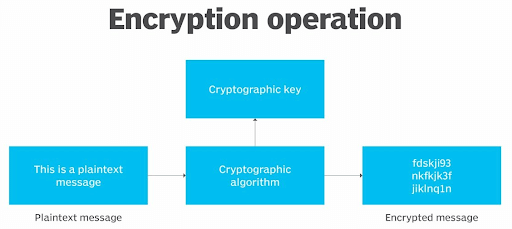
Working of Encryption
What is a brute-force attack?
|
How encryption keeps internet browsing secure?
- Encryption is essential for many technologies, but it is especially critical for keeping HTTP requests and responses secure.
- HTTPS (Hypertext Transfer Protocol Secure) is the protocol responsible for this.
- A website served over HTTPS rather than HTTP has a URL that begins with https:// rather than http://, which is usually represented by a secured lock in the address bar.
- HTTPS employs the Transport Layer Security (TLS) encryption protocol. Previously, the standard encryption protocol was Secure Sockets Layer (SSL), but TLS has replaced SSL.
- A TLS certificate will be installed on the origin server of a website that uses HTTPS.
Types of Encryptions
Symmetric Encryption
- The same key is used for encryption and decryption in symmetric encryption, also known as a shared key or private key algorithm.
- Symmetric key cyphers are less expensive to produce and require less computing power to encrypt and decrypt, resulting in less delay in decoding the data.
- The disadvantage is that if an unauthorised person obtains the key, they will be able to decrypt any messages or data exchanged between the parties.
- As a result, the transfer of the shared key must be encrypted with a different cryptographic key, resulting in a dependency cycle.
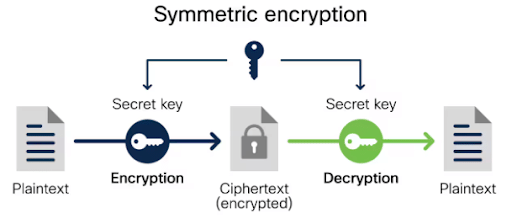
Asymmetric Encryption
- Asymmetric encryption, also known as public-key cryptography, encrypts and decrypts data using two distinct keys.
- One is a public key that all parties use for encryption. Anyone with the public key can then send an encrypted message, but only those with the private key can decrypt it.
- Asymmetric encryption is more expensive to produce and requires more computing power to decrypt because the public encryption key is often large, ranging from 1,024 to 2,048 bits.
- As a result, asymmetric encryption is frequently unsuitable for large data packets.
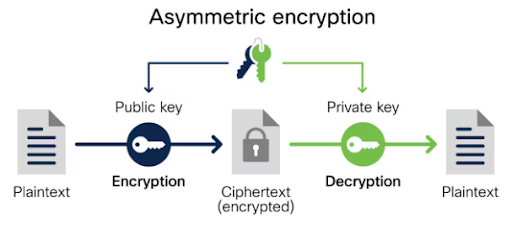
Asymmetric Encryption
What is End-to-End Encryption (E2EE)?
|
Significance of Data Encryption
- Encryption is used to secure devices like smartphones and personal computers, to protect financial transactions like making a bank deposit and purchasing an item from an online retailer, and to ensure the privacy of messages like email and texts.
- If you've ever noticed that the address of a website begins with "https://" It means that the website uses transport encryption (the "s" stands for "secure").
- Encryption is used in virtual private networks (VPNs) to keep data coming and going from a device private from prying eyes.
- Data encryption is critical because it protects people's privacy while also protecting data from attackers and other cybersecurity threats.
- From a regulatory standpoint, encryption is frequently required for organisations such as healthcare, education, finance and banking, and retail.
- Encryption serves four critical functions:
- Confidentiality: keeping the data's contents hidden.
- Integrity: confirms the message or data's origin.
- Authentication: ensures that the message or data has not been altered since it was sent.
- Nonrepudiation: prevents the originator of the data or message from denying it.
Advantages of Data Encryption
Encryption aids in the preservation of data integrity
- Hackers can alter data to commit fraud in addition to stealing it.
- While skilled hackers can alter encrypted data, recipients will be able to detect the corruption, allowing for a quick response.
Encryption assists organisations in adhering to regulations
- Many industries, such as financial services and healthcare providers, have stringent regulations governing how consumer data is used and stored.
- Encryption assists organisations in meeting these standards and maintaining compliance.
Encryption safeguards data across devices
- Most of us use multiple devices in our daily lives, and transferring data from one device to another can be dangerous.
- Encryption technology aids in the protection of data across devices, including during transfer.
- Additional security measures, such as advanced authentication, aid in deterring unauthorised access.
Encryption is beneficial when transferring data to the cloud
- As more users and organisations store their data in the cloud, cloud security becomes increasingly important.
- Encrypted storage aids in the preservation of data privacy. Users must ensure that data is encrypted in transit, in use, and at rest in storage.
Encryption aids in the security of offices
- Many organisations, especially post-pandemic, have remote offices. This can pose cybersecurity risks because data is being accessed from multiple locations; encryption protects against data theft or accidental loss.
Intellectual property is safeguarded by data encryption
- To prevent reverse engineering and unauthorised use or reproduction of copyrighted material, digital rights management systems encrypt data at rest — in this case, intellectual property such as songs or software.
Disadvantages of Data Encryption
Ransomware
- While encryption is typically used to protect data, malicious actors may use it to hold data hostage.
- If an organization's data is breached and accessed, the actors can encrypt it and hold it hostage until the organisation pays to have it released.
Key Management
- Encryption is significantly less effective when the cryptographic keys used to encrypt and decrypt data are not secure. Malicious actors frequently target an organization's encryption keys in their attacks.
- In addition to malicious actors, losing encryption keys (for example, during a natural disaster that compromises servers) can prevent organisations from accessing critical data.
- This is why organisations frequently use a secure key management system to manage and secure their keys.
Quantum Computing
- Modern encryption techniques face an existential threat from quantum computing. When it is complete, quantum computing will be capable of processing massive amounts of data in a fraction of the time that traditional computers do.
- As a result, quantum computing has the potential to decrypt current encryption.
- All organisations will have to adapt encryption techniques in the future by using quantum encryption techniques.
- Currently, quantum computing is limited and not yet capable of breaking modern encryption standards.
Encryption in India
- There is no specific encryption law in India. Nonetheless, a number of industry rules, such as those governing the banking, finance, and telecommunications industries, include minimum encryption standards that must be used in order to protect transactions.
- According to the licencing agreement between the ISP and the DoT, users are not permitted to use encryption standards larger than 40 bits using symmetric key algorithms or similar methods without prior clearance and deposition of decryption keys.
- There are a number of additional rules and recommendations for specific sectors that use a higher encryption level than 40 bits.
- Information Technology (Intermediary Guidelines and Digital Media Ethics Code) Rules 2021:
- It supersedes the previous Information Technology (Intermediary Guidelines) Rules 2011.
- The new set of rules has the potential to affect the end-to-end encryption techniques used by social messaging apps such as WhatsApp, Telegram, Signal, and others.
- The Information Technology Actof 2000: It governs electronic and wireless communication but contains no substantive provision or policy on encryption.
Conclusion
In a digital world, encryption is critical for keeping private information, messages, and financial transactions private and secure. It safeguards the privacy of digital data stored on computer systems or transmitted via the internet.
| Other Relevant Links | |
|---|---|
| Science & Technology Policy in India | Scientific Policy Resolution 1958 |
| Science & Technology Policy of 1983 | Science & Technology Policy of 2003 |
| Science, Technology and Innovation Policy 2013 | New Initiatives Aligned with the National Agenda |
| India and World collaboration in science projects | Technology Vision Document 2035 |
FAQs
Question: What is encryption?
Answer: Encryption is the process of converting data into a code to prevent unauthorized access, ensuring data security during transmission or storage.
Question: What is the purpose of encryption in communication?
Answer: Encryption ensures the privacy and security of sensitive information by making it unreadable to unauthorized users during communication.
Question: What are the main types of encryption?
Answer: The two main types of encryption are symmetric encryption (where the same key is used for encryption and decryption) and asymmetric encryption (which uses a public and a private key).
Question: How does encryption help in protecting data in the digital world?
Answer: Encryption helps protect data from unauthorized access, ensuring that sensitive information such as passwords, bank details, and personal messages remain secure.
Question: Why is encryption important for online banking?
Answer: Encryption is crucial for online banking as it secures financial transactions by encoding sensitive data, such as account numbers and passwords, making it unreadable to cybercriminals.
MCQs
1. What is the primary function of encryption in data security?
A) To make data accessible to everyone
B) To convert data into an unreadable format to ensure privacy
C) To increase data transmission speed
D) To decrease data storage requirements
Answer: (B) See the Explanation
Explanation: The primary function of encryption is to convert data into a code that makes it unreadable to unauthorized individuals, ensuring data privacy and security.
2. What is the main difference between symmetric and asymmetric encryption?
A) Symmetric encryption uses a single key for both encryption and decryption, while asymmetric encryption uses two keys
B) Symmetric encryption is slower than asymmetric encryption
C) Asymmetric encryption is only used in online banking
D) Symmetric encryption is used for more complex data sets
Answer: (A) See the Explanation
Explanation: Symmetric encryption uses the same key for both encryption and decryption, while asymmetric encryption uses a pair of keys: a public key for encryption and a private key for decryption.
3. Which of the following is a key benefit of encryption in communication?
A) Improved speed of data transmission
B) Enhanced data security during transmission
C) Lower cost of communication
D) Increased data storage capacity
Answer: (B) See the Explanation
Explanation: Encryption enhances the security of data during transmission, preventing unauthorized access and ensuring the confidentiality of sensitive information.
4. What is the role of a public key in asymmetric encryption?
A) It is used to encrypt data and can be freely shared
B) It is used to decrypt data and is kept secret
C) It is used to generate the encryption key
D) It is not used in asymmetric encryption
Answer: (A) See the Explanation
Explanation: In asymmetric encryption, the public key is used to encrypt data and can be shared openly, while the private key is used for decryption and is kept secret.
5. Which of the following is a real-world application of encryption?
A) Storing documents in the cloud
B) Sending emails with encrypted attachments
C) Streaming videos online
D) Conducting video calls without encryption
Answer: (B) See the Explanation
Explanation: Encryption is commonly used to secure email communications, especially when transmitting sensitive attachments, ensuring that only the intended recipient can access the information.
GS Mains Questions and Model Answers
Q1: Explain the role of encryption in safeguarding digital information and its importance in maintaining privacy and security in the digital world.
Answer: Encryption plays a pivotal role in protecting digital information from unauthorized access by converting it into an unreadable format that can only be decrypted with the correct key. It ensures privacy and security, particularly in online communications, transactions, and data storage. In an increasingly digital world, where cybercrimes and data breaches are common, encryption becomes essential in safeguarding sensitive data such as personal information, financial records, and intellectual property. It is vital for maintaining user trust in online platforms and preventing identity theft, fraud, and unauthorized access to private data.
Q2: What are the challenges and limitations of implementing encryption on a global scale?
Answer: While encryption provides significant security, its global implementation faces several challenges. One major issue is the balance between privacy and law enforcement access. Governments and law enforcement agencies may request access to encrypted data for investigative purposes, raising concerns about individual privacy rights. Another challenge is the computational resources required to implement strong encryption algorithms, which can slow down systems and increase costs for businesses. Additionally, there is a need for global cooperation and standardized encryption protocols, as differing regulations across countries can hinder the implementation of uniform security measures. Overcoming these challenges is critical for ensuring both privacy and security in a digital world.
Q3: How can advancements in encryption technology impact cybersecurity and global digital trade?
Answer: Advancements in encryption technology can significantly enhance cybersecurity by providing stronger protection against hacking, data breaches, and cyberattacks. Innovations such as quantum encryption, which leverages quantum mechanics, promise to offer virtually unbreakable encryption, making digital transactions and communications more secure. Strong encryption also builds trust in online platforms, which is essential for the growth of global digital trade. It ensures that sensitive data such as financial transactions, intellectual property, and personal information remain secure, fostering confidence in the global digital economy and encouraging businesses and consumers to engage in cross-border transactions.
Previous Year Questions on Encryption
1. UPSC CSE Mains 2020 (GS Paper 3):
Question: "What is encryption, and how does it contribute to the security of data in the digital age?"
Answer: Encryption is the process of converting readable data into an unreadable format using an algorithm, which ensures that only authorized parties can access it using a decryption key. It plays a vital role in securing data transmitted over the internet, preventing unauthorized access to sensitive information such as passwords, financial data, and personal communications. Encryption ensures privacy, protects data integrity, and builds trust in digital platforms, making it essential for secure communication in the digital age.
2. UPSC CSE Mains 2021 (GS Paper 2):
Question: "Discuss the implications of encryption on privacy, data protection, and national security."
Answer: Encryption ensures the protection of privacy by safeguarding personal and sensitive information from unauthorized access. It strengthens data protection by securing online transactions and communications, reducing the risk of cyberattacks. However, the widespread use of encryption raises concerns about national security, as law enforcement agencies may encounter difficulties accessing encrypted data during investigations. Balancing privacy rights with the need for security is a challenge for policymakers, who must consider the impact of encryption on both individual freedoms and national security.
Download the PREPP App and attempt FREE IAS Exam Mock Tests and get complete study material!

Full Test - 04: UPSC CSE Prelims CSAT (Paper-II)
Full Test - 03: UPSC CSE Prelims CSAT (Paper-II)
UPSC CSE Prelims 2026 GS Paper 1 Question Paper (24-May-2026)
UPSC CSE Prelims 2026 CSAT Paper 2 Question Paper (24-May-2026)

17 February 2025 | The Hindu Must Read Articles | Current Affairs

16 February 2026 | The Hindu Must Read Articles | Current Affairs

13 February 2026 | The Hindu Must Read Articles | Current Affairs









Comments