Emissions Gap Report 2022: Pledges To Cut Greenhouse Gas Emissions Way Off Track(UPSC Current Affairs)
Relevance: GS2 - Important International Institutions; GS3 - Environment & Conservation, Environmental Pollution & Degradation
(Source: Down to Earth, 28th October 2022)
Click here for Daily Current Affairs
Why in the news?
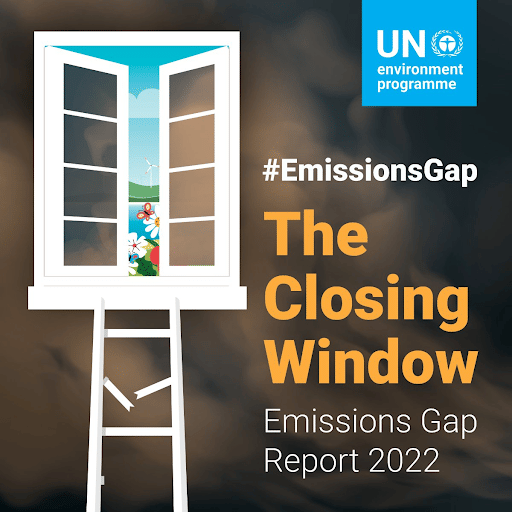
- The Emissions Gap Report 2022 was recently released by the United Nations Environment Programme (UNEP). The UNEP Emissions Gap Report is now in its thirteenth edition.
- The title of the 2022 report is ‘The Closing Window — Climate Crisis Calls For Rapid Transformation of Societies’
- It gives a broad overview of the disparity between where greenhouse gas emissions are expected to be in 2030 and where they ought to be in order to prevent the worst impacts of climate change.
What is Emissions Gap?
- The United Nations Environmental Program (UNEP) report states that the emissions gap is the difference between the expected total global greenhouse gas (GHG) emissions resulting from the full implementation of the nationally determined contributions (NDCs) and the total global GHG emissions from least-cost pathways consistent with the Paris Agreement long-term objective of limiting global average temperature increase to well below 2°C, and pursuing measures to
- Or, to put it another way, it is the difference between promised and actual emission reductions.
Key Findings of the Emissions Gap Report 2022
The findings demonstrate the following:
- The revised national pledges made since COP26 (2021 in Glasgow, UK) hardly alter estimated emissions for 2030.
- The Paris Agreement's target of keeping global warming to well below 2°C, ideally 1.5°C, is far from being met.
- By the end of the century, policies now in place predict a 2.8°C temperature rise.
- By the end of the century, the temperature will only climb by 2.4–2.6°C depending on whether the current pledges are conditional or unconditional.
- The report concludes that the significant reductions required to control greenhouse gas emissions by 2030 can only be achieved by an urgent system-wide transformation.
- Compared to forecasts based on existing policies, there will be a 45 percent increase for 1.5°C and a 30 percent increase for 2°C.
Global Emissions Trend in Emissions Gap Report 2022
- In 2020, the top seven emitters—China, the EU27, India, Indonesia, Brazil, the Russian Federation, and the United States of America—along with international transportation, accounted for 55% of all GHG emissions.
- In these nations, GHG emissions recovered in 2021 and surpassed pre-pandemic 2019 levels.
- G20 members are collectively in charge of 75% of the world's GHG (Greenhouse Gas Emission) emissions.
- In 2020, the average global per-person GHG emissions were 6.3 tonnes of CO2 equivalent (tCO2e).
India’s Status in Emissions Gap Report 2022
- It is good to see that India has maintained its pace in renewables adoption and is making inroads into photovoltaic (PV) technology.
- To reach its ambitions, it will need to increase its reliance on non-fossil energy.
Recommendations in Emissions Gap Report 2022
- The world must reduce greenhouse gas emissions to previously unheard-of levels over the next eight years.
- To stop the rise in the carbon intensity of global steel production, alternative technologies are needed in heavy industry.
- Reform is urgently needed to accomplish the large cuts necessary to minimize GHG emissions by 2030.
- By 2030, it is expected that unconditional and conditional NDCs (Nationally Determined Contributions) will reduce global emissions by 5% and 10%, respectively, in comparison to current policies.
- In order to maintain global warming at 2°C or 1.5°C, these percentages must reach 30% and 45%, respectively.
What is the Paris Agreement?
- The Paris Agreement was adopted by 196 nations on December 12, 2015, during the UNFCCC Conference of the Parties (COP 21) in Paris, and it went into force on November 4, 2016.
- The goal of the agreement is to minimize and mitigate greenhouse gas emissions.
- It took the place of the Kyoto Protocol, an earlier accord to address climate change.
- For the first time, it pulls all nations together in a single cause to undertake ambitious measures to mitigate climate change and adapt to its repercussions.
- The agreement aims to keep global warming far below 2°C, preferably 1.5°C, as compared to pre-industry levels.
- To meet the agreement's aims, member nations must propose their own targets that they feel would result in significant progress toward the Paris temperature goal.
- These aims are first referred to as Intended Nationally Determined Contributions (INDCs).
- When a country ratifies the agreement, they are transformed into NDCs.
(*Click this link to read prelims specific weekly current affairs articles)
FAQs
Question: What is meant by the emissions gap?
Answer:
Emissions Gap evaluates the difference between projected future worldwide greenhouse gas (GHG) emissions if nations carry out their commitments to mitigate climate change and the global emission levels from least-cost routes that are in line with meeting the Paris Agreement's temperature goals.
Question: What is Net-Zero Target?
Answer:
It is known as carbon neutrality, which does not imply that a nation would reduce its emissions to zero. Instead, it refers to a situation when a nation's emissions are balanced by removing and absorbing greenhouse gases from the atmosphere.
Question: What are the aims of the Kyoto Protocol?
Answer:
The Kyoto Protocol, in short, considers the United Nations Framework Convention on Climate Change by requiring industrialized nations and economies in transition to set and achieve individual emission reduction targets for greenhouse gases (GHG).
UPSC Mains Practice Question:
|
MCQs
Question: The ‘Common Carbon Metric’, supported by UNEP, has been developed for (UPSC 2022)
(a) Assessing the carbon footprint of building operations around the world.
(b) Enabling commercial farming entities around the world to enter carbon emission trading.
(c) Enabling governments to assess the overall carbon footprint caused by their countries.
(d) Assessing the overall carbon footprint caused by the use of fossil fuels by the world in a unit of time.
Answer: (a) See the Explanation
- The formula used to establish the measurement, reporting, and verification of GHG emissions related to the operation of different types of buildings in specific climate areas is known as the Common Carbon Metric.
- The Common Carbon Metric lays the groundwork for precise performance baselines, national targets, and competitive carbon trading.
- A common carbon metric for buildings is intended to provide information on the industry that accounts for 40% of worldwide energy consumption and associated 1/3 of greenhouse gas (GHG) emissions.
- More than any other industry, the building sector has the ability to quickly, deeply, and affordably reduce greenhouse gas emissions.
- Building energy efficiency can be significantly increased in the near future.
- By using widely available technologies, architecture, equipment, management systems, and alternative generating options, it is possible to reduce energy usage in both new and existing buildings by 30 to 50% by the year 2020.
- This can be paid for with quick returns on investments that also have positive social, economic, and environmental effects.
- A Common Carbon Metric, a global yardstick for calculating emissions, lays the groundwork for precise performance baselines, national targets, and competitive carbon trading.
- All phases of a building's life cycle, including construction and demolition, result in carbon emissions, but during the operational phase, energy use for things like heating, cooling, ventilation, lighting, and appliances is responsible for 80–90% of those emissions.
- The Common Carbon Metric is therefore focused on this phase of the building's life cycle.
Therefore, option (a) is the correct answer.
Download the PREPP App and attempt FREE IAS Exam Mock Tests and get complete study material!

Full Test - 04: UPSC CSE Prelims CSAT (Paper-II)
Full Test - 03: UPSC CSE Prelims CSAT (Paper-II)
UPSC CSE Prelims 2026 GS Paper 1 Question Paper (24-May-2026)
UPSC CSE Prelims 2026 CSAT Paper 2 Question Paper (24-May-2026)

17 February 2025 | The Hindu Must Read Articles | Current Affairs

16 February 2026 | The Hindu Must Read Articles | Current Affairs

13 February 2026 | The Hindu Must Read Articles | Current Affairs









Comments