Electoral Bonds Scheme Amended, Sale From Tomorrow (UPSC Current Affairs)
Relevance: GS2 - Polity- Constitution: Salient features of the Representation of People’s Act
(Source: The Hindu, 11/08/2022)
Click here for Daily Current Affairs
Why in the news?
- The Central Government has recently amended the electoral bonds in view of the forthcoming Gujarat and Himachal Pradesh elections.
- Along with a few other changes, the main amendment to the Electoral Bond Scheme was the extension period.
- The electoral bond sale period was extended to 15 days which was 10 days earlier.
What are electoral bonds?
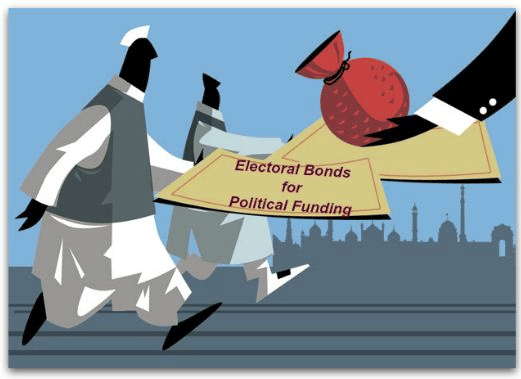
- Election bonds are interest-free bearer instruments that were introduced in the 2017 Union Budget and are used to make donations to political parties in an anonymous manner.
- A bearer instrument does not carry any information about the buyer or payee and the holder of the instrument (which is the political party) is presumed to be its owner.
- The bonds are only permitted to be offered by the State Bank of India (SBI), and they are sold in multiples of Rs 1,000, Rs 10,000, Rs 1 lakh, Rs 10 lakh, and Rs 1 crore.
- The bonds are available for donors to buy and then give to the party of their choice.
- The party can then cash the bonds through its verified account within 15 days.
- SBI deposits these into the Prime Minister's Relief Fund if a party hasn't encashed its bonds within 15 days.
*To know more about the topic, click this link Electoral Bonds
Recent Amendments to the Electoral Bonds
Extended Period of 15 days
- The Central introduced a new paragraph saying that in the year of general elections to the Legislative Assembly of States and Union Territories with the Legislature, an additional period of fifteen days shall be specified by the Central Government.
- These bonds were made available in 2018, when the Electoral Bond Scheme was implemented, for a period of 10 days in each of the months of January, April, July, and October, as may be defined by the central government.
- The Central Government was required to provide an additional 30-day term during the year of the general election for the House of People.
Eligibility
- The only political parties qualified to obtain electoral bonds are those that were registered in accordance with Section 29A of the Representation of the People Act, 1951.
- The party must also have received at least 1% of the votes cast in the most recent general election for the Lok Sabha or the State Legislative Assembly.
Validity
- The Electoral Bonds are valid for fifteen calendar days starting on the day of issuance, and if the Electoral Bond is deposited after the validity period has passed, no payment will be made to any payee Political Party.
- On the same day, the qualified political party's account will receive credit for the electoral bond that was deposited there.
Who is eligible to buy electoral bonds?
- A citizen of India or a body incorporated in India will be eligible to purchase the bond.
- A political party must be registered under Section 29A of the Representation of the People Act, 1951 (43 of 1951) and have received at least 1% of the votes cast in the most recent general election for the House of People or the State's Legislative Assembly in order to be eligible to receive Electoral Bonds.
- A qualifying political party may only redeem the electoral bonds through a bank account with the authorized bank.
What are the criticisms against electoral bonds?
- Lack of transparency: The electoral bonds scheme is criticized for doing the exact opposite of what it was intended to do, which was to increase transparency in funding elections.
- Anonymity: According to some, electoral bonds' anonymity only applies to the general people and the opposing parties.
- Such bonds are sold through a government-owned bank State Bank of India (SBI), which gives the government access to information about the financiers of its adversaries.
- The scheme has an impact on the fundamental notion of free and fair elections guaranteed by Article 324 of the Constitution.
- Denominations: Election-related bonds were introduced with the goal of facilitating easy funding of political parties by the general public, however, more than 90% of the bonds issued have been of the highest denomination (Rs 1 crore).
- Corporate Funding: Additionally, there was a limit on the sum of money that a firm may donate to a political party until the electoral bonds program was established. However, critics claim that after changing the Companies Act, the government abolished this prohibition, enabling corporate India to receive limitless funding.
(*Click this link to read prelims specific weekly current affairs articles)
Some Important FAQs
Question: What is an electoral bond?
Answer:
Electoral bond is an interest-free bearer instrument that was introduced in the 2017 Union Budget. An electoral bond is used to make donations to political parties in an anonymous manner.
Question: Who is Authorised to issue electoral bonds in India?
Answer:
The only bank permitted to issue electoral bonds is the State Bank of India (SBI). A political bond is valid for 15 days after it is issued. If the bond is deposited after the validity time has passed, no payment will be given to any political party, according to the statement.
Question: Are electoral bonds taxable?
Answer:
Electoral bond donations are regarded as tax-exempt under Sections 80 GG and 80 GGB of the Income Tax Act.
MCQs
Question: Consider the following statements on Electoral Bonds:
- Electoral Bonds are sold by the Reserve Bank of India.
- A political bond is valid for 15 days after it is issued.
Which of the statement(s) given above is/are correct?
(a) 1 only
(b) 2 only
(c) Both 1 and 2
(d) Neither 1 nor 2
Answer: (b) See the Explanation
- The only bank permitted to issue electoral bonds is the State Bank of India (SBI). A political bond is valid for 15 days after it is issued.
- If the bond is deposited after the validity time has passed, no payment will be given to any political party, according to the statement.
Therefore, option (b) is the correct answer.
Download the PREPP App and attempt FREE IAS Exam Mock Tests and get complete study material!

Full Test - 04: UPSC CSE Prelims CSAT (Paper-II)
Full Test - 03: UPSC CSE Prelims CSAT (Paper-II)
UPSC CSE Prelims 2026 GS Paper 1 Question Paper (24-May-2026)
UPSC CSE Prelims 2026 CSAT Paper 2 Question Paper (24-May-2026)

17 February 2025 | The Hindu Must Read Articles | Current Affairs

16 February 2026 | The Hindu Must Read Articles | Current Affairs

13 February 2026 | The Hindu Must Read Articles | Current Affairs









Comments