Electoral Bonds Promote and Help Donate Clean Money to Parties: AG tells SC
Primary Source: The Hindu
Click here for Daily Current Affairs
Prepp Prelims Booster: Electoral Bonds, Election Commission
Prepp Mains Booster: Appointment to various Constitutional Posts, Powers, FunctionsandResponsibilities of various Constitutional Bodies
Why in the news?
- The Attorney General of India, R. Venkataramani, has defended the government's electoral bonds scheme in the Supreme Court, highlighting it as a method that encourages the contribution of "clean money" to political parties, ensuring that tax obligations are fulfilled.
- The AG's defense comes in response to petitions claiming that the scheme allows for anonymous donations, potentially leading to corruption and the influence of undisclosed interests in politics.
Table of Contents

What are Electoral Bonds?
- Electoral bonds are a financial instrument introduced by the Government of India with the intent of making political donations more transparent and to ensure the flow of clean money to political parties.
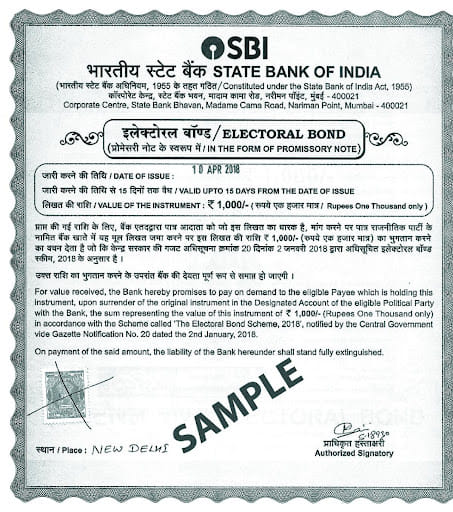
- An electoral bond is like a promissory note that can be bought by any Indian citizen or company incorporated in India from specified branches of the State Bank of India.
- The citizen or corporate entity can then donate the same to any eligible political party of their choice.
- One of the main features of electoral bonds is that they are meant to protect the donor's identity, making the donations anonymous.
- This is to prevent any potential backlash or undue influence over the donor by other political entities or individuals.
- Electoral bonds can only be encashed by an eligible political party through a designated bank account with the authorized bank.
- Only political parties registered under Section 29A of the Representation of the People Act, 1951, and which secured not less than 1% of the votes polled in the last general election to the House of the People or the Legislative Assembly, are eligible to receive donations through electoral bonds.
- Donations made through electoral bonds are exempt from tax, provided the political parties are compliant with the set norms.
- These bonds are valid for a short period from the date of issue. A political party must encash the bonds within this period, failing which the donation is transferred to the Prime Minister's Relief Fund.
Constitutional Rights & Provisions
- Article 19(1)(a): This article guarantees the freedom of speech and expression to all citizens. In the context of electoral bonds, it has been argued that this freedom includes the right to make political donations anonymously.
- Article 19(2): It allows the government to impose "reasonable restrictions" on the exercise of the right to freedom of speech and expression in the interests of the sovereignty and integrity of India, the security of the State, friendly relations with foreign states, public order, decency, or morality, or in relation to contempt of court, defamation, or incitement to an offence.
Transparency vs. Confidentiality
The core debate over the use of electoral bonds for political funding in India hinges on two conflicting principles: the need for transparency in political funding and the right to confidentiality for donors.
Transparency in Political Funding
- Transparency advocates argue that the sources of political funding should be open to public scrutiny to ensure that elected officials are accountable and to guard against undue influence or corruption.
- Knowing who funds political parties can help citizens understand potential biases or motivations behind policy decisions.
- Transparency is seen as essential to a healthy democracy, where voters can make informed decisions about who to support.
- Transparency also serves to deter corruption and maintain the integrity of the electoral process.
- Critics of the electoral bond scheme argue that it allows for anonymous donations, obscuring the link between donors and political parties.
- This lack of transparency can potentially lead to a situation where policy decisions are influenced by undisclosed financial contributions, hence affecting the fairness and integrity of the political process.
Confidentiality for Donors
- On the other side of the debate, proponents of confidentiality argue that donors have a right to privacy and may require protection from potential repercussions of their political contributions.
- This is particularly relevant in the context of retribution or adverse consequences from either the political class or the public for their funding choices.
- They may face pressure, harassment, or even economic consequences if their political contributions become public.
- Supporters of electoral bonds assert that they prevent the traditional practice of cash donations, which are untraceable and prone to being sourced from illegal activities.
- By channeling donations through a formal banking mechanism, electoral bonds are touted to ensure that only 'clean money'—funds that have fulfilled tax obligations—enters the political system.
Advocacy for Electoral Bonds
The Attorney General (AG) of India, R. Venkataramani, presented several arguments in favour of Electoral Bonds:
- Promotion of Clean Money: The AG argued that Electoral Bonds promote the contribution of clean money to political parties.
- Ensuring Tax Compliance: He claimed that the scheme ensures that contributors meet their tax obligations, which implies that only tax-paid money is used for political donations.
- Regulatory Framework: The AG stated that the Electoral Bonds scheme acts as a regulatory measure within the scope of Article 19(2) of the Indian Constitution. It regulates political donations by facilitating transfers through banking channels.
- Transfer through Banking Channels: He highlighted that the scheme allows for donations to political parties through banks, which is a departure from the earlier unregulated contributions that could lead to a lack of transparency.
- Confidentiality for Donors: The AG noted that the scheme extends the benefit of confidentiality to contributors, which can encourage more people to donate without fear of repercussions.
- Right to Information: The AG asserted that while the public does have a right to information, this right comes with reasonable restrictions. He differentiated the need-to-know criminal antecedents of political candidates, which has a direct relevance to voter choice, from the details of donations to political parties.
- Against Over-Broad Interpretation: Venkataramani argued that the right to know should not extend to over-broad ideas that cannot serve specific ends, suggesting that demanding information on Electoral Bonds does not necessarily serve a direct public interest.
- Not Violating Rights: He maintained that the scheme does not violate any existing rights.
- Matter of Legislative Debate: The AG expressed that the issues raised are highly debatable and should be subjected to parliamentary debates rather than being oversimplified in court.
- Judicial Review Not Suggested: Lastly, he contended that judicial review is not intended to critique state policies or suggest alternatives, implying that the Electoral Bonds scheme is a policy matter beyond the appropriate scope of judicial scrutiny.
Attorney General of India
|
Significance of Electoral Bonds Scheme
- Formalizing Political Donations: By routing funds through the banking system, electoral bonds aim to formalize the process of political donations.
- This mechanism can potentially reduce the influx of black money into the political system by ensuring that only legitimate, banked funds are used for donations.
- Tax Compliance: Electoral bonds require donors to purchase them through a bank, which means the money used to buy the bonds should be accounted for and tax-compliant.
- Donor Anonymity: The bonds maintain the confidentiality of the donor, which is intended to protect donors from any potential backlash or political victimization due to their funding choices.
- Encouraging Corporate Donations: With the promise of confidentiality, more corporations may be willing to support political parties without the risk of harming their business interests or facing backlash from the government or opposition parties.
- Reducing Cash Transactions: Electoral bonds aim to minimize cash transactions in political funding, which are harder to trace and more susceptible to being funded by illegal activities.
- Preventing Direct Influence: Since the bonds are purchased anonymously, it is argued that this could prevent donors from exerting direct influence over political parties in return for financial contributions, as there is no official record of their donation.
- Standardization: Electoral bonds provide a standardized mechanism for political donations, as opposed to various unregulated methods that were previously used.
- Ease of Use: Bonds can be purchased during specified windows and are easily accessible to donors, making the process of political donation straightforward.
- Accountability for Political Parties: Political parties are required to disclose the amounts received through electoral bonds to the Election Commission of India, which may improve the accountability of the political financing system.
Criticism of Electoral Bonds Scheme
- Lack of Transparency: One of the primary criticisms is that the anonymity provided to donors eliminates the transparency from political donations.
- Potential for Quasi-Anonymity for Parties: While the political parties are aware of the donors' identities (since donations are made through banking channels), the public is not. This can lead to a situation where parties may be influenced by big donors without any public scrutiny.
- Corporate Influence: There is a concern that electoral bonds allow corporations to wield significant political influence without disclosure. Large donors may gain undue access to and power over political decision-makers.
- Unlimited Donations: There is no cap on the amount of money that can be donated via electoral bonds, potentially leading to a scenario where wealthy individuals or entities could have a disproportionate impact on the political system.
- Possibility of Money Laundering: Critics argue that the anonymity provided by electoral bonds could be misused for laundering money, as there is no requirement to disclose the source of funds used to purchase these bonds.
- Foreign Influence: The anonymity clause raises concerns about foreign entities potentially influencing Indian elections by funneling money through Indian companies they own.
- State Bank of India Monopoly: All electoral bond transactions are routed exclusively through the State Bank of India (SBI), leading to concerns about centralization and the undue burden on a single institution.
- Legal and Regulatory Gaps: The scheme is seen as a workaround to existing legal caps on corporate donations and requirements for disclosure, creating a parallel system with different rules.
- Policy Influence: There is a fear that policy decisions may be influenced by anonymous donations, leading to policies that favor donors over the public interest.
- Selective Disclosure: Political parties are required to disclose the total amount received via electoral bonds to the Election Commission of India, but not the donors' identities, leading to selective transparency.
- Short Purchase Window Visibility: Electoral bonds are available for purchase only during specific periods, which critics argue can be strategically decided to benefit certain parties.
Conclusion
The Attorney General asserts that the electoral bonds scheme is a step towards regulating political donations. He suggests that the scheme ensures tax compliance and allows donors to contribute through secure banking channels. He emphasized that this matter requires thorough parliamentary debates rather than simplistic court-guided judgments.
(*Click this link to read prelims specific weekly current affairs articles)
FAQs
Question: What are electoral bonds?
Answer:
Electoral bonds are a financial instrument introduced by the Government of India with the intent of making political donations more transparent and to ensure the flow of clean money to political parties. An electoral bond is like a promissory note that can be bought by any Indian citizen or company incorporated in India from specified branches of the State Bank of India.
Question: What are the constitutional provisions related to electoral bonds?
Answer:
The constitutional provisions related to electoral bonds are:
- Article 19(1)(a): This article guarantees the freedom of speech and expression to all citizens. In the context of electoral bonds, it has been argued that this freedom includes the right to make political donations anonymously.
- Article 19(2): It allows the government to impose "reasonable restrictions" on the exercise of the right to freedom of speech and expression in the interests of the sovereignty and integrity of India, the security of the State, friendly relations with foreign states, public order, decency, or morality, or in relation to contempt of court, defamation, or incitement to an offence.
Question: What is the eligibility criteria for receiving funds through electoral bonds?
Answer:
Only political parties registered under Section 29A of the Representation of the People Act, 1951, and which secured not less than 1% of the votes polled in the last general election to the House of the People or the Legislative Assembly, are eligible to receive donations through electoral bonds.
UPSC Mains Practice Question:
|
MCQs
Question: Consider the following statements: (UPSC 2017)
- The Election Commission of India is a five-member body.
- Union Ministry of Home Affairs decides the election schedule for the conduct of both general elections and by-elections.
- Election Commission resolves the disputes relating to splits/mergers of recognized political parties.
Which of the statements given above is/are correct?
(a) 1 and 2 only
(b) 2 only
(c) 2 and 3 only
(d) 3 only
Answer: (d) See the Explanation
The Election Commission of India is an autonomous constitutional organization in India that is in charge of overseeing Union and State election processes. The body is in charge of elections to India's Lok Sabha, Rajya Sabha, and State Legislative Assemblies, as well as the positions of President and Vice President.
Articles 324 to 329 of the constitution address the commission's and member's powers, functions, tenure, eligibility, and so on. The election commission consists of three members: one Chief Election Commissioner and two Election Commissioners. Hence, statement 1 is incorrect.
Functions of election commission include:
- The election commission determines the election calendar for both general elections and bye-elections. Hence, statement 2 is incorrect.
- It also resolves issues involving splits/mergers of recognized political parties. Hence, statement 3 is correct.
- It compiles the voting roll and issues the Electronic Photo Identity Card (EPIC).
- It recognizes political parties and assigns electoral symbols to them, as well as resolving election-related disputes.
- It publishes the Model Code of Conduct for Political Parties and Candidates in Elections.
- It establishes campaign spending limitations for all political parties.
Therefore, option (d) is the correct answer.
Question: Consider the following statements: (UPSC 2020)
- According to the Constitution of India, a person who is eligible to vote can be made a minister in a state for six months even if he/she is not a member of that state.
- According to the Representation of People Act,1951, a person convicted of a criminal offence and sentenced to imprisonment for five years is permanently disqualified from contesting an election even after his release from prison.
Which of the statements given above is/are correct?
(a) 1 only
(b) 2 only
(c) Both 1 and 2
(d) Neither 1 nor 2
Answer: (d) See the Explanation
Every citizen who is 18 years old on the qualifying date (January 1 of the year in this case) is eligible to vote, unless disqualified.
A person who is not an MLA can become a minister if he is elected to the State Legislature within six months of his appointment. While the voting age is 18, a person cannot become an MLA until they are 25 years old. Hence, statement 1 is incorrect.
Section 8 of the RPA of 1951 specifies the reasons for disqualification upon conviction of various offenses. From the date of conviction until the time specified, the guilty candidate is ineligible to serve in either house of Parliament or the State Legislature. This is not a permanent situation. Hence, statement 2 is incorrect.
Therefore, option (d) is the correct answer.
Question: Which one of the following Schedules of the Constitution of India contains provisions regarding anti-defection? (UPSC 2014)
(a) Second Schedule
(b) Fifth Schedule
(c) Eighth Schedule
(d) Tenth Schedule
Answer: (d) See the Explanation
The Tenth Schedule is often referred to as Anti-Defection Act. It was inserted into the Constitution by the 52nd Amendment Act of 1985, and it provides for the disqualification of elected members for defecting to another political party.
According to the 91st CAA, 2003, at least two-thirds of the members of a party must be in favour of a "merger" for it to be legal. Disqualification due to defection is decided by the Speaker or the Chairman of the appropriate Legislative chamber.
Therefore, option (d) is the correct answer.
Download the PREPP App and attempt FREE IAS Exam Mock Tests and get complete study material!

Full Test - 04: UPSC CSE Prelims CSAT (Paper-II)
Full Test - 03: UPSC CSE Prelims CSAT (Paper-II)
UPSC CSE Prelims 2026 GS Paper 1 Question Paper (24-May-2026)
UPSC CSE Prelims 2026 CSAT Paper 2 Question Paper (24-May-2026)

17 February 2025 | The Hindu Must Read Articles | Current Affairs

16 February 2026 | The Hindu Must Read Articles | Current Affairs

13 February 2026 | The Hindu Must Read Articles | Current Affairs









Comments