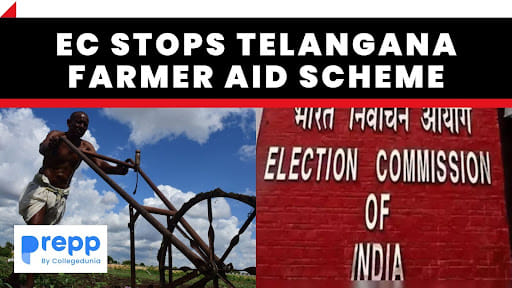
EC Stops Telangana Farmer Aid Scheme
Click here for Daily Current Affairs
Why in the news?
- The Election Commission (EC) has withdrawn permission for the Rythu Bandhu scheme in Telangana due to a violation of the model code of conduct.
- This decision is significant in the context of the upcoming Telangana Assembly elections scheduled for November 30.
Table of Contents
What is the Rythu Bandhu Scheme?
- The Rythu Bandhu Scheme is a welfare initiative launched by the Government of Telangana, India, aimed at supporting the state's farmers.
- Introduced in May 2018, the scheme offers direct financial support to farmers. This assistance is provided to cover various input costs such as seeds, fertilizers, and pesticides, which are essential for crop cultivation.
- The scheme is designed to benefit land-owning farmers. The government provides a fixed amount per acre to eligible farmers, regardless of their crop choice.
- The financial assistance is directly deposited into the bank accounts of the beneficiaries, ensuring transparency and reducing the chances of corruption or mismanagement.
- By providing financial aid, the scheme aims to empower farmers, boost agricultural productivity, and enhance their income.
- It is also seen as a step towards mitigating the distress in the agricultural sector, which often arises from factors like debt, inadequate prices for crops, and the high cost of inputs.
Why did the EC Stop the Rythu Bandhu Scheme?
- The Election Commission (EC) of India stopped the Rythu Bandhu scheme in Telangana due to a violation of the model code of conduct.
- The decision was taken following a statement made by the State Finance Minister, who announced that money would be disbursed under the Rythu Bandhu scheme on November 28, which was just two days before the scheduled Assembly election in Telangana on November 30.
- Earlier, on November 25, the EC had permitted the disbursement of the Rabi season installment under this scheme with certain conditions: no publicity, no public functions for disbursement, and no involvement of political functionaries in the process.
- However, the EC found that the minister's statement violated these conditions by publicizing the release under the scheme, thereby disrupting the level playing field in the ongoing election process. This led to the withdrawal of permission for the scheme.
What is the Model Code of Conduct (MCC)?
- The Model Code of Conduct (MCC) is a set of guidelines issued by the Election Commission of India to regulate political parties and candidates prior to elections.
- Its primary purpose is to ensure fair and free elections by creating a level playing field for all candidates.
- The MCC comes into effect as soon as an election schedule is announced and remains in force until the end of the electoral process.
Key Aspects and Implications of the Model Code of Conduct
- Prevention of Unfair Practices: The MCC prohibits any activity that can affect the outcomes of the election unfairly, such as bribery, intimidation, and the use of government resources for campaigning.
- It also restricts the announcement of any new projects or developmental initiatives by the government that could influence voters.
- Neutral Stance of Government Officials: The MCC requires that government officials involved in elections remain politically neutral and impartial throughout the electoral process.
- Regulation of Political Campaigns: The MCC sets guidelines for the conduct of political parties and candidates during campaigning, including restrictions on hate speech, communal campaigning, and criticism of private individuals or unconnected issues.
- Media Conduct: The MCC provides guidelines for the media to conduct itself in a balanced and neutral manner during the election period. This includes restrictions on broadcasting any content that might favor or oppose any political party or candidate.
- Peaceful Conduct of Elections: The MCC includes measures to ensure that elections are conducted peacefully, without any violence or conflict. It mandates that parties and candidates avoid creating mutual animosity or hatred and prohibits the use of places of worship for campaigning.
- Redressal Mechanism: The Election Commission monitors compliance with the MCC and has the authority to take appropriate actions against violations. This includes reprimanding or censuring candidates or parties, canceling or postponing elections, or even disqualifying candidates.
Election Commission's Authority to Enforce the Model Code of Conduct
- Moral Authority: The MCC is more of a moral code than a legal document. While it doesn't have statutory backing, political parties and candidates generally adhere to it due to the moral and ethical authority of the ECI and the public expectation of fair play.
- Monitoring and Implementation: The ECI sets up various mechanisms to monitor compliance with the MCC. This includes deploying observers, setting up control rooms, and using other methods to keep a check on any unfair practices or violations.
- Directive Powers: The ECI issues directives and advisories to political parties and candidates, reminding them of the provisions of the MCC. It also provides guidelines and clarifications on various aspects of campaigning, conduct during the polling, etc.
- Redressal and Punitive Measures: In case of violations of the MCC, the ECI has the power to issue warnings, reprimand parties or candidates, and in severe cases, it can order the filing of FIRs, recommend the disqualification of candidates, or even countermand or postpone elections in that constituency.
- Control over Government Machinery: During the election period, the ECI exercises control over the civil administration and police forces to ensure they perform their duties impartially. It can transfer or suspend officers who are deemed to be biased or acting in favor of any political party.
- Media Regulation: The ECI also monitors media, including social media, for adherence to the MCC. It can issue guidelines for the media to ensure balanced coverage and prevent any form of biased reporting or paid news.
- Dealing with Complaints: The ECI actively deals with complaints regarding the violation of the MCC. It has set up mechanisms to receive and act on such complaints promptly.
- Educating and Informing: The ECI undertakes initiatives to educate and inform political parties, candidates, and the general public about the MCC. This includes conducting workshops, seminars, and issuing informational booklets.
Conclusion
The incident raises questions about the use of government schemes in election campaigns and the enforcement of the model code of conduct. By establishing clear rules for the conduct of elections, the MCC helps in reducing electoral malpractices and ensures that the electoral competition is fair and equitable.
(*Click this link to read prelims specific weekly current affairs articles)
FAQs
Question: What is the Rythu Bandhu scheme?
Answer:
The Rythu Bandhu scheme is a welfare program initiated by the Telangana government that provides direct financial assistance to farmers each season to cover the cost of inputs and other initial needs.
Question: What is Model Code of Conduct (MCC)?
Answer:
The Model Code of Conduct (MCC) is a set of guidelines issued by the Election Commission of India to regulate political parties and candidates prior to elections. Its primary purpose is to ensure fair and free elections by creating a level playing field for all candidates. The MCC comes into effect as soon as an election schedule is announced and remains in force until the end of the electoral process.
UPSC Mains Practice Question:
|
MCQs
Question: Consider the following statements: (UPSC 2017)
- The Election Commission of India is a five-member body.
- Union Ministry of Home Affairs decides the election schedule for the conduct of both general elections and by-elections.
- Election Commission resolves the disputes relating to splits/mergers of recognized political parties.
Which of the statements given above is/are correct?
(a) 1 and 2 only
(b) 2 only
(c) 2 and 3 only
(d) 3 only
Answer: (d) See the Explanation
The Election Commission of India is an autonomous constitutional organization in India that is in charge of overseeing Union and State election processes. The body is in charge of elections to India's Lok Sabha, Rajya Sabha, and State Legislative Assemblies, as well as the positions of President and Vice President.
Articles 324 to 329 of the constitution address the commission's and member's powers, functions, tenure, eligibility, and so on.
The election commission consists of three members: one Chief Election Commissioner and two Election Commissioners. Hence, statement 1 is incorrect.
The Chief Election Commissioner and Election Commissioners are appointed by the President. They have a fixed term of six years, or until they reach the age of 65, whichever comes first. They have the same position, income, and benefits as Judges of the Supreme Court of India. The Chief Election Commissioner can be dismissed only through a procedure identical to that of a Supreme Court judge appointed by Parliament.
The election commission determines the election calendar for both general elections and bye-elections. Hence, statement 2 is incorrect.
It also resolves issues involving splits/mergers of recognized political parties. Hence, statement 3 is correct.
It compiles the voting roll and issues the Electronic Photo Identity Card (EPIC).
It recognizes political parties and assigns electoral symbols to them, as well as resolving election-related disputes.
It publishes the Model Code of Conduct for Political Parties in Elections.
Therefore, option (d) is the correct answer.
Question: The Rythu Bandhu scheme, a welfare program initiated by the Telangana government, primarily aims to:
(a) Provide subsidized seeds to farmers.
(b) Offer direct financial assistance to farmers for each cropping season.
(c) Facilitate crop insurance for small and marginal farmers.
(d) Implement new farming techniques.
Answer: (b) See the Explanation
The Rythu Bandhu scheme is designed to provide financial support directly to the farmers' accounts to assist with the costs associated with farming, notably for purchasing inputs.
Therefore, option (b) is the correct answer.
Download the PREPP App and attempt FREE IAS Exam Mock Tests and get complete study material!

Full Test - 04: UPSC CSE Prelims CSAT (Paper-II)
Full Test - 03: UPSC CSE Prelims CSAT (Paper-II)
UPSC CSE Prelims 2026 GS Paper 1 Question Paper (24-May-2026)
UPSC CSE Prelims 2026 CSAT Paper 2 Question Paper (24-May-2026)

17 February 2025 | The Hindu Must Read Articles | Current Affairs

16 February 2026 | The Hindu Must Read Articles | Current Affairs

13 February 2026 | The Hindu Must Read Articles | Current Affairs









Comments