Dropout Rates Among SC, ST, OBC Students a Concern
Click here for Daily Current Affairs
Why in the news?
Concerns were raised during the Zero Hour in the Rajya Sabha about the high dropout rates among students from Scheduled Castes (SC), Scheduled Tribes (ST), and Other Backward Classes (OBC) in Central higher education institutions in India.
Table of Contents
What is the issue?
- The primary concern is the alarming number of students from the SC, ST, and OBC communities who are dropping out of Central universities.
- In the past five years, an alarming total of 13,626 students from the SC, ST, and OBC categories have ceased their higher education.
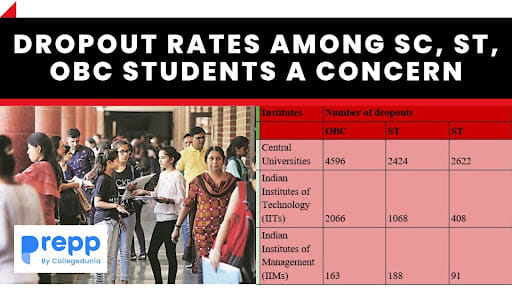
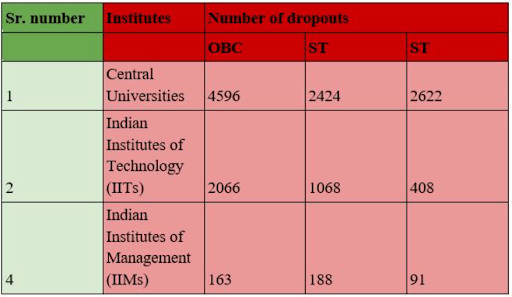
- Specifically, in Central Universities, the dropout numbers were 4,596 for OBC, 2,424 for SC, and 2,622 for ST students.
- Additionally, there have been significant dropouts in prestigious institutions:
- In IITs, 2,066 OBC, 1,068 SC, and 408 ST students terminated their studies, while at IIMs, the figures were 163 OBC, 188 SC, and 91 ST students.
- Socio-economic barriers such as financial constraints, lack of access to resources, discrimination, and social challenges disproportionately affect these marginalized groups.
- Possible gaps in educational policies and their implementation, especially concerning affirmative action, financial aid, and support mechanisms for students from marginalized communities.
What is a Dropout Rate?
- The dropout rate is a measure used to indicate the percentage of students who leave school or discontinue their education at a specific level before completing the prescribed curriculum or graduating.
- The dropout rate is a critical metric for understanding the effectiveness and inclusivity of an educational system.
- The dropout rate is typically calculated by dividing the number of students who drop out during a specific period (like an academic year) by the total number of students enrolled at the beginning of the period, then multiplying the result by 100 to express it as a percentage.
What are the Root Causes of High Dropout Rates Among SC, ST & OBC?
- Economic Constraints: Many students from SC, ST, and OBC backgrounds come from economically disadvantaged families. The cost of education, including tuition, books, and living expenses, can be a significant burden, leading to dropouts.
- Social Discrimination and Stigma: These students often face social discrimination and stigma in educational environments. This can manifest as bias from faculty and peers, leading to an unwelcoming and hostile educational experience.
- Lack of Adequate Support Systems: Educational institutions may lack sufficient support systems, such as mentoring, counseling, and remedial classes, which are crucial for students who might be first-generation college students or come from schools with fewer resources.
- Cultural and Linguistic Barriers: Students from different cultural or linguistic backgrounds may struggle to adapt to the predominant culture in higher education institutions. This can lead to a sense of alienation and difficulty in coping with academic demands.
- Poor Primary and Secondary Education: Often, the primary and secondary education available to SC, ST, and OBC students is of lower quality due to disparities in educational resources.
- Inadequate Implementation of Reservation Policies: While reservation policies exist to support SC, ST, and OBC students, their implementation is sometimes inadequate, resulting in these students not receiving the intended benefits.
- Psychological Factors: The pressure of being first-generation learners, along with the stress of navigating an unfamiliar environment, can take a psychological toll.
- Family Responsibilities and Pressure: Students may face pressure to start earning at an early age to support their families. Balancing academic responsibilities with family obligations can be challenging.
- Lack of Role Models and Guidance: The absence of role models from similar backgrounds in academia can lead to a lack of guidance and inspiration for these students.
- Institutional Biases: There can be subtle institutional biases and systemic issues within educational institutions that do not adequately address the needs of SC, ST, and OBC students.
Potential Solutions for SC, ST & OBC Students
- Financial Assistance and Scholarships: Increase the availability of scholarships, grants, and financial aid specifically targeted at SC, ST, and OBC students. This would help alleviate the economic burden of higher education.
- Mentorship Programs: Implement mentorship and counseling programs where senior students or alumni from similar backgrounds mentor new students, providing guidance and support.
- Strengthening Primary and Secondary Education: Improve the quality of primary and secondary education in regions predominantly inhabited by SC, ST, and OBC communities.
- Academic Support and Tutoring: Offer extra tutoring, bridge courses, and academic support services to help students who may be struggling with the curriculum.
- Anti-Discrimination Policies: Establish and enforce strict anti-discrimination policies within educational institutions to create a more inclusive and welcoming environment for SC, ST, and OBC students.
- Awareness and Sensitization Programs: Conduct regular awareness and sensitization programs for students and faculty to foster an understanding and appreciation of the challenges faced by marginalized communities.
- Enhanced Infrastructure and Facilities: Improve infrastructure and facilities in educational institutions, such as libraries, laboratories, and hostels, to ensure they are accessible and comfortable for all students.
- Monitoring and Evaluation: Regularly monitor and evaluate the progress of SC, ST, and OBC students. This data can be used to identify areas needing improvement and to develop targeted interventions.
- Career Counseling and Placement Assistance: Provide career counseling and placement assistance to help students from these communities secure employment post-graduation.
- Community Engagement: Engage with the communities of SC, ST, and OBC students to understand their needs and challenges better. This can also involve parents and local leaders in supporting educational endeavors.
- Liaison Officers and Committees: Appoint liaison officers and committees dedicated to addressing the specific needs and grievances of SC, ST, and OBC students within educational institutions.
Social Implications of High Dropout Rates Among SC, ST & OBC Students
- Perpetuation of Inequality: Education is a key factor in social mobility, and without it, students from these communities may find it harder to break out of poverty and marginalization.
- Reduced Employment Opportunities: High dropout rates can limit the professional and career prospects of individuals from these communities, further entrenching socio-economic disparities.
- Widening the Skill Gap: A lack of higher education can widen the skill gap in the workforce. This not only affects the individuals but can also have a broader impact on the economy, especially in sectors that rely on skilled labor.
- Impact on Community Development: Educated individuals often contribute significantly to the development of their communities. High dropout rates can therefore slow down the overall development and progress of SC, ST, and OBC communities.
- Social Exclusion: Lack of access to higher education for SC, ST, and OBC students can lead to their social exclusion, reinforcing existing caste and class divides.
- Gender Disparities: Women from these communities are often at a double disadvantage due to their gender and caste/class. High dropout rates can exacerbate gender disparities in education and employment within these communities.
- Decreased Political Representation and Voice: Lower educational attainment can lead to decreased political representation and a weaker voice in policy and decision-making for these communities.
- Impact on Mental Health: Experiencing the barriers that lead to dropping out, such as discrimination and financial strain, can have adverse effects on students' mental health and well-being.
- Reduced Social Cohesion: High dropout rates among certain communities can lead to a sense of alienation and resentment, affecting the social fabric and cohesion of society as a whole.
- Economic Impact: On a broader scale, high dropout rates can affect the nation's economy. A less educated workforce can mean lower productivity, innovation, and competitiveness on a global scale.
Conclusion
The government must take immediate steps to address and reduce the dropout rates among SC, ST, and OBC students in Central higher education institutions. There is a need for targeted measures to support students from these communities and improve their educational experiences and outcomes.
(*Click this link to read prelims specific weekly current affairs articles)
FAQs
Question: What is a Dropout Rate?
Answer:
The dropout rate is a measure used to indicate the percentage of students who leave school or discontinue their education at a specific level before completing the prescribed curriculum or graduating. The dropout rate is a critical metric for understanding the effectiveness and inclusivity of an educational system.
Question: Why is the dropout rate among SC, ST, and OBC students in Central higher education institutions a concern?
Answer:
The high dropout rates among SC, ST, and OBC students in Central higher education institutions are concerning because they reflect underlying issues such as socio-economic challenges, lack of adequate support, and possibly systemic inequalities.
Question: What measures can be taken to reduce the dropout rates among SC, ST, and OBC students in higher education?
Answer:
To reduce dropout rates, it's essential to provide enhanced financial support, create mentorship programs, improve access to educational resources, implement inclusive policies, and raise awareness about the importance of education in these communities .
UPSC Mains Practice Question:
|
MCQs
Question: Which of the following provisions of the Constitution does India have a bearing on Education? (UPSC 2012)
- Directive Principles of State Policy
- Rural and Urban Local Bodies
- Fifth Schedule
- Sixth Schedule
- Seventh Schedule
Select the correct answer using the codes given below:
(a) 1 and 2 only
(b) 3, 4 and 5 only
(c) 1, 2 and 5 only
(d) 1, 2, 3, 4 and 5
Answer: (d) See the Explanation
Article 45 provides for early childhood care and education for children under the age of six. Hence, statement 1 is correct.
The Panchayati raj institutions have permitted 29 subjects to work in their respective territories under Schedule 11 of the constitution. One of them is education. Similarly, Schedule 12 of the constitution includes education as one of the 18 disciplines. Hence, statement 2 is correct.
The Indian Constitution's Fifth Schedule deals with the administration and management of Scheduled territories and Scheduled tribes where tribal groups predominate. The purpose of this Schedule is to keep the state accountable for the accomplishment of tribal educational and economic goals. It also seeks to provide them with social justice and to shield them from all types of exploitation. Hence, statement 3 is correct.
Autonomous District Councils (ADC) were established in four northeastern states, namely Assam, Meghalaya, Tripura, and Mizoram, under the Sixth Schedule. These councils shall have the authority to enact laws concerning education, primary and secondary education, and vocational training within their respective districts. Hence, statement 4 is correct.
The constitution's seventh schedule addresses the division of authorities among states and centers through three lists: the State List, the Center List, and the Concurrent List.
The 42nd Amendment Act of 1976 moved the following five subjects from the State List to the Concurrent List: Forests, Education, Wild animal and bird protection, Weights and measures, and administration of justice, constitution and organization of all courts except the Supreme and High Courts. Hence, statement 5 is correct.
Therefore, option (d) is the correct answer.
Question: Which of the following is a primary concern regarding the high dropout rates among SC, ST, and OBC students in Central higher education institutions?
(a) Overcrowding in classrooms
(b) Lack of qualified teachers
(c) Socio-economic challenges and systemic inequalities
(d) Curriculum difficulty
Answer: (c) See the Explanation
The primary concern is the socio-economic challenges and systemic inequalities that students from SC, ST, and OBC communities face, which contribute to their higher dropout rates. These challenges include financial constraints, lack of support systems, and possible discrimination.
Therefore, option (c) is the correct answer.
Download the PREPP App and attempt FREE IAS Exam Mock Tests and get complete study material!

Full Test - 04: UPSC CSE Prelims CSAT (Paper-II)
Full Test - 03: UPSC CSE Prelims CSAT (Paper-II)
UPSC CSE Prelims 2026 GS Paper 1 Question Paper (24-May-2026)
UPSC CSE Prelims 2026 CSAT Paper 2 Question Paper (24-May-2026)

17 February 2025 | The Hindu Must Read Articles | Current Affairs

16 February 2026 | The Hindu Must Read Articles | Current Affairs

13 February 2026 | The Hindu Must Read Articles | Current Affairs









Comments