Disinvestment - Indian Economy Notes
Disinvestment is the sale or the liquidation of assets by the government, usually the central and state public sector enterprises, projects, or other fixed assets. The funds generated from disinvestment help in reducing public debt and decreasing the debt to GDP ratio. According to the Budget 2022-23, the disinvestment target for 2022-23 is Rs 65,000 crore. This article will discuss various aspects of disinvestment from the perspective of the UPSC examination.
| To Read update on this topic: |
|
Table of Contents |
What is Disinvestment?
- Disinvestment is defined as the conversion of money claims or securities into money or cash.
- Disinvestment is also defined as a company (or government) selling or liquidating an asset or subsidiary. It is also known as a 'divestment' or a 'divestiture.'
- In most cases, disinvestment refers to the sale of a government-owned firm by the government, either partially or entirely.
- Typically, a firm or government organization will disinvest an asset as a strategic move for the company or to raise resources to address general/specific needs.
- The shares of various government companies that are held by the Government act as earning assets at the disposal of the Government. These can be sold at any time to generate capital.
- Therefore, when these shares are sold to earn capital the process is known as disinvestment.
- It includes the sale or liquidation of assets or subsidiaries of an organization or government but never the Government’s share should go below 51%.
| Other Relevant Links | |
|---|---|
| Strategic Disinvestment | Navratnas |
| Outsourcing | Maharatnas |
Objectives of Disinvestment Policy in India
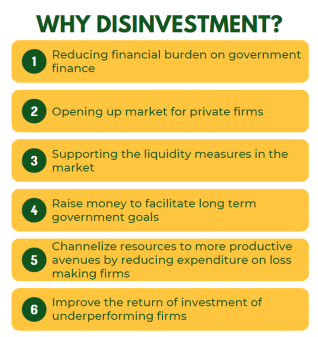
- Decrease the financial burden from the sick, loss-making PSU’s
- To help improve public finances.
- Introduce competition and market discipline amongst enterprises.
- Help in the funding of various social sector welfare initiatives.
- To encourage a wider share of ownership
- Reduce political interference in non-essential services
Need for The Disinvestment Policy in India
- The new economic policy, which went into effect in July 1991, plainly showed that PSUs had a severely negative rate of return on capital employed.
- Inefficient PSUs had been and continued to be a drain on the government's resources, turning them into liabilities rather than assets.
- Many projects that had previously been constructed as pillars of growth have become a burden on the economy.
- Low returns from PSUs were also having a negative impact on the national GDP and gross national savings.
- Due to poor savings from PSUs, around 10 to 15% of overall gross domestic savings were lowered.
- Profit levels were excessively low in relation to the capital used.
- The following were found as particularly crucial among the several reasons responsible for low earnings in PSUs:
- Price policies of public-sector enterprises
- Capacity underutilization
- Problems with project planning and construction
- Labor, personnel, and management issues
- Inadequate autonomy
- As a result, the necessity for the government to eliminate these units and focus on core functions was identified.
- The government also believed that it should exit non-core businesses, particularly those where the private sector had now made a considerable contribution.
- Finally, the government saw disinvestment as a way to raise revenue for general/specific requirements.
- The government implemented the 'Disinvestment Policy' in this direction. This was highlighted as an active method for reducing the load of PSU finance.
Types of Disinvestments
1) Minority Disinvestment
- The government wants to keep managerial control of the company by keeping a majority stake (equal to or more than 51 percent).
- Because public sector firms serve citizens, the government must be able to influence company policy in order to enhance the general public's interests.
- In most cases, the government auctions off the minority ownership to possible institutional investors or issues an offer for sale (OFS) to the general public.
2) Majority Disinvestment
- This occurs when the government sells a majority ownership in a government-owned enterprise.
- Following the disinvestment, the government now owns a minority part in the corporation.
- Such a choice is based on strategic considerations and government policy.
- Typically, the bulk of disinvestments benefit other public-sector firms.
- For example, after government disinvestment, Chennai Petroleum Corporation Limited, formerly known as Madras Refineries Limited, is a group business of Indian Oil Corporation.
- The concept is to consolidate resources within a corporation, which eventually leads to operational efficiency.
3) Strategic Disinvestment
- This occurs when the government sells a PSU to a non-government, private enterprise.
- The goal is to transfer ownership of a non-performing organization to more efficient private sector participants, reducing the financial load on the government's balance sheet.
4) Complete Disinvestment/Privatization
- The total sale of a government stake in a PSU results in the company's privatization, in which complete ownership and control are transferred to the buyer.
Disinvestment Examples1) Air India Disinvestment
2) Life Insurance Corporation of India (LIC)
|
Disinvestment Policy in India
- Focus on public sector enterprises began from the second five-year plan and Industrial Policy Resolution, 1956.
- Disinvestment as a policy initiative began in the wake of economic liberalization, globalization, and structural reforms launched in 1991.
- PV Narasimha Rao government in 1991 initiated a disinvestment policy and announced that government would disinvest up to 20% of its equity in selected PSUs mainly through mutual funds and FIIs (Financial institutions investors).
- The next phase of disinvestment allowed more individuals like FII, Employees of the Company etc.
- C Rangarajan Committee was appointed that recommended 49% of disinvestment.
- Major changes associated with disinvestment occurred during the regime of Atal Bihari Vajpayee that involved stake sale in Paradeep Phosphates, Hindustan Zinc and BALCO.
- The Department of Disinvestment used to be a separate cabinet ministry. The Ministry of 2004 was, however, integrated into the Ministry of Finance while remaining an independent department.
- Later in 2016, the government renamed the Department of Disinvestment as Department of Investments and Public Asset Management (DIPAM).
- DIPAM is primarily responsible for managing the Central Government's equity share in public sector enterprises (PSUs) and carrying out disinvestment activities in accordance with the Finance Ministry's monthly targets.
- Every year, the government sets a disinvestment target in the budget for the following fiscal year, and disinvestment is carried out in accordance with the amount anticipated.
- The FY24 disinvestment target is Rs. 51,000 crores, which is lower than the FY23 disinvestment target of Rs. 65,000 crores.
- According to DIPAM, the following are the characteristics of India's disinvestment policy:
- Promote public ownership of CPSEs to secure and enhance responsibility to the Indian public through minority or strategic disinvestment.
- Meet the minimum public shareholding criterion of 25% for each listed CPSE via an OFS, FPO, or a combination of the two.
- CPSEs must be listed if they have no accumulated losses and have made a net profit for the previous three years in a row.
- Disinvestment for CPSEs will be handled on a case-by-case basis, with CPSEs identified for divestiture following consultation with the respective ministries overseeing such CPSEs.
- The Government will evaluate OFS of Government equity recommendations.
- Niti Aayog, the Government think tank, would be a key player in managing debates on strategic disinvestment suggestions and modalities.
- Niti Aayog will recommend the form of sale, percentage of stake to be disposed of, and valuation of CPSEs that require strategic disinvestment.
National Investment Fund (NIF)
|
Recent Trends in Disinvestment Policy
- The government has revised its disinvestment estimate for the current financial year to ₹78,000 crores, down from ₹1.75 lakh crore envisaged in the budget estimate (BE) on February 1 last year, which is a 55.4% reduction
- The disinvestment target for 2022-23 is Rs 65,000 crore. This is 17% lower than the revised estimate of 2021-22 (Rs 78,000 crore).
- So far, the total disinvestment government proceed is ₹12,029.9 crore, which includes ₹2,700 crore receipt from Air India privatisation and a balance of ₹9,330 crores through the sale of minority stakes in CPSEs.
- In the current financial year (2022), major disinvestments planned include the IPO of LIC, Bharat Petroleum Corporation Ltd (BPCL), RINL and Pawan Hans.

Disinvestment Target Over the Years
Significance of Disinvestment
- The significance of disinvestment rests in the use of funds for:
- Funding the growing budgetary deficit.
- Large-scale infrastructure development financing.
- To increase consumption through investing in the economy.
- To retire government debt, over 40-45% of the Centre's revenue sources are used to repay public debt/interest.
- For social programs such as health care and education.
- Disinvestment is particularly important because of the existence of a more competitive market, which makes it harder for many PSUs to run financially.
- This causes the value of public assets to rapidly erode, making it important to disinvest early in order to realize a high value.
Disinvestment vs Divestment
Disinvestment vs Privatization
|
Conclusion
The process of disinvestment undertaken by the government has enabled it to overcome various challenges such as reducing the fiscal deficit, generating capital to channel for welfare schemes, infrastructure projects, etc. However, the government will need to ensure confidence in the sale processes, a semblance of fair valuations, give officers some cover from potential post-transaction witch-hunts by auditors and investigating agencies
FAQs
Q1: What is disinvestment?
Answer: Disinvestment refers to the process of reducing or eliminating government ownership in public sector enterprises (PSEs) through selling shares to private investors or the public.
Q2: What are the main objectives of disinvestment in India?
Answer: The primary goals of disinvestment include enhancing the efficiency of PSEs, reducing the fiscal burden on the government, attracting private investment, and promoting competition in the market.
Q3: How does disinvestment impact the economy?
Answer: Disinvestment can lead to increased operational efficiency, better resource allocation, and improved public finances. However, it may also result in job losses and concerns about reduced government control over essential services.
Q4: What are the major disinvestment initiatives taken by the Indian government?
Answer: Significant initiatives include the sale of shares in major companies like Indian Oil Corporation, Hindustan Zinc, and Air India, along with the ongoing strategy to disinvest in several other state-owned enterprises.
Q5: What challenges does disinvestment face in India?
Answer: Challenges include political opposition, public sector unions' resistance, concerns about loss of control over strategic sectors, and market conditions affecting the valuation of PSEs.
MCQs
- What does disinvestment primarily aim to achieve?
(a) Increase government ownership
(b) Reduce fiscal deficit
(c) Enhance public control over enterprises
(d) Increase employment in PSEs
Answer: (b) See the Explanation
- Which of the following is a significant disinvestment initiative in India?
(a) Nationalization of banks
(b) Sale of shares in Air India
(c) Increase in government subsidies
(d) Implementation of GST
Answer: (b) See the Explanation
- What is a potential negative impact of disinvestment?
(a) Increased operational efficiency
(b) Enhanced competition
(c) Job losses
(d) Higher government revenues
Answer: (c) See the Explanation
- Which sector has witnessed significant disinvestment efforts in India?
(a) Agriculture
(b) Manufacturing
(c) Public transportation
(d) Information Technology
Answer: (c) See the Explanation
- What is one of the main concerns associated with disinvestment?
(a) Increased government control
(b) Reduction in market competition
(c) Loss of strategic control
(d) Decrease in foreign investment
Answer: (c) See the Explanation
GS Mains Questions and Model Answers
Q1: Discuss the implications of disinvestment for public sector enterprises in India.
Answer: Disinvestment has significant implications for public sector enterprises (PSEs) in India, primarily focused on improving operational efficiency and reducing government expenditure. By transferring ownership to private entities, the government aims to foster competitiveness and innovation within these enterprises. This shift can lead to increased productivity, better management practices, and enhanced customer service, benefiting consumers and the economy at large. However, disinvestment also raises concerns regarding job security for employees, as privatization often leads to restructuring. Furthermore, the loss of strategic control over critical sectors could pose risks to national interests. Therefore, while disinvestment can catalyze economic growth, it necessitates careful consideration of its social impacts and the development of robust regulatory frameworks to safeguard public interests.
Q2: Evaluate the role of disinvestment in addressing India’s fiscal deficit.
Answer: Disinvestment plays a crucial role in addressing India’s fiscal deficit by generating revenue for the government without increasing taxes. By selling stakes in state-owned enterprises, the government can raise funds to finance public welfare projects, reduce debt, and improve fiscal health. Historically, disinvestment initiatives have provided substantial income, contributing to budgetary stability. Moreover, divesting from inefficient enterprises allows for reallocating resources towards more productive sectors. However, while disinvestment can help in short-term fiscal consolidation, it is essential to ensure that such measures are part of a broader strategy focused on sustainable economic reforms. This includes enhancing tax compliance, rationalizing expenditure, and fostering an environment conducive to private investment.
Q3: Analyze the challenges faced by the Indian government in the disinvestment process.
Answer: The Indian government encounters several challenges in the disinvestment process, hindering its ability to effectively implement its strategy. Firstly, political opposition often arises, with various parties and interest groups resisting the sale of public assets, viewing it as a loss of public control. Additionally, trade unions representing employees of PSEs frequently protest against potential job losses and changes in working conditions. Concerns regarding market conditions also pose challenges; unfavorable market conditions can lead to lower valuations, making it difficult to achieve desired revenue targets. Furthermore, the lack of transparency in the disinvestment process can breed distrust among stakeholders. To overcome these challenges, the government needs to engage in effective communication, build consensus, and ensure that disinvestment is executed with proper safeguards for employees and the public.
Previous Year Questions on Disinvestment
1. UPSC CSE Prelims 2020
Question: What is the primary objective of disinvestment by the Government of India?
Answer: The primary objective of disinvestment is to reduce the fiscal burden on the government and improve the financial health of public sector enterprises. Disinvestment enables the government to generate revenue while promoting efficiency and competition in the economy.
2. UPSC CSE Mains 2019
Question: Discuss the pros and cons of disinvestment in public sector enterprises.
Answer: Disinvestment of public sector enterprises (PSEs) in India offers several advantages, including increased operational efficiency, reduced fiscal burden on the government, and the attraction of private investment. It can stimulate competition, resulting in improved services and products for consumers. Additionally, successful disinvestment can enhance government revenue, which can be utilized for public welfare projects. However, disinvestment also presents challenges, such as potential job losses for employees and public discontent over perceived loss of control over essential services. Critics argue that privatization might prioritize profit over social welfare, leading to increased inequality. Moreover, concerns about the accountability and ethical practices of private entities further complicate the issue. Balancing these pros and cons is crucial for the government to navigate the disinvestment process effectively and ensure it aligns with broader socio-economic goals.
Download the PREPP App and attempt FREE IAS Exam Mock Tests and get complete study material!

Full Test - 04: UPSC CSE Prelims CSAT (Paper-II)
Full Test - 03: UPSC CSE Prelims CSAT (Paper-II)
UPSC CSE Prelims 2026 GS Paper 1 Question Paper (24-May-2026)
UPSC CSE Prelims 2026 CSAT Paper 2 Question Paper (24-May-2026)

17 February 2025 | The Hindu Must Read Articles | Current Affairs

16 February 2026 | The Hindu Must Read Articles | Current Affairs

13 February 2026 | The Hindu Must Read Articles | Current Affairs









Comments