Digital Transaction Methodologies – Science & Technology Notes
Several measures have been taken to promote digital payments in the country through the Government of India's flagship programme 'Digital India,' which aims to transform India into a digitally empowered society and knowledge economy. The announcement made by Finance Minister Nirmala Sitharaman to set up 75 digital banking units in 75 districts adds to India's digital leap. It also stated that all 1.5 lakh post offices would be included in the core banking system, that digital currency would be issued, and that financial assistance would be provided to encourage the use of digital payments. The government's actions demonstrate its commitment to a "Faceless, Paperless, Cashless" economy. In this article, we will discuss in detail regarding Digital Transaction Methodologies which will be helpful for UPSC exam preparation.
Table of Contents
What is a Digital Transaction?
- A digital payment, also known as an electronic payment, is a money transfer from one account to another through the use of an electronic medium.
- As a result, there is no exchange of physical money or instruments such as cash, checks, and so on.
- However, you should be aware that digital payment is not limited to online payments; it also includes payments made in a physical location on brick-and-mortar premises.
- Payments made via UPI to a grocery store or salon, for example, qualify for digital payment.
- Swiping a debit card at a store, paying for a purchase online, or transferring money from an app to your bank account are all examples.
- These types of transactions are becoming more common and necessary as consumers transition from a cash-based economy to a digital one.
| Other Relevant Links | |
|---|---|
| Digital India | Quantum computing |
| Project brainwave | Sagar Vani System |
| Locky Ransomware, Petya, WannaCry | Hindi word for computer i.e., “SANGANAK” |
| India’s first technology and innovation support centre (TISC) | Net neutrality |
| National cyber coordination center | Hortnet |
| Bitcoins | Cyber Swachhta Kendra |
| Bharat Net Project | Wi-Fi Technology |
| Digital Terrestrial Television Transmission System | Internet of Things |
What is NPCI?
|
Different Methods of Digital Transactions
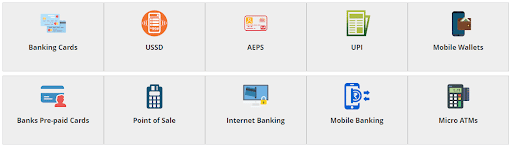
Methos of Digital Transactions in India
1) Banking Cards
- Banking cards provide more security, convenience, and control to consumers than any other payment method.
- The variety of cards available, including credit, debit, and prepaid, provides additional flexibility.
- These cards offer two-factor authentication for secure payments, such as a secure PIN and an OTP.
- Some examples of card payment systems include RuPay, Visa, and MasterCard.
- Payment cards enable people to make purchases in stores, online, through mail-order catalogues, and over the phone.
- They save both customers and merchants time and money, making transactions easier.
2) Unstructured Supplementary Service Data (USSD)
- The novel payment service *99# operates through the Unstructured Supplementary Service Data (USSD) channel.
- This service allows mobile banking transactions to be completed using a basic feature mobile phone; there is no need for a mobile internet data connection to use USSD-based mobile banking.
- It is intended to provide financial depth and inclusion of the underbanked society in mainstream banking services.
- The *99# service was launched to bring banking services to every common man in the country.
- Banking customers can use this service by dialling *99#, a "Common number across all Telecom Service Providers (TSPs)" on their mobile phone and navigating through an interactive menu displayed on the mobile screen.
- Key services provided by the *99# service include interbank account to account fund transfer, balance inquiry, and mini statement, among others.
- The *99# service is a one-of-a-kind interoperable direct-to-consumer service that brings together a diverse ecosystem of ecosystem partners, including banks and TSPs (Telecom Service Providers).
3) Aadhaar Enabled Payment System (AEPS)
- AEPS is a bank-led model that enables online interoperable financial transactions at PoS (Point of Sale / Micro ATM) using Aadhaar authentication through any bank's Business Correspondent (BC)/Bank Mitra.
- The AePS does not necessitate any physical activity such as going to the bank, using a banking card, signing anything, and so on.
- The Reserve Bank of India has not imposed any transaction limits, but each bank has established its own.
- The AePS supports all basic transactions, including balance inquiries, cash withdrawals, cash deposits, Aadhar-to-Aadhar fund transfers, and payment transactions such as Customer-to-Business (C2B) and Customer-to-Government (C2G).
- Currently, 138 banks provide the service.
4) Unified Payments Interface (UPI)
- The Unified Payments Interface (UPI) is a system that integrates multiple bank accounts into a single mobile application (of any participating bank), combining multiple banking features, seamless fund routing, and merchant payments under one hood.
- It also handles "Peer to Peer" collect requests, which can be scheduled and paid according to need and convenience.
- Each bank has its own UPI App available for the Android, Windows, and iOS mobile platforms. It enables instant fund transfer via registered mobile phone.
- Money can be transferred instantly to phone contacts registered with UPI, QR codes in stores, by typing the contact number or UPI ID, to pay utility bills and make donations, and so on.
- To process transactions, a 2-factor authentication is required for double-layer security.
- A registered mobile device with internet access and an MPIN is required for a UPI transaction.
- Banks do not charge customers for UPI transactions. The maximum transferable amount per transaction is Rs 1 lakh.
- Currently, 458 banks are live on UPI.
5) Mobile Wallets
- A mobile wallet is a method of carrying cash in digital form.
- You can link your mobile device's credit card or debit card information to the mobile wallet application, or you can transfer money online to the mobile wallet.
- You can use your smartphone, tablet, or smart watch to make purchases instead of your physical plastic card.
- To load money into a digital wallet, an individual's account must be linked to it.
- Paytm, Freecharge, Mobikwik, Oxigen, mRuppee, Airtel Money, Jio Money, SBI Buddy, Citrus Pay, Vodafone M-Pesa, Axis Bank Lime, ICICI Pockets, and other private companies have their own e-wallets.
6) Bank Prepaid Cards
- A bank prepaid card is a debit card that is typically pre-loaded with a set amount for one-time use and is not linked to the bank's checking account.
- Unlike a credit card, the user can only spend what has been pre-loaded onto the card.
- When the card's balance has been depleted, it can be reloaded online or at an ATM. A prepaid card is commonly used for gifting, corporate rewards, and so on.
- A KYC-compliant account can be used to create a prepaid card on the bank's website.
7) Point of Sale (PoS)
- A point of sale (PoS) is a location where purchases are made. A PoS can be a mall, a market, or a city on a larger scale.
- On a micro level, retailers define a point of sale (PoS) as the location where a customer completes a transaction, such as a checkout counter.
- Through their contactless reader, PoS machines can even debit money (up to INR 2000) without requiring a pin.
- PoS shortens transaction times, especially in locations with long checkout lines.
- As a result, transactions are quick and efficient, and the customer experience is seamless.
8) Internet Banking
- Internet banking, also known as online banking, e-banking, or virtual banking, is an electronic payment system that allows bank or other financial institution customers to conduct a variety of financial transactions via the financial institution's website.
- Transferring funds to any bank account is possible using National Electronic Fund Transfer (NEFT), Real Time Gross Settlement (RTGS), and Immediate Payment Services (IMPS).
- Each of these payment methods has a transaction limit of its own.
- Stop payment of cheque, chequebook request, downloading of bank statements for up to 3-5 years, checking balance, using Electronic Clearing System (ECS), applying for a loan, availing of instant loans, paying credit card and utility bills, purchasing mutual fund and insurance, applying or renewing a credit card, debit card, pre-paid card, and redeeming reward points are some of the requests and transactions that can be done via internet banking.
- Most banks do not charge for internet banking payments.
| National Electronic Fund Transfer (NEFT) |
|
| Real Time Gross Settlement (RTGS) |
|
| Electronic Clearing System (ECS) |
|
| Immediate Payment Services (IMPS) |
|
9) Mobile Banking
- Mobile banking is a service offered by a bank or other financial institution that allows its customers to conduct various types of financial transactions remotely using a mobile device such as a phone or tablet.
- It does so by utilising software, commonly referred to as an app, provided by banks or financial institutions.
- Each bank has its own mobile banking app for the Android, Windows, and iOS platforms.
10) Micro ATMs
- A micro ATM is a device used by a million Business Correspondents (BC) to provide basic banking services.
- The platform will allow Business Correspondents (for example, a local kirana shop owner who will act as a 'micro ATM') to conduct instant transactions.
- The micro platform will function through low-cost devices (micro ATMs) linked to banks across the country.
- This would allow a person to deposit or withdraw funds instantly regardless of the bank associated with a specific BC.
- This device will use a mobile phone connection and will be available at all BCs
- Customers would only need to have their identities verified before withdrawing or depositing funds into their bank accounts.
- This money will come from the BC's cash drawer. Essentially, BCs will act as banks for customers, and all they need to do is verify the customer's authenticity using the customer's UID.
- Deposit, Withdrawal, Transfer, and Balance enquiry are the basic transaction types that will be supported by micro ATMs.
Digital Transactions in India
- During the fiscal year (FY) 2021-2022, the volume of digital payments in India increased by 33% year on year (YoY).
- NPCI's unified payment interface (UPI) was the most popular digital transaction platform during the period, accounting for 452.75 crore transactions worth Rs. 8.27 lakh crore until the end of February.
- According to NPCI, the total volume of UPI transactions in February 2022 was nearly double that of the previous year.
- 229.2 crore UPI transactions worth 4.25 lakh crore were made in February 2021.
- In India, the use of digital payment apps has increased significantly, particularly since the pandemic, which forced people to stay indoors and order food and other items through online platforms.
- Many online stores and aggregator platforms had blocked cash payments in order to avoid contact with delivery agents.
- Since 2019, India has been the market leader in digital payments. With 2550 crores in payments, India was the leading market for real-time payments, followed by China (1570 crores) and South Korea (600 crores). The United States was ranked ninth, with 120 crore transactions.
Significance of Digital Payment in India
- As part of the Government of India's strategy to digitise the financial sector and economy, digital payment transactions have steadily increased in recent years.
- Furthermore, concerted efforts have been made to promote financial inclusion as one of the country's important national objectives.
- The JAM Trinity - Jan Dhan, Aadhaar, and Mobile - is a key enabler at the heart of India's transformed digital payment landscape.
- Pradhan Mantri Jan-Dhan Yojana (PMJDY) is one of the world's largest financial inclusion initiatives, launched in August 2014, with the goal of providing universal banking services to every unbanked household.
- Aadhaar, the flagship product of the Unique Identification Authority of India, is a simple but effective method for verifying individuals and beneficiaries based on biometric information.
- Jan Dhan accounts, Aadhaar cards, and mobile phone connections have all contributed to the establishment of a Digital India in which a wide range of government services are made available directly to citizens with enhanced ease of access and without the presence of any intermediary (middlemen).
- In India, digital payment transactions have grown at an unprecedented rate over the last three years.
- Easy and convenient modes of digital payment, such as the Bharat Interface for Money-Unified Payments Interface (BHIM-UPI); Immediate Payment Service (IMPS); pre-paid payment instruments (PPIs); and National Electronic Toll Collection (NETC) system, have seen significant growth and have transformed the digital payment ecosystem by increasing both P2P and P2M payments.
- Simultaneously, pre-existing payment methods such as debit cards, credit cards, National Electronic Funds Transfer (NEFT), and Real-Time Gross Settlement (RTGS) have expanded rapidly.
- The Government of India also launched e-RUPI, a cashless and contactless digital payment instrument that is expected to play a significant role in making Direct Benefit Transfer (DBT) more effective in digital transactions in the country.
Benefits of Digital Transactions
1) Faster, easier, and more convenient
- One of the most significant advantages of cashless payments is that they speed up the payment process and eliminate the need to fill out lengthy information.
- There is no need to stand in queue at an ATM or carry cards in your wallet.
- Furthermore, with the transition to digital, banking services will be available to customers 24 hours a day, 365 days a year, including bank holidays.
2) Economical and low transaction fees
- Many payment apps and mobile wallets do not charge any service or processing fees for the services they provide.
- The UPI interface is one such example, where customers can use services for free.
3) Waivers, discounts, and cashbacks
- Many rewards and discounts are available to customers who use digital payment apps and mobile wallets.
- Many digital payment banks provide appealing cash back offers.
- Customers benefit from this, and it also serves as a motivator to go cashless.
4) Digital transaction records
- Another advantage of going digital is that all transaction records can be kept.
- Customers can track each and every transaction, regardless of how small the transaction amount is.
5) Bill payment in one place
- Many digital wallets and payment apps have evolved into a convenient platform for paying utility bills.
- All utility bills, whether mobile phone, internet, or electricity, can be paid through a single app with ease.
6) Aids in the control of black money
- Digital transactions will assist the government in keeping track of things and, in the long run, will aid in the elimination of the circulation of black money and counterfeit notes.
- Aside from that, the cost of minting currency may be reduced, which may help the economy.
7) Economic Progress
- Customers are more likely to transact online when they see the ease, convenience, and security of online payments.
- This means that an increasing number of people are comfortable purchasing online, investing digitally, and transferring funds via electronic means.
- The increase in money movement and online business contributes to the economy's growth.
- This is why new online businesses are being launched every day, and even more are turning a profit.
8) Safety and Efficient Tracking
- Handling and dealing in cash is a difficult and time-consuming task. Along with the risk of losing money, there is also the inconvenience of carrying cash everywhere and keeping it safe.
- With digital payments, one can easily keep their funds secure in an online format.
- Thanks to UPI, net banking, and mobile wallets, your mobile phone is now sufficient to make and receive payments.
- Furthermore, most digital payment channels provide regular updates, notifications, and statements to allow customers to track their funds.
Challenges Related to Digital Transactions
- Connectivity Issues: Despite widespread internet and mobile penetration in India, not everyone enjoys continuous and uninterrupted connectivity.
- Digital payments are heavily reliant on connectivity, but secure and seamless internet connectivity across India remains a major challenge.
- There is also a network connectivity issue in remote locations, and not all telecoms work everywhere.
- Rural adoption: Rural India is home to roughly 70% of the total population. Unfortunately, issues such as digital illiteracy, underdevelopment, a lack of infrastructure, and so on pose significant challenges.
- Rural digital empowerment is critical for bridging the digital divide.
- Lack of understanding among small merchants: Small merchants frequently lack understanding of how digital payments work. Furthermore, the time-consuming dispute resolution process discourages them from using digital payments.
- The language barrier is also an important consideration, as most payment confirmation, invoices, and charge slips are in English.
- Understanding the legal implications of content that is more or less technical in nature can be difficult for small and local merchants in some cases. These factors may cause them to lose faith in digital payments.
- Cyber fraud: People fell for cybercrimes due to a lack of public awareness and inadequate investments in security technology, reducing their trust in digital payments.
Conclusion
India's unwavering shift to digital payments demonstrates the country's progress towards becoming a cashless economy. Several factors and occurrences in recent years have collectively driven this transformation. Internet and mobile penetration, the pandemic of shifting commerce from offline to online, robust digital infrastructure, ease and convenience, and a variety of digital payment methods are just a few of the factors that have aided the transition.
| Other Relevant Links | |
|---|---|
| Science & Technology Policy in India | Scientific Policy Resolution 1958 |
| Science & Technology Policy of 1983 | Science & Technology Policy of 2003 |
| Science, Technology and Innovation Policy 2013 | New Initiatives Aligned with the National Agenda |
| India and World collaboration in science projects | Technology Vision Document 2035 |
FAQs
Question: What are digital transaction methodologies?
Answer: Digital transaction methodologies refer to the various electronic methods used for transferring money or completing financial transactions over the internet. These include online banking, mobile payment systems, digital wallets, and cryptocurrency transactions.
Question: How do mobile payment systems work?
Answer: Mobile payment systems allow users to make transactions using smartphones or tablets. These systems use technologies such as Near Field Communication (NFC), QR codes, or apps like Google Pay, Paytm, and Apple Pay to facilitate secure payments by linking the user's bank account or credit/debit cards to their mobile devices.
Question: What are the benefits of digital transactions over traditional payment methods?
Answer: Digital transactions are fast, convenient, and secure. They eliminate the need for physical currency, reduce transaction costs, and offer greater transparency and record-keeping. Moreover, they are available 24/7 and can be used for cross-border transactions with minimal effort.
Question: What are the security risks associated with digital transactions?
Answer: The primary security risks include data breaches, identity theft, phishing attacks, and malware. While digital transactions are generally secure, it is crucial for users to employ strong passwords, multi-factor authentication, and secure networks to protect sensitive financial information.
Question: What role does blockchain technology play in digital transactions?
Answer: Blockchain technology provides a decentralized and secure method of recording digital transactions. It ensures transparency, prevents fraud, and reduces the risk of double-spending by creating immutable records that are verified and stored across multiple distributed nodes.
MCQs
1. Which of the following is a popular digital wallet system?
A) PayPal
B) Bank Transfer
C) Cash on Delivery
D) Debit Card
Answer: (A) See the Explanation
PayPal is one of the most popular digital wallet systems, allowing users to store funds and make payments online securely.
2. What is the primary technology used in mobile payment systems for contactless transactions?
A) Bluetooth
B) NFC (Near Field Communication)
C) Wi-Fi
D) GPS
Answer: (B) See the Explanation
NFC (Near Field Communication) is the primary technology used in mobile payment systems for secure, contactless transactions between devices.
3. Which of the following is NOT a benefit of digital transactions?
A) Reduced transaction time
B) Increased risk of fraud
C) Lower operational costs
D) Enhanced security
Answer: (B) See the Explanation
While digital transactions provide various benefits like faster processing and reduced costs, they also increase the risk of fraud and cyber attacks if not properly secured.
4. Which technology is used to record transactions in cryptocurrencies?
A) Artificial Intelligence
B) Cloud Computing
C) Blockchain
D) Quantum Computing
Answer: (C) See the Explanation
Blockchain technology is used to record and verify transactions in cryptocurrencies, ensuring decentralized, transparent, and secure digital records.
5. What is one major advantage of using digital transactions in international trade?
A) Reduced transaction fees
B) Increased physical infrastructure requirements
C) Simplified currency conversion
D) Limited geographical reach
Answer: (A) See the Explanation
Digital transactions reduce transaction fees, especially for international trade, as they eliminate the need for intermediaries and currency conversion hassles.
GS Mains Questions and Model Answers
Q1: How do digital transaction methodologies impact the economic development of developing countries?
Answer: Digital transaction methodologies have a profound impact on economic development, particularly in developing countries. They promote financial inclusion by providing access to banking and financial services for unbanked populations. Digital payments reduce transaction costs, improve transparency, and enable faster remittances. Furthermore, they foster small business growth and entrepreneurship by offering affordable payment solutions. However, challenges such as digital literacy, cybersecurity risks, and inadequate infrastructure must be addressed to maximize the benefits of digital transactions in these regions.
Q2: Discuss the security challenges associated with digital transactions and how they can be mitigated.
Answer: Digital transactions face significant security challenges, including fraud, identity theft, phishing attacks, and hacking. These risks arise from the increasing reliance on internet-based payment systems and the vulnerability of digital infrastructures. To mitigate these risks, financial institutions and businesses must implement robust security measures such as encryption, multi-factor authentication, and real-time fraud detection systems. Additionally, educating consumers on secure transaction practices, encouraging the use of secure networks, and promoting the adoption of blockchain for transparency can help safeguard digital transactions.
Q3: Evaluate the role of blockchain technology in enhancing the security of digital transactions.
Answer: Blockchain technology enhances the security of digital transactions by providing a decentralized and immutable ledger. Each transaction is recorded in a block and verified by multiple nodes within the blockchain network, making it nearly impossible to alter or falsify transaction records. This ensures transparency and accountability, reducing the risks of fraud and double-spending. Blockchain also eliminates the need for intermediaries, lowering transaction costs and increasing efficiency. Its application in cryptocurrencies, supply chains, and digital contracts is revolutionizing the security landscape of digital transactions.
Previous Year Questions on Digital Transactions
1. UPSC CSE Prelims 2021:
Question: What is the primary advantage of using blockchain technology in digital transactions?
A) Faster transaction speed
B) Reduced costs
C) Transparency and security
D) Easier integration with banks
Answer: (C)
Explanation: The primary advantage of blockchain technology in digital transactions is its ability to provide transparency and security by creating immutable records that are verified across decentralized networks, reducing fraud and increasing trust in digital transactions.
2. UPSC CSE Mains 2020 (GS Paper 3):
Question: "Assess the implications of increasing digital transaction methodologies on the global financial system, with a focus on challenges and benefits."
Answer: The rise of digital transaction methodologies has significantly impacted the global financial system, leading to greater efficiency, lower costs, and enhanced financial inclusion. However, challenges include cybersecurity risks, digital literacy gaps, and regulatory hurdles. The transition to digital payments offers new opportunities for innovation and economic growth, but it requires careful regulation to ensure consumer protection, data privacy, and equitable access for all populations.
Download the PREPP App and attempt FREE IAS Exam Mock Tests and get complete study material!

Full Test - 04: UPSC CSE Prelims CSAT (Paper-II)
Full Test - 03: UPSC CSE Prelims CSAT (Paper-II)
UPSC CSE Prelims 2026 GS Paper 1 Question Paper (24-May-2026)
UPSC CSE Prelims 2026 CSAT Paper 2 Question Paper (24-May-2026)

17 February 2025 | The Hindu Must Read Articles | Current Affairs

16 February 2026 | The Hindu Must Read Articles | Current Affairs

13 February 2026 | The Hindu Must Read Articles | Current Affairs









Comments