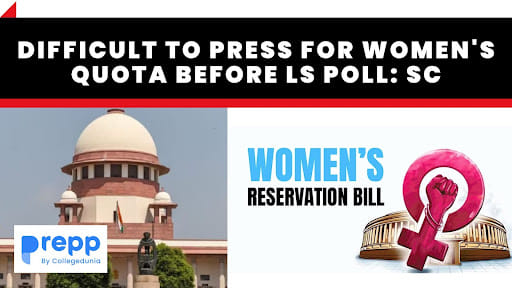
Difficult to Press for Women's Quota Before LS Poll: SC
Click here for Daily Current Affairs
Why in the news?
- The Supreme Court recognizes the constitutional amendment to reserve one-third of the seats for women in Parliament, State legislatures, and the Delhi Legislative Assembly as a commendable move towards gender equality in politics.
- However, the Court expressed reservations about implementing the quota law before the 2024 general elections, citing it as a form of legislation.
Table of Contents
- Context of the Case
- Historical Precedents and Comparison
- Supreme Court's Observation
- What is the Women's Reservation Bill 2023?
- Current Scenario of Women’s Representation in Parliament
- Constitutional Provisions Related to Women's Rights and Their Representation
- Importance of Political Empowerment of Women
- Conclusion
- FAQs
- MCQs
Context of the Case
- The petition challenges a law clause that mandates the quota's implementation post the next Census and delimitation.
- It is argued that constitutional amendments, especially those passed unanimously, shouldn't be delayed.
- The petition challenges a clause in the law stating that the reservation would only be implemented after the next Census followed by a delimitation exercise.
- It posits that delaying the implementation until after these events creates an indefinite postponement, effectively suspending the Act's intentions.
- The clause delaying implementation is "offending" and should be declared "void ab-inito."
- Constitutional amendments should not be deferred without a compelling constitutional violation "ultra-vires".
- It emphasizes the role of women in the democratic process and argues that the immediate implementation of the reservation is aligned with the basic structure and features of the Indian Constitution, including democracy, rule of law, and fair elections.
Historical Precedents and Comparison
- The petition brought up the 73rd and 74th constitutional amendments of 1993, which reserved one-third of the seats for women in local body elections.
- The 77th amendment was cited, which provides reservations for promotions in jobs for Scheduled Castes and Scheduled Tribes.
- Reference was made to the recent 10% EWS reservation for the economically weaker Forward Caste sections in education and jobs, which was implemented without Census data.
Supreme Court's Observation
- The Supreme Court acknowledged that the constitutional amendment to reserve one-third of the seats for women was a positive step for gender parity.
- However, it expressed reservations about the Court's ability to enforce the quota law before the 2024 general election, indicating that doing so would be akin to the judiciary legislating, which is not its role.
- Despite these reservations, the Supreme Court decided to list the case for a hearing on November 22, alongside a similar petition.
What is the Women's Reservation Bill 2023?
- The proposed legislation allocates a third of the parliamentary seats in the Lok Sabha, as well as those in the state legislative assemblies and the Delhi assembly, to women.
- This includes the constituencies designated for SC (Scheduled Castes) and ST (Scheduled Tribes) members.
- Reservation for Women in the Lok Sabha: The Bill suggests the addition of Article 330A to the Constitution, inspired by Article 330, which guarantees seat reservations for SCs/STs in the Lok Sabha.
- It specifies that the reserved seats for women shall be distributed by rotation among various constituencies in the states or Union Territories.
- For constituencies reserved for SCs/STs, the Bill aims to ensure one-third of these seats are earmarked for women on a rotational basis.
- Reservation for Women in State Legislative Assemblies: The Bill proposes Article 332A, which directs that a proportion of seats in each state Legislative Assembly be reserved for women.
- It also dictates that one-third of the seats reserved for SCs and STs are to be set aside for women, and similarly, one-third of all directly elected assembly seats should be held by women.
- Reservation for Women in NCT of Delhi (Amendment to Article 239AA): Article 239AA of the Constitution gives Delhi special status as the national capital in terms of its administration and legislative operations.
- The Bill amends Article 239AA(2)(b) to state that the laws made by Parliament will also apply to the National Capital Territory of Delhi.
- Commencement of Reservation (Introduction of Article 334A): The reservation measures will become applicable after the publication of the next census and subsequent redistricting (delimitation) that allocates reserved seats for women.
- These reservations are set to last for 15 years but could be extended by a parliamentary law.
- Rotation of Seats: The seats designated for women will undergo rotation after each redistricting process, as will be outlined in a future law by Parliament.
Current Scenario of Women’s Representation in Parliament
- As of 2023, the Lok Sabha (lower house) has less than 15% women members, and this gender disparity is more pronounced in some state assemblies where women's representation falls below 10%.
- The total count of women parliamentarians as of 2023 is 102, with 78 in the Lok Sabha out of 542 members and 24 in the Rajya Sabha out of 224 members.
- After the last national election, only around 13% of India's 788 MPs were women, which ranked India 110th in the world for women’s representation in parliament.
Constitutional Provisions Related to Women's Rights and Their Representation
- Article 14: Guarantees “equality before the law” and “equal protection of the laws” to all persons, including women.
- Article 15(1): Prohibits discrimination against any citizen on the grounds of religion, race, caste, sex, or place of birth.
- Article 15(3): Allows the state to make special provisions for women and children, thereby enabling affirmative action in favor of women.
- Article 16: Ensures equality of opportunity for all citizens in matters of employment or appointment to any office under the State. This includes public offices where political representation matters.
- Article 39(a) & (d): Mandates that the State shall direct its policy towards ensuring that men and women have the right to an adequate means of livelihood and equal pay for equal work, respectively.
- Article 243D: Provides reservation of seats in the local bodies of Panchayats and Municipalities for women, ensuring women representation in local governance. This has led to a significant number of women entering the political space at the grassroots level.
- 73rd and 74th Constitutional Amendment Acts (1992): These were significant amendments that provided for the reservation of one-third of seats at the local government level (Panchayats and Municipalities) for women.
Importance of Political Empowerment of Women
- Reflecting Diversity: To have a true representative democracy, the diversity of the population should be mirrored in decision-making bodies.
- Breaking Stereotypes: Women in political roles can challenge societal norms and gender stereotypes, paving the way for greater gender equality.
- Holistic Policies: Women politicians tend to focus more on social welfare, health, and education. Their involvement ensures a more comprehensive approach to development.
- Collaborative Approach: Women often employ a more collaborative and inclusive decision-making style, fostering unity and consensus.
- Upholding Global Standards: Many international conventions and commitments emphasize the importance of women's political participation. Empowering women politically helps nations uphold these standards.
Conclusion
The Supreme Court acknowledges the importance of women's reservations in legislatures for democratic equality. However, the court's hesitation to intervene before the upcoming elections underscores the complexities of implementing constitutional amendments.
(*Click this link to read prelims specific weekly current affairs articles)
FAQs
Question: What is the significance of the Constitution (One Hundred and Sixth Amendment) Act of 2023?
Answer:
The Supreme Court recognized the Constitution (One Hundred and Sixth Amendment) Act of 2023, which reserves one-third of the seats in Parliament, State legislatures, and the Delhi Legislative Assembly for women, as a significant step towards gender parity in Indian politics. The Act is seen as a means to ensure more representation of women in the political arena, which has been a longstanding demand.
Question: What is the significance of 73rd and 74th Constitutional Amendment Act?
Answer:
These were significant amendments that provided for reservation of one-third of seats at the local government level (Panchayats and Municipalities) for women.
UPSC Mains Practice Question:
|
MCQs
Question: Consider the following statements:
- The Women's Reservation Bill proposes to reserve 33% of all seats in the Lok Sabha and state legislative assemblies for women.
- The 73rd and 74th Constitutional Amendments provide for at least one-third reservation for women in local self-governing bodies.
- The National Commission for Women was set up in 1992 to address the issues of women's rights and representation.
How many of the statements given above are correct?
(a) Only one
(b) Only two
(c) All three
(d) None
Answer: (c) See the Explanation
The Women's Reservation Bill, also known as the Constitution (108th Amendment) Bill, proposes to amend the Constitution to reserve 33% of all seats in the Lok Sabha and state legislative assemblies for women. The main aim of this bill is to improve the representation of women in legislative bodies and thereby empower them politically. Hence, statement 1 is correct.
The 73rd and 74th Constitutional Amendments Act, 1992, provide for at least one-third reservation for women in all local self-governing bodies such as Panchayats and Municipalities. These amendments were landmark steps towards ensuring women's participation in local governance, which is crucial for their political empowerment. Hence, statement 2 is correct.
The National Commission for Women (NCW) was set up in January 1992 as a statutory body to review the constitutional and legal safeguards available for women, recommend remedial measures to address the issues affecting women, and facilitate redressal of grievances. It plays a significant role in ensuring women's rights and representation in various fields. Hence, statement 3 is correct.
Therefore, option (c) is the correct answer.
Question: Given below are two statements, one labeled as Assertion(A) and the other labeled as Reason (R) (UPSC 1997)
Assertion (A): Reservation of thirty-three percent of seats for women in Parliament and State Legislature does not require any Constitutional amendment.
Reason (R): Political parties contesting elections can allocate thirty-three percent of seats they contest to women candidates without any Constitutional amendment.
In the context of the above two statements which one of the following is correct?
(a) Both A and R are true and R is the correct explanation of A
(b) Both A and R are true but R is not the correct explanation of A
(c) A is true but R is false
(d) A is false but R is true
Answer: (d) See the Explanation
Reservation of 33% of seats for women in Parliament and state legislatures requires a Constitutional amendment. Recently the Parliament passed the 128th Constitutional Amendment Bill to grant 33% reservation to women in Parliament and state legislative bodies. Hence assertion is incorrect.
However, political parties are not constitutional bodies and can grant 33% of seats to women candidates without the need for a Constitutional amendment. Hence, the reason is correct.
Therefore, option (d) is the correct answer.
Download the PREPP App and attempt FREE IAS Exam Mock Tests and get complete study material!

Full Test - 04: UPSC CSE Prelims CSAT (Paper-II)
Full Test - 03: UPSC CSE Prelims CSAT (Paper-II)
UPSC CSE Prelims 2026 GS Paper 1 Question Paper (24-May-2026)
UPSC CSE Prelims 2026 CSAT Paper 2 Question Paper (24-May-2026)

17 February 2025 | The Hindu Must Read Articles | Current Affairs

16 February 2026 | The Hindu Must Read Articles | Current Affairs

13 February 2026 | The Hindu Must Read Articles | Current Affairs









Comments