Developed Countries To Overshoot Carbon Emissions Goal
Primary Source: The Hindu
Click here for Daily Current Affairs
Prepp Prelims Booster: Carbon Emissions, International Environment Agencies & Agreements
Prepp Mains Booster: Environmental Pollution and Degradation
Why in the news?
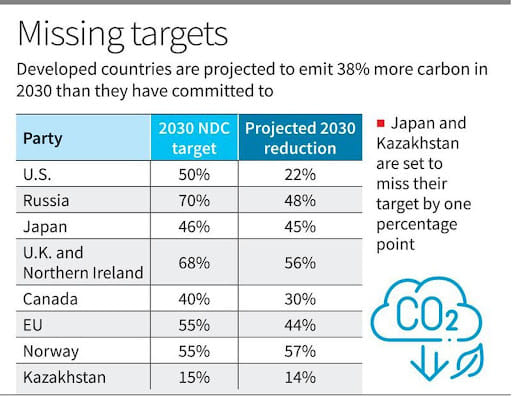
- As per a recent study by the Council for Energy Environment and Water (CEEW), it was highlighted that developed countries are likely to exceed their carbon emission limits set for 2030 by 38% based on current trends.
- 83% of this excess emission is expected from the United States, Russia, and the European Union.
- The UN Framework Convention on Climate Change will conduct its 28th Conference of Parties (COP-28) where countries will report on their Nationally Determined Contributions (NDCs).
Table of Contents
Council for Energy Environment and Water (CEEW)
|
What is UN Framework Convention on Climate Change (UNFCCC)
- The United Nations Framework Convention on Climate Change (UNFCCC) is an international environmental treaty established to combat "dangerous human interference with the climate system," primarily through the stabilization of greenhouse gas concentrations in the Earth's atmosphere at a level that would prevent adverse effects on the climate.
- The UNFCCC was adopted at the Earth Summit in Rio de Janeiro, Brazil, in 1992, and entered into force in 1994.
- Its primary objective is to limit average global temperature increases and the resulting climate change, and to cope with its impacts.
- The UNFCCC's decision-making body, the Conference of the Parties (COP), meets annually to assess progress in dealing with climate change. COP21, held in Paris in 2015, led to the landmark Paris Agreement.
- An agreement within the UNFCCC framework, the Paris Agreement's goal is to limit global warming to well below 2, preferably to 1.5 degrees Celsius, compared to pre-industrial levels. It requires all Parties to put forward their best efforts through "nationally determined contributions" (NDCs) and to strengthen these efforts in the years ahead.
- Parties to the UNFCCC are required to submit regular national reports on emissions and efforts in climate change mitigation and adaptation.
- Before the Paris Agreement, the Kyoto Protocol was adopted in 1997 under the UNFCCC, with binding obligations on industrialized countries to reduce greenhouse gas emissions.
- The UNFCCC plays a critical role in tracking the efforts of nations in addressing climate change, facilitating international cooperation, and holding states accountable to their commitments to reduce carbon emissions and support global climate initiatives.
What are Nationally Determined Contributions (NDCs)?
- Nationally Determined Contributions (NDCs) are central to the Paris Agreement, a landmark accord adopted by countries that are party to the UN Framework Convention on Climate Change (UNFCCC).
- NDCs embody the efforts by each country to reduce national emissions and adapt to the impacts of climate change.
- NDCs are prepared by countries based on their national priorities, circumstances, and capabilities.
- These often include targets for reducing greenhouse gas emissions by a certain year. They may specify economy-wide reductions or focus on specific sectors like energy, transportation, or agriculture.
- Every five years, countries are expected to submit updated NDCs that are meant to represent a progression beyond the previous ones, reflecting the highest possible ambition as defined by the Paris Agreement.
- The UNFCCC conducts a regular "global stocktake" to assess collective progress towards achieving the purpose of the Paris Agreement and inform the updating of NDCs.
- NDCs are key to achieving the long-term goals of the Paris Agreement, including holding the increase in the global average temperature to well below 2°C above pre-industrial levels.
- NDCs reflect the principle of "common but differentiated responsibilities and respective capabilities" that is foundational to the UNFCCC, acknowledging that developed countries should take the lead in mitigation efforts and support developing countries.
Important Statistical Data
|
Developed Nations Falling Short on Climate Targets
- Insufficient Targets: They aim for a collective 36% reduction in emissions, which is below the 43% reduction level needed to prevent a temperature rise above 1.5°C.
- Unplanned Reductions: The emission cuts that have occurred were not entirely due to deliberate actions to reduce greenhouse gases but were significantly influenced by the global economic slowdown caused by the COVID-19 pandemic.
- Postponement of Action: There is a tendency among developed countries to delay substantial emission reductions until after 2030, with plans to make deeper cuts closer to the 2050 net zero target.
- Over-Reliance on Future Measures: Developed countries' projections are based on achieving significant future reductions without clear year-on-year reduction plans in the current decade, which is crucial for meeting their long-term goals.
- Shifting Responsibility: Developed countries' lack of substantial emission reductions means the burden of mitigating global warming is shifting to developing countries.
- Financial Commitments Unfulfilled: There is an inadequacy of financial support from developed countries for renewable energy infrastructure in developing countries, which is essential for a global transition away from fossil fuels.
- Complex Negotiations: There is also a complex debate about the extent and speed of transitioning away from fossil fuels, with developed countries pointing out that large developing nations like India and China also need to make significant cuts.
Postponing the Timeline for Achieving Net Zero Carbon Emissions
The following are some of the reasons why developed countries have set 2050 as the timeline for achieving net zero carbon emissions:
- Intermediate Goals Misaligned with Long-term Objectives: Developed countries have established targets for 2030 that fall significantly short of the necessary reductions to limit warming to 1.5°C, with most planning major cuts only after 2030.
- Current Emissions Trajectories: The analysis by CEEW indicates that current emissions trajectories for developed countries are not on track to meet even their 2030 targets, let alone earlier net zero ambitions.
- Historical Emissions and Promises: The actual emissions reductions in the past have often been due to unintended consequences like the economic slowdown during the COVID-19 pandemic, rather than through planned exercises to cut emissions. This has possibly led to a lack of immediate and aggressive policy implementations that are required for an earlier net zero target.
- Economic and Political Challenges: Achieving net zero requires transformative changes in the economy, infrastructure, and societal behavior, which can be politically challenging and may face resistance from various stakeholders, including industries and the public. A 2050 timeline may be viewed as more politically feasible and economically manageable.
- Technological and Financial Optimism: There may be an expectation that future technological advancements will make it easier and more cost-effective to reduce emissions at a faster rate in the future.
- The Burden-Shifting Debate: The postponement to 2050 is seen as a move that shifts the burden of mitigating climate change to developing countries, who argue they are less responsible for historical emissions and should therefore receive financial support to make their own transitions.
What is Net Zero Carbon Emission?
|
Shifting the Burden: An Ongoing Debate
Responsibility for Emissions
- Developing nations emphasize that developed countries are responsible for the majority of historical carbon emissions and should therefore lead in making significant cuts.
Transitioning to Renewable Energy
- Developing countries are pressing for financial and technical support from developed nations to help them transition to renewable energy sources.
- They argue that the developed countries should not only make their own transition away from fossil fuels more rapidly but also compensate developing countries for their transition.
Fairness and Equity
- Developing nations believe that the burden of mitigating climate change is being unfairly shifted onto them, despite their relatively smaller contribution to historical emissions.
Financial Support
- There is a contention over the promised financial aid from developed countries, which is deemed insufficient and not delivered as pledged.
- Developing countries need this support to build renewable-energy infrastructure, which is critical for their sustainable development and transition away from fossil fuels.
Ambition and Commitment
- Developed countries are criticized for not setting or adhering to ambitious enough targets to meet the global emissions reduction goals.
- There is a call for developed countries to devise clear, yearly reduction plans and remain committed to international agreements such as the Paris Agreement.
Shared Responsibility
- On the other hand, developed countries point out that large developing countries, like India and China, also have a significant role in the global emissions scenario and should engage in more aggressive emission reduction strategies.
Expectations for Future Cuts
- There is skepticism about developed countries’ intentions to make deeper emission cuts only after 2030, which appears overly ambitious based on their historical performance.
Conclusion
One main concern in global climate discussions is the transition rate away from fossil fuels. Developed countries are mainly responsible for carbon emissions and should financially assist developing countries in this transition. There's a call for developed countries to establish reliable year-on-year reduction plans and remain faithful to international climate commitments like the Paris Agreement.
(*Click this link to read prelims specific weekly current affairs articles)
FAQs
Question: What is UN Framework Convention on Climate Change (UNFCCC)?
Answer:
The United Nations Framework Convention on Climate Change (UNFCCC) is an international environmental treaty established to combat "dangerous human interference with the climate system," primarily through the stabilization of greenhouse gas concentrations in the Earth's atmosphere at a level that would prevent adverse effects on the climate. The UNFCCC was adopted at the Earth Summit in Rio de Janeiro, Brazil, in 1992, and entered into force in 1994.
Question: What is net zero carbon emissions?
Answer:
Net Zero Carbon Emission, often referred to simply as "Net Zero," is a state in which a country, company, or individual achieves a balance between the amount of greenhouse gas emissions produced and the amount removed from the atmosphere. At its core, achieving Net Zero involves drastically reducing existing carbon emissions from sources such as electricity production, transportation, industry, and agriculture.
Question: What are Nationally Determined Contributions (NDCs)?
Answer:
Nationally Determined Contributions (NDCs) are central to the Paris Agreement, a landmark accord adopted by countries that are party to the UN Framework Convention on Climate Change (UNFCCC). NDCs embody the efforts by each country to reduce national emissions and adapt to the impacts of climate change. NDCs are prepared by countries based on their national priorities, circumstances, and capabilities.
UPSC Mains Practice Question:
|
MCQs
Question: Consider the following statements: (UPSC 2023)
Statement-I: Carbon markets are likely to be one of the most widespread tools in the fight against climate change.
Statement-II: Carbon markets transfer resources from the private sector to the State.
Which one of the following is correct in respect of the above statements?
(a) Both Statement-I and Statement-II are correct and Statement-II is the correct explanation for Statement-I
{b) Both Statement-I and Statement-II are correct and Statement-II is not the correct explanation for Statement-I
(c) Statement-I is correct but Statement-II is incorrect
(d) Statement-I is incorrect but Statement-II is correct
Answer: (c) See the Explanation
Carbon markets are widely regarded as one of the most effective strategies in the battle against climate change. Hence, statement 1 is correct.
Carbon markets operate on the carbon pricing principle, which seeks to assign a monetary value to carbon dioxide (CO2) emissions. The main concept is to establish a market for trading carbon credits or permits in which corporations or institutions that emit greenhouse gases can purchase or sell these permits.
Carbon markets seek to create economic incentives for decreasing greenhouse gas emissions. Companies that can reduce their emissions more efficiently and cheaply can sell their excess permits to companies who find it more costly to reduce emissions. This provides enterprises with a financial incentive to embrace greener technology, enhance energy efficiency, and minimize their carbon footprint.
Carbon markets offer a flexible and market-driven strategy to reducing emissions. They support the adoption of cleaner technology, promote investments in renewable energy, and incentivize emission reduction initiatives across all sectors of the economy by putting a price on carbon.
It is not correct to suggest that carbon markets move resources from the private to the public sector. Carbon markets, in fact, work on the idea of establishing a market-based mechanism through which the private sector can participate in emissions trading and accept responsibility for their carbon emissions. Hence, statement 2 is incorrect.
Therefore, option (c) is the correct answer.
Question: “Climate Action Tracker” which monitors the emission reduction pledges of different countries is a: (UPSC 2022)
(a) Database created by coalition of research organisations
(b) Wing of “International Panel of Climate Change”
(c) Committee under “United Nations Framework Convention on Climate Change”
(d) Agency promoted and financed by United Nations Environment Programme and World Bank
Answer: (a) See the Explanation
The Climate Action Tracker (CAT) is an impartial scientific analysis that follows government climate action and compares it to the Paris Agreement's goal of "holding warming well below 2°C and pursuing efforts to limit warming to 1.5°C." Since 2009, the CAT, a collaboration of two organizations, Climate Analytics and NewClimate Institute, has provided this impartial study to policymakers. The Climate Action Tracker (CAT) initiative aims to give policymakers, civil society, and the media with an up-to-date assessment of countries' specific reduction targets as well as an overview of their combined global effects.
Therefore, option (a) is the correct answer.
Question: The ‘Common Carbon Metric’, supported by UNEP, has been developed for: (UPSC 2021)
(a) assessing the carbon footprint of building operations around the world
(b) enabling commercial farming entities around the world to enter carbon emission trading
(c) enabling governments to assess the overall carbon footprint caused by their countries
(d) assessing the overall carbon foot-print caused by the use of fossil fuels by the world in a unit time
Answer: (a) See the Explanation
The Common Carbon Metric is a computation that is used to describe the measurement, reporting, and verification of GHG emissions linked with the operation of specific building types in specific climate areas. It lays the groundwork for realistic performance baselines, national targets, and carbon trading on a fair playing field.
The goal of a Common Carbon Metric for Buildings is to provide information to a sector that accounts for 40% of worldwide energy consumption and a third of global greenhouse gas (GHG) emissions.
Therefore, option (a) is the correct answer.
Question: “Momentum for Change: Climate Neutral Now” is an initiative launched by: (UPSC 2018)
(a) The Intergovernmental Panel on Climate Change
(b) The UNEP Secretariat
(c) The UNFCCC Secretariat
(d) The World Meteorological Organisation
Answer: (c) See the Explanation
In 2015, the UNFCCC secretariat established the Climate Neutral Now project. It is a campaign that encourages individuals, businesses, and governments to assess their carbon footprint and cut their greenhouse gas emissions as much as feasible.
As part of a bigger effort to highlight successful climate action around the world, the secretariat introduced a new pillar within its Momentum for Change campaign centered on Climate Neutral Now in 2016.
Climate neutrality is a three-step procedure that requires individuals, businesses, and governments to: measure their carbon footprint; decrease emissions as much as possible; and offset what they can't lower with UN-certified emission reductions.
Therefore, option (c) is the correct answer.
Question: The term ‘Intended Nationally Determined Contributions’ is sometimes seen in the news in the context of: (UPSC 2016)
(a) pledges made by the European countries to rehabilitate refugees from the war-affected Middle East
(b) plan of action outlined by the countries of the world to combat climate change
(c) capital contributed by the member countries in the establishment of Asian Infrastructure Investment Bank
(d) plan of action outlined by the countries of the world regarding Sustainable Development Goals
Answer: (b) See the Explanation
Intended Nationally Determined Contributions (INDCs) represent each country's efforts to reduce national emissions and adapt to climate change impacts. The United Nations Framework Convention on Climate Change (UNFCCC) uses the phrase "intended nationally determined contributions" (INDCs).
INDCs are parties' post-2020 climate action commitments to strengthen their ability to adapt to the adverse effects of climate change, develop climate resilience, and reduce greenhouse gas emissions.
Therefore, option (b) is the correct answer.
Download the PREPP App and attempt FREE IAS Exam Mock Tests and get complete study material!

Full Test - 04: UPSC CSE Prelims CSAT (Paper-II)
Full Test - 03: UPSC CSE Prelims CSAT (Paper-II)
UPSC CSE Prelims 2026 GS Paper 1 Question Paper (24-May-2026)
UPSC CSE Prelims 2026 CSAT Paper 2 Question Paper (24-May-2026)

17 February 2025 | The Hindu Must Read Articles | Current Affairs

16 February 2026 | The Hindu Must Read Articles | Current Affairs

13 February 2026 | The Hindu Must Read Articles | Current Affairs









Comments