Daimabad - Indus Valley Civilisation - Ancient India History Notes
Daimabad is an abandoned settlement and an Indus Valley Civilization archaeological site in Maharashtra, India, on the left bank of the Pravara River, a tributary of the Godavari River. Late Harappan civilisation may have spread into India's Deccan Plateau, according to findings at Daimabad. This article will explain to you the Daimabad which will be helpful in Ancient History preparation for the UPSC Civil Service exam.
|
Table of Contents |
Daimabad
- In 1958, B.P. Bopardikar found Daimabad.
- Archaeological Survey of India teams have excavated the site three times thus far.
- M.N. Deshpande directed the initial excavation, which took place between 1958 and 1959.
- In 1974-75, S.R. Rao conducted the second excavation. Finally, from 1975 to 1978, S.A. Sali directed the excavations.
- Late Harappan civilization may have reached India's Deccan Plateau, according to discoveries at Daimabad.
- Many bronze objects were discovered in Daimabad, some of which were inspired by Harappan culture.
|
|
|
|---|---|
| Mohenjodaro | Banawali |
| Kalibangan | Chanhudaro |
| Lothal | Surkotada |
| Dholavira | Harappa |
| Ropar | Rangpur |
Daimabad - Features
- Daimabad is a Chalcolithic or copper-age site (2200-1000 BCE) on the left bank of the Pravara, a tributary of the Godavari in present-day Maharashtra's Ahmednagar district.
- Daimabad was discovered to be Maharashtra's biggest chalcolithic site, with evidence suggesting the site's last occupant abandoned it at the start of the first millennium BCE.
- Since then, there has been no human presence on the property.
- The bronze sculpture of a man riding a chariot driven by bulls known as the Daimabad man is one of the most important findings at the site.
- The sculpture is intricate and is 45 cm long by 16 cm broad. It portrays a guy riding a magnificent chariot drawn by two bulls.
- The chariot's two wheels are solid, and a dog stands on the middle pole directly in front of the guy.
- The platform on which the guy stands is truncated and oval in shape, with a pair of birds facing opposite directions on either side of him.
- These are stylistically similar to the clay bird whistles discovered in Harappan sites.
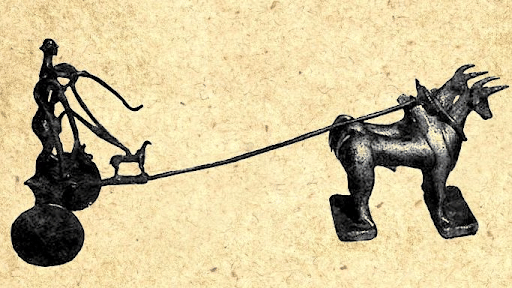
Daimabad Man
Daimabad - Artefacts
- This period's pottery was black-on-buff-and-cream ware, primarily slow-wheel-made ceramics with fast-wheel-turned instances.
- It was coated with thin slip on the outside, which peeled off in spots, then painted black with mostly geometric motifs.
- Copper Rhinoceros, Copper Elephant, and Copper Chariot were among the sculptures discovered in Daimabad.
- The major artefacts from this era include microlithic blades, bone tools, a solitary piece of worked elephant tusk, beads, and a few remnants of graded terracotta rings used as measuring instruments.
- The remains of a copper-smelting furnace were discovered.
- Three types of graves were discovered during this phase: one pit burial, one post-cremation urn burial, and one symbolic burial.
Conclusion
Daimabad is an abandoned village and an archaeological site from the Indus Valley Civilization. In Daimabad, several metal artefacts were uncovered, some of which were influenced by Harappan culture. According to finds at Daimabad, the late Harappan civilisation may have extended into India's Deccan Plateau.
|
|
|
|---|---|
| Ancient History Notes | Indus Valley Civilisation |
| Decline of indus valley Civilisation | Phases of IVC |
| Town Planning & Structures of Harappa Civilization | Society and Culture of Indus Valley Civilization |
| Religious Practises of Indus Valley Civilization | Economy during Indus Valley Civilization |
| Early Vedic Period or Rig Vedic Period (1500 BC – 1000 BC) | Foreign Accounts of ancient travellers |
| Ancient Inscriptions | Pre mauryan age |
| Language in Ancient India | Literary Sources of Ancient India |
FAQs
Question: What is the significance of Daimabad in the context of the Indus Valley Civilization?
Answer: Daimabad is an important archaeological site associated with the late Harappan phase of the Indus Valley Civilization. It is located in Maharashtra and is notable for revealing bronze artifacts, suggesting the extensive spread and influence of Harappan culture beyond its traditional boundaries.
Question: What notable artifacts have been found at Daimabad?
Answer: Excavations at Daimabad have uncovered significant artifacts, including bronze sculptures of a chariot, an elephant, a rhinoceros, and a buffalo. These artifacts highlight the advanced metallurgical skills and artistic expressions of the Harappan people.
Question: How did the discoveries at Daimabad influence our understanding of the Indus Valley Civilization?
Answer: The discoveries at Daimabad expanded the known geographical extent of the Indus Valley Civilization, showing that its cultural and technological influence reached farther south than previously thought. This site also indicated trade and cultural exchange with other regions.
Question: When were the major excavations at Daimabad conducted?
Answer: Major excavations at Daimabad were conducted in the 1970s, led by archaeologists such as B.B. Lal and S.R. Rao. These excavations yielded numerous findings that contributed to the understanding of late Harappan society.
Question: What is the importance of the bronze artifacts found at Daimabad?
Answer: The bronze artifacts found at Daimabad, such as the chariot and animal figures, demonstrate the advanced metallurgical practices of the time. These objects are significant because they showcase the craftsmanship and artistic capabilities of the Harappan people.
MCQs
1. Where is Daimabad, a significant site of the Indus Valley Civilization, located?
A) Gujarat
B) Punjab
C) Maharashtra
D) Rajasthan
Answer: (C) See the Explanation
Explanation: Daimabad is located in Maharashtra and is associated with the late Harappan phase of the Indus Valley Civilization. It is an important site for understanding the civilization’s spread to southern regions.
2. What notable bronze artifact was discovered at Daimabad?
A) Bronze statue of a priest-king
B) Bronze chariot
C) Bronze seals with inscriptions
D) Bronze tools
Answer: (B) See the Explanation
Explanation: A notable bronze chariot along with other animal figurines were discovered at Daimabad, showcasing the metallurgical expertise of the late Harappan period.
3. During which period were the major excavations at Daimabad conducted?
A) 1920s
B) 1950s
C) 1970s
D) 2000s
Answer: (C) See the Explanation
Explanation: Major excavations at Daimabad were carried out in the 1970s under the supervision of archaeologists like B.B. Lal and S.R. Rao, revealing significant findings.
4. What do the findings at Daimabad suggest about the Harappan civilization?
A) It was confined to the Indus region only
B) It had no trade relations with other regions
C) Its cultural influence extended to southern India
D) It lacked metallurgical skills
Answer: (C) See the Explanation
Explanation: The findings at Daimabad suggest that the cultural and technological influence of the Harappan civilization extended to southern India, indicating a broader geographical spread than previously thought.
5. What type of artifacts were predominantly found at Daimabad?
A) Pottery with inscriptions
B) Bronze sculptures
C) Stone tools
D) Gold ornaments
Answer: (B) See the Explanation
Explanation: Bronze sculptures, including a chariot and animal figures, were predominantly found at Daimabad, highlighting the craftsmanship and metallurgical skills of the Harappan people.
GS Mains Questions and Model Answers
Q1: Discuss the archaeological significance of Daimabad in understanding the later phases of the Indus Valley Civilization.
Answer: Daimabad, located in Maharashtra, holds significant archaeological value for understanding the later phases of the Indus Valley Civilization. This site, excavated extensively in the 1970s, revealed bronze artifacts such as a chariot and animal figurines that showcase advanced metallurgical skills. The presence of these artifacts indicates that the influence of the Harappan civilization extended farther south than previously believed. Daimabad's findings suggest that trade networks, cultural exchange, and technological advancements were prevalent during the late Harappan period. This site has helped historians and archaeologists piece together the broader geographical spread and interactions of the Harappan people, contributing to a more comprehensive understanding of their society and economy.
Q2: Evaluate the impact of the findings at Daimabad on our knowledge of Harappan metallurgy and art.
Answer: The findings at Daimabad have greatly enhanced our understanding of Harappan metallurgy and art. The discovery of bronze artifacts, including a chariot and animal sculptures, highlights the advanced metallurgical techniques employed by the Harappan civilization. These artifacts showcase the high level of craftsmanship and artistic expression prevalent during the late Harappan phase. The intricate designs and use of bronze indicate that the Harappans had a well-developed understanding of metalworking and artistic aesthetics. Such findings provide valuable insights into the technological and cultural aspects of the civilization, demonstrating their capability to create sophisticated art pieces and functional items.
Q3: Analyze the role of Daimabad in expanding the known geographical boundaries of the Indus Valley Civilization.
Answer: Daimabad played a crucial role in expanding the known geographical boundaries of the Indus Valley Civilization. Situated in Maharashtra, its discovery demonstrated that the influence of the Harappan culture extended beyond the traditional northwestern region of the Indian subcontinent. The presence of artifacts like the bronze chariot and animal figurines indicated that there was significant cultural and technological dissemination towards the south. This finding challenges earlier assumptions about the limited reach of the Harappan civilization and highlights the possibility of trade networks and cultural interactions with other regions. Thus, Daimabad serves as evidence of the broader influence and connectivity of the Indus Valley people.
Previous Year Questions on Daimabad
1. UPSC CSE Prelims 2017:
Question: Daimabad, an archaeological site, is associated with which ancient civilization?
A) Mauryan
B) Gupta
C) Indus Valley Civilization
D) Vedic Civilization
Answer: (C)
Explanation: Daimabad is associated with the late Harappan phase of the Indus Valley Civilization and has yielded significant findings like bronze sculptures.
2. UPSC CSE Mains 2018 (GS Paper 1):
Question: "Assess the significance of regional archaeological sites like Daimabad in understanding the spread and diversity of the Indus Valley Civilization."
Answer: Regional archaeological sites like Daimabad are pivotal in understanding the spread and diversity of the Indus Valley Civilization. Daimabad, located in Maharashtra, revealed evidence of advanced bronze artifacts, indicating that the Harappan cultural and technological influence extended to southern India. This finding challenges the traditional view of the civilization's geographical limits and suggests extensive trade and cultural exchange. The artifacts showcase the civilization's technological prowess and artistic capabilities. Such regional sites highlight the complexity and interconnected nature of the Indus Valley Civilization, contributing to a more nuanced understanding of its reach and impact.
Download the PREPP App and attempt FREE IAS Exam Mock Tests and get complete study material!

Full Test - 04: UPSC CSE Prelims CSAT (Paper-II)
Full Test - 03: UPSC CSE Prelims CSAT (Paper-II)
UPSC CSE Prelims 2026 GS Paper 1 Question Paper (24-May-2026)
UPSC CSE Prelims 2026 CSAT Paper 2 Question Paper (24-May-2026)

17 February 2025 | The Hindu Must Read Articles | Current Affairs

16 February 2026 | The Hindu Must Read Articles | Current Affairs

13 February 2026 | The Hindu Must Read Articles | Current Affairs









Comments