Cyber Law – Science & Technology Notes
Cyber law refers to the legal issues associated with the use of communications technology, specifically "cyberspace," or the Internet. It is a nexus of many legal fields, including intellectual property, privacy, freedom of expression, and jurisdiction. In essence, cyber law is an attempt to reconcile the challenges posed by human activity on the Internet with the legacy legal system that governs the physical world. In this article, we will discuss in detail regarding Cyber Law which will be helpful for UPSC exam preparation.
Table of Contents
What is Cybercrime?
- A cybercrime is any criminal activity that involves a computer, networked device, or other related device.
- Some cybercrimes are committed with the intent of generating profit for the cybercriminals, whereas others are committed with the intent of directly damaging or disabling the computer or device.
- Others may also use computers or networks to spread malware, illegal information, images, or any other type of material.
- Many types of profit-driven criminal activities can be perpetrated as a result of cybercrime, including ransomware attacks, email and internet fraud, identity theft, and frauds involving financial accounts, credit cards, or any other payment card.
- Cybercriminals may seek to steal and resell personal and corporate data.
- Because of the Internet's anonymity, it is possible to engage in a wide range of criminal activities with impunity, and intelligent people have been grossly misusing this aspect of the Internet to perpetuate criminal activities in cyberspace.
- There are two types of cybercrime:
- The Computer as a Target: Using one computer to attack another. For example, hacking, virus/worm attacks, DOS attacks, and so on.
- Using a computer as a weapon: Using a computer to commit real-life crimes. For example, cyber terrorism, IPR violations, credit card fraud, EFT fraud, pornography, and so on.
| Other Relevant Links | |
|---|---|
| NASA: Asteroid impact and deflection assessment mission | Commercial use of Lithium-Ionbattery technology |
| Hyperspectral imaging satellite | Water propulsion system in CUBESAT |
| Neutrino Observatory | Indian Space Vision-2025 |
| Major Policy Initiatives National Optical Fibre network | Spectrum Management |
| Internet, Types of Network and e- Governance | Spectrum Policy in India |
| Mobile Spectrum | Cloud Computing |
| Big Data | Encryption |
| Biometrics | Virtual Reality |
| Cybercrime | Description |
|---|---|
| Child Pornography |
|
| Hacking |
|
| Virus Dissemination |
|
| Card Fraud/Phishing |
|
| Spoofing |
|
| Cyber Stalking |
|
| Email Bombing |
|
| Virus Attacks |
|
| Logic Bombs |
|
| Trojan Attacks |
|
| Cyber Squatting |
|
| Cyber Defamation |
|
| DNS Spoofing |
|
| Dumpster Diving |
|
| Keystroke Logging |
|
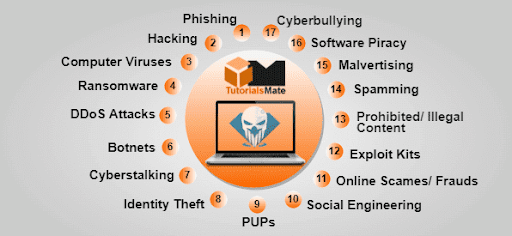
Types of Cybercrime
What is Cyber Law?
- Cyber law refers to the area of the legal system that is related to legal informatics and regulates electronic information exchange, e-commerce, software, and information security.
- It is linked to legal informatics as well as electronic components such as computers, software, hardware, and information systems.
- It addresses a wide range of issues, including online privacy and freedom of expression, as well as Internet access and use.
- In essence, cyber law is an attempt to reconcile the challenges posed by human activity on the Internet with the legacy legal system that governs the physical world.
- The Information Technology Act of 2000 and the Indian Penal Code of 1860 both cover cybercrime in India.
- It is the Information Technology Act of 2000 that addresses cybercrime and electronic commerce.
- However, in 2008, the Act was amended to include a definition and punishment for cybercrime.
- Several amendments were also made to the Indian Penal Code 1860 and the Reserve Bank of India Act.
Main Areas of Cyber Law
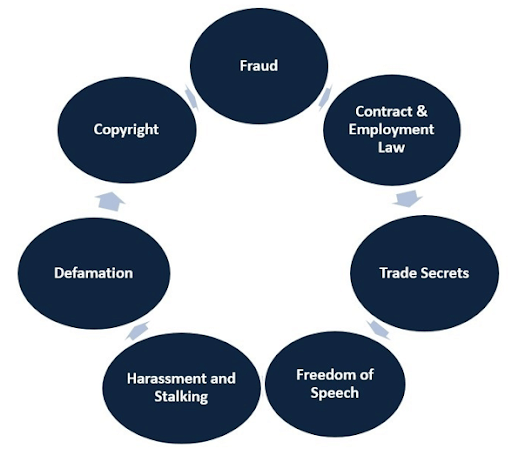
1) Fraud
- Consumers rely on cyber laws to keep them safe from online fraud. Laws are enacted to combat identity theft, credit card fraud, and other financial crimes committed online.
- Identity theft may result in confederate or state criminal charges. They may also come across a civil action brought by a victim.
- Cyber lawyers work to defend and prosecute against allegations of internet fraud.
2) Copyright
- The internet has made it easier to violate intellectual property rights. Copyright violations were all too common in the early days of online communication.
- In order to impose copyright protections, both businesses and individuals must hire lawyers.
- Copyright infringement is a branch of cyber law that protects individuals' and businesses' rights to profit from their creative works.
3) Defamation
- When people use the internet to spread false information, it can cross the line into defamation.
- Defamation laws are civil laws that protect individuals from false public statements that can harm a company's or an individual's reputation.
- Defamation law applies when people use the internet to make statements that violate civil laws.
4) Harassment and Stalking
- Online statements can sometimes violate criminal laws that prohibit harassment and stalking.
- When a person repeatedly makes threatening statements about another person online, both civil and criminal laws are violated.
- Cyber lawyers prosecute and defend people who are stalked via the internet or other forms of electronic communication.
5) Freedom of Speech
- Freedom of expression is an important aspect of cyber law. Even though cyber laws prohibit certain online behaviours, freedom of speech laws allow people to express themselves.
- Cyber attorneys must advise their clients on the boundaries of free speech, including laws prohibiting obscenity.
- Cyber lawyers may also defend their clients when the question of whether their actions constitute permissible free speech is raised.
6) Trade Secrets
- Companies that conduct business online frequently rely on cyber laws to protect their trade secrets.
- Google and other online search engines, for example, spend a significant amount of time developing the algorithms that produce search results.
- They also devote significant time to developing other features such as maps, intelligent assistance, and flight search services, to name a few.
- Cyber laws enable these businesses to take legal action as needed to safeguard their trade secrets.
7) Contract & Employment Law
- You have violated cyber law every time you click a button that says you agree to the terms and conditions of using a website.
- Every website has terms and conditions that are related to privacy concerns in some way.
Cyber Law in India
- Every year, over 44,000 cases of cybercrime are reported in India. Karnataka ranks first among Indian states in terms of cybercrime rates.
- According to a 2022 report, the average cost of data breaches in India was USD 2 million. This monetary impact reflects the financial consequences of data breach incidents.
- In India, cyber law is governed by two key pieces of legislation: the Indian Penal Code and the Information Technology Act of 2000.
- These legal frameworks establish the guidelines and provisions required to combat cybercrime and protect digital assets and individuals' rights in cyberspace.
- The main goal of this Act is to ensure the legal protection of eCommerce by making it simple to register real-time records with the government.
- A number of changes were made as a result of the sophistication of cybercriminals and people's proclivity to abuse technology.
- The ITA emphasises the harsh penalties and fines imposed by the Indian Parliament to safeguard the e-government, e-banking, and e-commerce industries.
- ITA's scope has been broadened to include all modern communication devices.
- Indian cyber laws address a wide range of cybercrimes, with two main areas of focus: hacking systems and using them to commit crimes of varying severity.
- Furthermore, Indian cyber law covers a wide range of domains, including intellectual property rights and privacy rights, among others.
- The following are the most relevant sections of the IPC that address cyber frauds:
- Section 464 - Fraud
- Section 465 - False documentation
- Section 468 - Premeditated forgery used to cheat
- Section 469 - Damage to reputation
- Section 471 - Trying to pass off a fake document as a real one
Information Technology Act, 2000 – Salient Features
- The IT Act 2000 and its provisions have many positive aspects in terms of e-commerce in India.
- The implications of these provisions for e-businesses are that email is now a valid and legal form of communication in our country that can be produced and approved in a court of law.
- Companies can now conduct electronic commerce by utilising the legal infrastructure provided by the Act.
- The Act grants legal validity and sanction to digital signatures.
- The Act allows corporate entities to operate as Certifying Authorities for the purpose of issuing Digital Signature Certificates.
- The Act now allows the government to issue notifications via the internet, ushering in e-governance.
- The Act allows companies to file any form, application, or other document in electronic form with any office, authority, body, or agency owned or controlled by the appropriate Government using any electronic form prescribed by the appropriate Government.
- The IT Act also addresses the critical security issues that are critical to the success of electronic transactions.
- The Act provides a legal definition for the concept of secure digital signatures, which must be passed through a system of a security procedure as specified by the government at a later date.
- Under the IT Act of 2000, corporations will now have a statutory remedy if someone breaks into their computer systems or network and causes damage or copies data. The Act provides a remedy in the form of monetary damages not exceeding Rs. 1 crore.
Information Technology Act, 2000 – Important Sections
| Section 65 – Tampering with computer source documents | A person who intentionally conceals, destroys, or modifies any computer source code (such as programmes, computer commands, design, and layout) when it is required by law commits an offence punishable by three years in prison, a fine of two lakh rupees, or both. |
| Section 66 – Using password of another person | If a person fraudulently uses another person's password, digital signature, or other unique identification, he or she faces up to three years in prison or a fine of one lakh. |
| Section 66D – Cheating using computer source | If a person defrauds someone by using a computer or a communication device, he or she may face imprisonment for up to three years or a fine of up to one lakh. |
| Section 66E – Publishing private images of others | If a person captures, transmits, or publishes images of another person's private parts without his/her consent or knowledge, the person faces up to 3 years in prison or a fine of up to 2 lakh, or both. |
| Section 66F – Acts of cyber terrorism | A person faces life in prison if he or she denies an authorised person access to a computer resource or attempts to penetrate/access a computer resource without authorization in order to threaten the nation's unity, integrity, security, or sovereignty. This is not a bailable offence. |
| Section 67 – Publishing Child Porn or predating children online | If a person captures, publishes, or transmits images of a child in a sexually explicit act, or induces anyone under the age of 18 into a sexual act, the person faces up to 7 years in prison or a fine of up to ten lakh or both. |
| Section 69 – Govt.’s Power to block websites | In the interest of India's sovereignty and integrity, the government may intercept, monitor, or decrypt any information generated, transmitted, received, or stored in any computer resource. The authority is subject to procedure compliance. The central government can also restrict public access to information under Section 69A. |
| Section 43A – Data protection at corporate level | If a body corporate is negligent in implementing reasonable security practises, resulting in wrongful loss or gain to any person, the body corporate is liable to pay damages to the affection person. |
Conclusion
As a result of the new dimension that computers bring to criminal law, law enforcement faces a variety of challenges. The need for adequate training to combat these crimes is high on the priority list of law enforcement. New methodologies necessitate a higher level of technical sophistication than previous research techniques. Data is encrypted in some cases, making it more difficult for law enforcement to access the information's contents. Businesses may be concerned about the negative publicity that a system compromise could generate. Despite the fact that not everyone is a victim of cybercrime, they are all at risk.
| Other Relevant Links | |
|---|---|
| Science & Technology Policy in India | Scientific Policy Resolution 1958 |
| Science & Technology Policy of 1983 | Science & Technology Policy of 2003 |
| Science, Technology and Innovation Policy 2013 | New Initiatives Aligned with the National Agenda |
| India and World collaboration in science projects | Technology Vision Document 2035 |
FAQs
Question: What is Cyber Law?
Answer: Cyber Law is a branch of law that deals with the regulation of activities in cyberspace, addressing issues such as internet crime, intellectual property, data protection, and privacy rights.
Question: Why is Cyber Law important?
Answer: Cyber Law is crucial to ensure the legal protection of digital assets, combat cybercrime, and safeguard individuals' privacy and intellectual property rights in the online world.
Question: What are the main components of Cyber Law?
Answer: The main components include electronic contracts, digital signatures, data protection laws, cybercrimes, and intellectual property rights in cyberspace.
Question: Which Act governs Cyber Law in India?
Answer: In India, the Information Technology Act, 2000 (IT Act, 2000) is the primary legislation governing cyber laws, addressing various aspects of electronic commerce, digital signatures, and cybercrimes.
Question: What is the role of CERT-In in Cyber Law enforcement in India?
Answer: The Indian Computer Emergency Response Team (CERT-In) is responsible for coordinating responses to cyber incidents, advising on cybersecurity measures, and assisting in the enforcement of cyber laws in India.
MCQs
1. What is the primary objective of Cyber Law?
A) To protect intellectual property in cyberspace
B) To regulate internet usage
C) To combat cybercrime and protect digital rights
D) To manage e-commerce transactions
Answer: (C) See the Explanation
Explanation: The primary objective of Cyber Law is to combat cybercrime, protect digital rights, and ensure legal protection for electronic transactions and communication.
2. Which of the following is a key component of Cyber Law?
A) Internet censorship
B) Regulation of social media platforms
C) Intellectual property rights in cyberspace
D) E-commerce taxation
Answer: (C) See the Explanation
Explanation: Intellectual property rights in cyberspace, such as patents, trademarks, and copyrights, are a key component of Cyber Law to protect digital content and online businesses.
3. What does the Information Technology Act, 2000 address in India?
A) Regulation of online content
B) Protection of personal data
C) E-commerce and digital signatures
D) Control of the internet
Answer: (C) See the Explanation
Explanation: The Information Technology Act, 2000 (IT Act, 2000) addresses issues such as e-commerce, digital signatures, cybercrimes, and the legal recognition of electronic documents in India.
4. Which agency is responsible for cybersecurity and cyber law enforcement in India?
A) Indian Cyber Crime Cell
B) CERT-In (Indian Computer Emergency Response Team)
C) Ministry of IT
D) CBI Cybercrime Department
Answer: (B) See the Explanation
Explanation: CERT-In is the national agency responsible for addressing cybersecurity issues, assisting in cyber law enforcement, and coordinating responses to cyber incidents in India.
5. What is a digital signature in the context of Cyber Law?
A) An electronic signature that identifies the sender
B) A signature used only for official documents
C) A signature that is not legally binding
D) A signature required for registering a website
Answer: (A) See the Explanation
Explanation: A digital signature is a type of electronic signature that authenticates the identity of the sender and ensures the integrity of the signed document or transaction.
GS Mains Questions and Model Answers
Q1: Analyze the significance of Cyber Law in regulating online activities and ensuring digital security in India.
Answer: Cyber Law plays a vital role in regulating online activities by establishing legal frameworks to deal with issues such as cybercrime, intellectual property violations, online fraud, and data protection. In India, the Information Technology Act, 2000, serves as the cornerstone of cyber legislation, providing legal recognition to electronic records, digital signatures, and facilitating e-commerce. The law also addresses cybercrimes like hacking, identity theft, and phishing, ensuring a secure online environment. Cyber Law also plays a significant role in safeguarding personal data and privacy, helping build trust in digital platforms. By creating legal provisions to tackle emerging cyber threats, Cyber Law contributes to a safer, more secure digital ecosystem for businesses and individuals alike.
Q2: Discuss the challenges faced by India in enforcing Cyber Laws and combating cybercrime.
Answer: Despite the enactment of the Information Technology Act, 2000, India faces significant challenges in enforcing Cyber Laws. One of the primary issues is the lack of technical expertise among law enforcement agencies, which hampers their ability to tackle sophisticated cybercrimes like hacking, cyber fraud, and data breaches. The rapidly evolving nature of technology also poses a challenge, as new forms of cybercrime emerge regularly. Additionally, jurisdictional issues arise when cybercrimes are committed across borders, complicating enforcement and prosecution. India's digital infrastructure is also vulnerable to cyberattacks, and the growing reliance on digital platforms further increases the risks. Effective enforcement requires continuous training, collaboration with international law enforcement bodies, and the adoption of advanced technology for monitoring and investigation.
Q3: How does the Information Technology Act, 2000 provide a legal framework for e-commerce in India?
Answer: The Information Technology Act, 2000 (IT Act, 2000) provides a comprehensive legal framework for e-commerce by recognizing electronic records, digital signatures, and electronic contracts as legally valid. The Act establishes provisions for the secure transmission of data over the internet and ensures that online transactions are legally enforceable. It provides a legal structure for conducting electronic business, including the protection of consumer rights, ensuring that online contracts have the same legal standing as traditional paper contracts. The Act also addresses issues related to cybercrimes, including fraud, identity theft, and hacking, offering legal recourse for victims of cybercrimes. Through these provisions, the IT Act fosters confidence in e-commerce transactions and promotes the growth of the digital economy in India.
Previous Year Questions on Cyber Law
1. UPSC CSE Mains 2018 (GS Paper 2):
Question: "Examine the role of Cyber Law in regulating e-commerce and online transactions in India."
Answer: Cyber Law, primarily governed by the Information Technology Act, 2000, plays a crucial role in regulating e-commerce and online transactions in India by providing legal recognition to electronic contracts, digital signatures, and electronic records. The law ensures that online business transactions are legally enforceable, safeguarding consumer interests and ensuring security in digital payments and electronic communication. It also addresses cybersecurity concerns, including identity theft, hacking, and cyber fraud, which are critical to maintaining trust in e-commerce.
2. UPSC CSE Mains 2020 (GS Paper 2):
Question: "Discuss the importance of Cyber Law in combating cybercrimes and securing the digital infrastructure of a country."
Answer: Cyber Law is essential in combating cybercrimes and securing a country's digital infrastructure by setting legal standards and penalties for cybercriminal activities. It helps in protecting citizens and businesses from online fraud, hacking, and identity theft. The law also facilitates international cooperation in addressing cross-border cybercrimes. By ensuring the legal validity of electronic transactions, Cyber Law promotes trust in digital platforms, which is critical for the development of the digital economy and secure online communications.
Download the PREPP App and attempt FREE IAS Exam Mock Tests and get complete study material!

Full Test - 04: UPSC CSE Prelims CSAT (Paper-II)
Full Test - 03: UPSC CSE Prelims CSAT (Paper-II)
UPSC CSE Prelims 2026 GS Paper 1 Question Paper (24-May-2026)
UPSC CSE Prelims 2026 CSAT Paper 2 Question Paper (24-May-2026)

17 February 2025 | The Hindu Must Read Articles | Current Affairs

16 February 2026 | The Hindu Must Read Articles | Current Affairs

13 February 2026 | The Hindu Must Read Articles | Current Affairs









Comments