Curbs on Fireworks Binding on all States: SC
Primary Source: The Hindu
Click here for Daily Current Affairs
Why in the news?
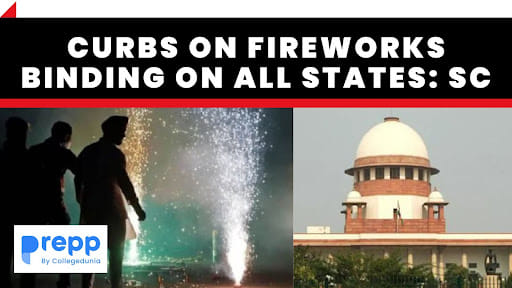
The Supreme Court of India has stated that its directives to reduce air and noise pollution from firecrackers are applicable to all states, not just the Delhi National Capital Region, especially with the approach of Deepavali.
Table of Contents
Contextual Background
- Diwali celebrations have historically been linked to significant increases in air and noise pollution, especially in urban areas like the Delhi National Capital Region, due to the widespread use of firecrackers.
- The Supreme Court has previously issued orders aimed at minimizing the environmental impact of firecrackers. These orders were initially perceived to be specifically targeting the Delhi NCR region, which faces acute air pollution problems.
- The Supreme Court clarified that its orders to minimize pollution are not limited to the Delhi NCR but are binding on all states across India.
- The court's clarification comes just days before Deepavali, suggesting an urgent need to reinforce the rules to prevent a surge in pollution during the festival.
Supreme Court's Observations
- Celebration vs. Environment: Justice M.M. Sundresh, has expressed that while celebrations are important, they should not come at the cost of environmental health. This indicates a clear stance that the joy of festivities cannot override the need for environmental conservation.
- Awareness and Behavior: Justice A.S. Bopanna pointed out the paradox in awareness levels between children and adults. He noted that despite children being more aware and restrained due to education, adults tend to engage more in bursting crackers without considering the pollution they cause.
- Circumventing Restrictions: The court observed that given a time limit, like 10:30 p.m., people rush to burst all their crackers beforehand, focusing on using up their stock rather than adhering to the spirit of the restriction.
- Importance of Sensitization: The court underlined the need for sensitizing the population about the importance of reducing fireworks to mitigate pollution. This suggests a push for public education and consciousness-raising efforts.
- Hope for Improved Consciousness: Reflecting a positive outlook, the court, through Justice Sundresh's remark "We live on hope," implies an expectation that societal attitudes towards environmental protection will improve.
Major Chemicals/Pollutants Used in Fireworks
| Chemicals | Pollutants |
|---|---|
|
|
Responsibilities of Individuals
- Awareness and Education: Individuals should educate themselves and others about the harmful effects of firecrackers on air quality and noise levels.
- Moderation: Celebrations can occur but should be with moderation. Individuals should limit the use of firecrackers or opt for eco-friendly alternatives that are less harmful to the environment.
- Compliance with Time Restrictions: Respecting and adhering to the time restrictions set by authorities for bursting firecrackers can greatly reduce noise pollution and its associated discomforts.
- Collective Action: Cultivating a collective consciousness about the environment by encouraging communities to celebrate with fewer or no firecrackers.
- Public Campaigns and Petitions: Participate in or initiate campaigns that support the ban or limitation of firecrackers, and sign petitions that advocate for environmentally friendly practices.
- Reporting Violations: If there are clear violations of the restrictions imposed by the court, individuals should report them to the authorities for appropriate action.
- Personal Responsibility: Taking personal responsibility for one's actions and their impact on the environment, understanding that environmental protection is not solely the government's responsibility.
Responsibilities of Government
- Enforcement: Enforcing the Supreme Court's orders strictly and ensuring that violators are penalized.
- Public Awareness Campaigns: Organizing awareness campaigns through various media to educate the public about the harmful effects of firecrackers and promoting alternative ways to celebrate festivals.
- Policy Implementation: Creating and implementing policies that regulate the production, sale, and use of firecrackers, possibly incentivizing the manufacture and purchase of green crackers or other eco-friendly alternatives.
- Research and Development: Supporting the development of less polluting firecrackers or alternative celebration tools through research funding and subsidies.
- Setting and Monitoring Quality Standards: Establishing and monitoring standards for permissible noise and emission levels for firecrackers.
- Infrastructure for Monitoring: Developing infrastructure to continuously monitor air and noise pollution levels, especially during festive seasons.
- Healthcare Preparedness: Ensuring the healthcare system is prepared for any spike in respiratory and other health issues that may arise due to increased pollution.
- Legal Framework: Crafting a robust legal framework that empowers local authorities to act decisively and ensures accountability.
- Inter-departmental Coordination: Coordinating between various departments and levels of government to enforce rules effectively.
- Community Engagement: Engaging with community leaders and groups to promote compliance with pollution-curbing measures at the grassroots level.
Conclusion
The Supreme Court's orders are binding for all states, emphasizing the inclusive responsibility for environmental conservation. It highlights that states should enforce measures to curb pollution year-round, not just during festive seasons.
(*Click this link to read prelims specific weekly current affairs articles)
FAQs
Question: Supreme Court’s orders to reduce air and noise pollution from firecrackers is binding on which states?
Answer:
The Supreme Court of India has stated that its directives to reduce air and noise pollution from firecrackers are applicable to all states, not just the Delhi National Capital Region, especially with the approach of Deepavali.
Question: How do firecrackers contribute to air pollution?
Answer:
Bursting crackers releases more heat, carbon dioxide, and toxic gasses into the atmosphere, raising the earth's temperature and polluting the air, resulting in global warming.
Question: What pollutants are released in air by firecrackers?
Answer:
The combustion of fireworks emits pollutants such as sulfur dioxide, carbon dioxide, carbon monoxide, suspended particles, and various metals such as aluminum, manganese, and cadmium, among others, which are linked to major health risks.
UPSC Mains Practice Question:
|
MCQs
Question: In the context of WHO consider the Air Quality Guidelines, consider the following statements: (UPSC 2022)
- The 24-hour mean of PM2.5 should not exceed 15 ug/m³ and annual mean of PM 2.5 should not exceed 5 μg/m³.
- In a year, the highest levels of ozone pollution occur during the periods of inclement weather.
- PM10 can penetrate the lung barrier and enter the bloodstream.
- Excessive ozone in the air can trigger asthma.
Which of the statements given above are correct?
(a) 1, 3 and 4
(b) 1 and 4 only
(c) 2, 3 and 4
(d) 1 and 2 only
Answer: (b) See the Explanation
The WHO Air Quality Guidelines are a set of evidence-based recommendations for limit values for particular air pollutants developed to assist nations in achieving public health-protective air quality. The guidelines were initially published in 1987.
PM2.5 should not exceed 5 g/m3 annual mean or 15 g/m3 24-hour mean, and PM10 should not exceed 15 g/m3 annual mean or 45 g/m3 24-hour mean, according to the standards. Hence, statement 1 is correct.
PM10 particles (particles having a diameter of 10 micrometres or less) are small enough to pass through the throat and nose and into the lungs. These particles, when inhaled, can harm the heart and lungs and create major health problems. They can penetrate and lodge deep within the lungs.
PM2.5 particles (particles with a diameter of 2.5 micrometres or less) are so small that they can enter the lungs and bloodstream. They are considerably more hazardous to one's health. PM2.5 can pass through the pulmonary barrier and into the bloodstream. Hence, statement 3 is incorrect.
As ozone concentrations rise above the recommended threshold, health repercussions on the population grow more widespread and severe. Such impacts can occur in areas where concentrations are currently high owing to human activity or when temperatures are extremely high. Hence, statement 2 is incorrect.
Because it is particularly irritating to the lungs and airways, ozone causes asthma. It is commonly understood that ozone levels are closely associated to asthma attacks. Hence, statement 4 is correct.
Therefore, option (b) is the correct answer.
Question: How is the National Green Tribunal (NGT) different from the Central Pollution Control Board (CPCB)? (UPSC 2018)
- The NGT has been established by an Act whereas the CPCB has been created by an executive order of the Government.
- The NGT provides environmental justice and helps reduce the burden of litigation in the higher courts whereas the CPCB promotes cleanliness of streams and wells, and aims to improve the quality of air in the country.
Which of the statements given above is/are correct?
(a) 1 only
(b) 2 only
(c) Both 1 and 2
(d) Neither 1 nor 2
Answer: (b) See the Explanation
The National Green Tribunal (NGT) is a statutory organization formed by the National Green Tribunal Act in 2010. It was established to address and expedite disputes involving environmental issues.
The Tribunal shall be guided by natural justice principles rather than the method outlined in the Code of Civil method, 1908.
The Tribunal's principal venue of sitting is New Delhi, and the other four places of sitting are Bhopal, Pune, Kolkata, and Chennai.
The statutory institution, the Central Pollution Control Board (CPCB), was established in September 1974 under the Water (Prevention and Control of Pollution) Act of 1974. Hence, statement 1 is incorrect.
Furthermore, the CPCB was given powers and functions under the Air (Prevention and Control of Pollution) Act of 1981.
The CPCB's primary functions, as outlined in the Water (Prevention and Control of Pollution) Act of 1974 and the Air (Prevention and Control of Pollution) Act of 1981, are to promote the cleanliness of streams and wells in various areas of the States by preventing, controlling, and abating water pollution, and to improve air quality and prevent, control, or abate air pollution in the country. Hence, statement 2 is correct.
Therefore, option (b) is the correct answer.
Download the PREPP App and attempt FREE IAS Exam Mock Tests and get complete study material!

Full Test - 04: UPSC CSE Prelims CSAT (Paper-II)
Full Test - 03: UPSC CSE Prelims CSAT (Paper-II)
UPSC CSE Prelims 2026 GS Paper 1 Question Paper (24-May-2026)
UPSC CSE Prelims 2026 CSAT Paper 2 Question Paper (24-May-2026)

17 February 2025 | The Hindu Must Read Articles | Current Affairs

16 February 2026 | The Hindu Must Read Articles | Current Affairs

13 February 2026 | The Hindu Must Read Articles | Current Affairs









Comments