Curbing Air Pollution In India Needs Efforts Across South Asia: WB Report (UPSC Current Affairs)
Relevance: GS 3 - Environment; GS 2 - Bilateral, regional and global groupings and agreements involving India and/or affecting India’s interests; Important International institutions, agencies, and fora- their structure, mandate.
(Source: The Hindu,12/16/22)
Click here for Daily Current Affairs
Why in the news?
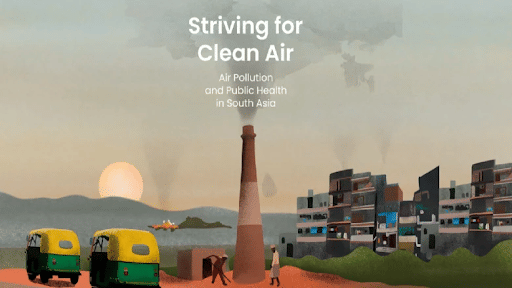
- A new World Bank report ‘Striving for Clean Air: Air Pollution and Public Health in South Asia’ show that there are economically feasible, cost-effective solutions to achieve clean air in the region, but this requires countries to coordinate policies and investments.
- South Asia is home to 9 of the world’s 10 cities with the worst air pollution, which causes an estimated 2 million premature deaths across the region each year and incurs high economic costs.
- Various scenarios to reduce air pollution with varied levels of policy execution and international cooperation were examined in the paper.
Highlights of report
- According to a new report titled Striving for Clean Air: Air Pollution and Public Health in South Asia, concentrations of fine particulate matter (PM 2.5), which includes soot and small dust, are up to 20 times higher than what the WHO considers healthy (5 g/m) in some of the region's most impoverished and densely populated areas.
- Large industries, power plants and vehicles are dominant sources of air pollution around the world, but in South Asia, other sources make substantial additional contributions.
- Currently,an average of 35 g/m3 of PM2.5 is exposed annually to nearly 60% of South Asians.
- According to World Bank research, it rose to as much as 100 g/m3 in some areas of the Indo-Gangetic Plain (IGP), which is more than 20 times the World Health Organization's recommended upper limit of 5 g/m3.
- Impact: Children's cognitive development can be stunted and their immune systems can become infected, leading to chronic and life-threatening illnesses.
- This increases healthcare expenditures, reduces a nation's capability for production, and leads to lost days worked.
India
- According to the report, government initiatives can reduce particle matter, but the considerable reduction is only attainable if the regions across the airsheds enact coordinated policies.
- The report presents various scenarios and the costs associated with lowering the typical South Asian's exposure to particulate matter using a modeling technique over South Asia as a whole.
- There are six significant airsheds in India, some of which are shared with Pakistan.
- The six major airsheds in South Asia where air quality in one affected the other were:
- West/Central IGP: Includes Punjab (Pakistan), Punjab (India), Haryana, part of Rajasthan, Chandigarh, Delhi, and Uttar Pradesh.
- Central/Eastern IGP: Bihar, West Bengal, Jharkhand, Bangladesh;
- Middle India: Odisha/Chhattisgarh;
- Middle India: Eastern Gujarat/Western Maharashtra;
- Northern/Central Indus River Plain: Pakistan, part of Afghanistan; and
- Southern Indus Plain and further west: South Pakistan, Western Afghanistan extending into Eastern Iran.
- When the wind was primarily from the northwest to the southeast, Punjab Province in Pakistan was responsible for 30% of the air pollution in Indian Punjab, while Dhaka, Chittagong, and Khulna, Bangladesh's three major cities, were responsible for 30% of the pollution on average.
- This suggests that even if Delhi National Capital Territory fully implemented all air pollution management measures by 2030 and other regions of South Asia continued to execute the current regulations, pollutant exposure would still be above 35 g/m3.
- When comparing different pollution management strategies, it is important to take into account the interconnectedness of air quality among South Asian airsheds, the paper stated.
- The most cost-effective option, which asks for complete coordination between airsheds, would lower South Asia's average PM 2.5 exposure to 30 g/m3 at a cost of $278 million (about 2,400 crore) per g/m of reduced exposure and save more than 7,50,000 lives a year.
Steps to taken
- Given the results, it is thought that experts from India, Pakistan, Nepal, Bangladesh, and other South Asian nations need to start a dialogue about how to combat air pollution using an "airshed approach."
- This is how the issue has been handled in other regions, such as ASEAN, the Nordic countries, and China as a whole.
- If states want to lower air pollution for their citizens, they must stop pointing the finger and adopt a cooperative strategy.
- The report offers a three-phased roadmap:
- Phase 1: Sets the condition for airshed-wide coordination by expanding the monitoring of air pollution beyond the big cities, sharing data with the public, and creating or strengthening credible scientific institutes.
- Phase 2: Abatement interventions are broadened beyond the traditional targets of powerplants, large factories and transportation. During this phase major progress can be made in reducing air pollution from agriculture, solid waste management, cookstoves, brick kilns, and other small firms. At the same time, airshed-wide standards can be introduced.
- Phase 3: Economic incentives are finetuned to enable private-sector solutions, to address distributional impacts, and to exploit synergies with climate change policies. In this phase trading of emission permits can also be introduced to optimize abatement across jurisdictions and firms.
Way forward
- A severe public health catastrophe has been brought on in South Asia by persistently dangerous levels of air pollution, which calls for immediate action.
- In order to effectively reduce air pollution, local and national jurisdictional borders must work closely together in addition to addressing the problem's individual origins.
- Regional collaboration can assist with the implementation of affordable collaborative plans that capitalise on the interdependence of air quality.
National Clean Air Campaign (NCAP)
|
(*Click this link to read prelims specific weekly current affairs articles)
Some Important FAQs
Question: What is PM2.5?
Answer:
PM2.5 are fine inhalable particles, with diameters that are generally 2.5 micrometers and smaller, and pose the greatest risk to health
Question: What is a National Clean Air Campaign (NCAP)?
Answer:
The National Clean Air Campaign (NCAP), a program the Center initiated in 2019, aims to lower air pollution in 131 of India's most polluted cities.
- The goal was originally to reduce pollution by 20% to 30% over 2017 levels by 2024, but it has since been changed to a 40% reduction by 2025-26.
Question: What is World Bank?
Answer:
The World Bank is an international financial institution that lends and gives money to the governments in low- and middle-income nations to fund capital projects. It is headquartered in Washington D.C, United States. It is a crucial topic in the Economy syllabus for the UPSC Examination.
MCQs
Question: With reference to National Clean Air Campaign (NCAP), consider the following statements:
- It was launched by the Center in 2019.
- The goal is to reduce pollution by 40% over 2017 levels by 2026.
Which of the above statements is/are correct?
(a) 1 only
(b) 2 only
(c) Both 1 and 2
(d) Neither 1 nor 2
Answer: (c) See the Explanation
- The National Clean Air Campaign (NCAP), a program the Center initiated in 2019, aims to lower air pollution in 131 of India's most polluted cities. Hence, statement 1 is correct.
- The goal was originally to reduce pollution by 20% to 30% over 2017 levels by 2024, but it has since been changed to a 40% reduction by 2025-26.Hence, statement 2 is correct.
- Therefore, option (c) is the correct answer.
Download the PREPP App and attempt FREE IAS Exam Mock Tests and get complete study material!

Full Test - 04: UPSC CSE Prelims CSAT (Paper-II)
Full Test - 03: UPSC CSE Prelims CSAT (Paper-II)
UPSC CSE Prelims 2026 GS Paper 1 Question Paper (24-May-2026)
UPSC CSE Prelims 2026 CSAT Paper 2 Question Paper (24-May-2026)

17 February 2025 | The Hindu Must Read Articles | Current Affairs

16 February 2026 | The Hindu Must Read Articles | Current Affairs

13 February 2026 | The Hindu Must Read Articles | Current Affairs









Comments