Cryogenic Rockets – Science & Technology Notes
A cryogenic rocket engine is a type of engine used in space vehicles that use cryogenics. Cryogenics is the study of how materials behave and are produced at extremely low temperatures (below -150 degrees Celsius) to lift and launch heavier objects into space. The Indian Space Research Organisation (ISRO) recently completed a hot test of the CE20 cryogenic engine for the LVM3, formerly known as the GSLV-Mk3. In this article, we will discuss in detail regarding Cryogenic Rockets which will be helpful for UPSC exam preparation.
Table of Contents
What is a Cryogenic Rocket Engine?
- A cryogenic engine or cryogenic stage is the final stage of a space launch vehicle that uses cryogenics.
- A cryogenic rocket engine is one that uses cryogenic fuel or oxidizer, which means that its fuel or oxidizer (or both) are gases that have been liquefied and stored at extremely low temperatures.
- Cryogenics is the study of the production and behaviour of materials at extremely low temperatures (less than -150°C) in order to lift and place heavier objects in space.
- Its propellants are liquid oxygen (LOx) and liquid hydrogen (LH2).
- When compared to solid and earth-storable liquid propellant rocket stages, a cryogenic rocket stage is more efficient and provides more thrust per kilogramme of propellant burned.
- Specific impulse is much higher with cryogenic propellants (liquid Hydrogen and liquid Oxygen) than with earth storable liquid and solid propellants, giving it a significant payload advantage.
- The specific impulse of a propellant indicates how many pounds (or kilogrammes) of thrust are produced by consuming one pound (or kilogramme) of propellant in one second.
- They are one of the most difficult to develop, and only six countries have them so far: the United States, China, Russia, France, Japan, and India.
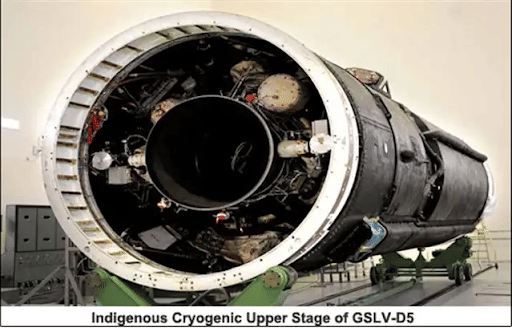
- Cryogenic fuel is used in the upper stage of India's heaviest launch vehicles, the GSLV and GSLV Mk III.
| Other Relevant Links | |
|---|---|
| GSLV and Various Engine | Recent National and International Space Missions |
| Scramjet Engine | GSLV Mk III-D1 OR GSAT-19 Mission |
| ISRO’s World Record PSLV C37 Launch: | Global Positioning System |
| Galileo | GLONASS |
| IRNSS | GAGAN |
| Chandrayaan – I & II | Mars Orbiter Mission |
Working of a Cryogenic Rocket Engine
- A combustion/thrust chamber, igniter, fuel injector, fuel cryo pumps, oxidizer cryo pumps, gas turbine, cryo valves, regulators, fuel tanks and a rocket engine nozzle are the main components of a Cryogine engine.
- Cryogenic rocket engines are almost entirely pump-fed in terms of propellant delivery to the combustion chamber.
- Pump-fed engines operate in a gas-generator, staged-combustion, or expander cycle.
- Due to their lower efficiency, gas-generator engines are typically used on booster engines, while staged-combustion engines can fill both roles at the expense of greater complexity, and expander engines are only used on upper stages due to their low thrust.
- Cryogenic engines use liquid oxygen (LOX) and liquid hydrogen (LH2) as propellants, which liquefy at -183 degrees Celsius and -253 degrees Celsius, respectively.
- LH2 and LOX are stored in separate tanks.
- Individual booster pumps are then used to pump them into the turbopump, ensuring a high propellant flow rate inside the combustion/thrust chamber.
Applications of Cryogenic Rocket Engine
- Satellite Launches: Their efficiency and power make them ideal for placing satellites, especially into geostationary orbits.
- Deep Space Missions: The high specific impulse ensures prolonged thrust, suitable for missions to distant planets or asteroids.
- Human Spaceflight: Their efficiency can be vital for future crewed missions to the Moon, Mars, and beyond.
Advantages of Cryogenic Rocket Engine
- Superior Efficiency: Cryogenic rockets offer higher specific impulse, resulting in increased efficiency and reduced fuel consumption.
- Payload Capacity: The high energy density of cryogenic fuels allows for larger payloads and longer missions.
- Interplanetary Travel: Cryogenic rockets are vital for ambitious interplanetary missions, reducing travel time and mission costs.
- Eco-friendly: The combustion of LH2 and LOX results in water vapor, minimizing environmental pollution.
Disadvantages of Cryogenic Rocket Engine
- Complex Technology: Cryogenic rocket systems are highly complex and require advanced engineering and precision in handling cryogenic fluids.
- Cost: The production and storage of cryogenic fuels are expensive, making the initial investment and subsequent missions costlier.
- Fuel Handling Challenges: Cryogenic propellants require specialized handling and storage facilities, adding to operational challenges.
- Potential Hazards: Cryogenic fuels, being extremely cold, can pose threats if not handled with adequate safety measures.
Cryogenic Rocket Engine and India
- The indigenously developed cryogenic engine that will power India's heaviest rocket, the LVM-3, has been successfully tested by the Indian Space Research Organisation (Isro).
- For the first time, the Launch Vehicle Mark-III was subjected to a hot test at an increased thrust level of 21.8 tonnes.
- According to Isro, the goal of the hot fire was to demonstrate that the engine can support a payload of up to 450 kg with additional propellant loading.
- Following the successful testing of a cryogenic engine, Hindustan Aeronautics Limited (HAL) will manage all of the Indian Space Research Organization's rocket engine manufacturing under one roof at the Integrated Cryogenic Engine Manufacturing Facility (ICMF).
Conclusion
Cryogenic rockets have redefined the boundaries of space exploration, bringing efficiency and power to the forefront. With countries like India making strides in this domain, the future of space exploration backed by cryogenic technology seems promising.
| Other Relevant Links | |
|---|---|
| Science & Technology Policy in India | Scientific Policy Resolution 1958 |
| Science & Technology Policy of 1983 | Science & Technology Policy of 2003 |
| Science, Technology and Innovation Policy 2013 | New Initiatives Aligned with the National Agenda |
| India and World collaboration in science projects | Technology Vision Document 2035 |
FAQs
Question. What is a cryogenic rocket?
Answer: A cryogenic rocket uses cryogenic fuel, which is a combination of liquid hydrogen (LH2) and liquid oxygen (LOX), as propellants. These fuels are stored at very low temperatures (below -150°C) to maintain their liquid state.
Question. Why are cryogenic rockets preferred for space missions?
Answer: Cryogenic rockets are preferred because liquid hydrogen has a very high specific impulse, meaning they produce more thrust per unit of fuel compared to traditional propellants. This makes them more efficient and suitable for launching heavier payloads into space.
Question. What are the main components of a cryogenic rocket engine?
Answer: The main components of a cryogenic rocket engine include the fuel tanks (for liquid hydrogen and liquid oxygen), turbopumps (to transfer the cryogenic propellants to the engine), combustion chamber, and nozzle for expelling gases to generate thrust.
Question. What challenges are associated with cryogenic rocket technology?
Answer: Cryogenic rocket technology faces challenges such as the complexity of storing and handling cryogenic fuels, the need for advanced insulation to prevent fuel from vaporizing, and the high cost and difficulty in manufacturing cryogenic engines.
Question. Which space organizations use cryogenic rockets?
Answer: Several space organizations, including NASA, ESA, Roscosmos, and ISRO, have developed and used cryogenic rocket technology for launching satellites, interplanetary missions, and space exploration endeavors.
MCQs
- What is the primary fuel used in cryogenic rockets?
A) Liquid oxygen and kerosene
B) Liquid hydrogen and liquid oxygen
C) Liquid methane and liquid oxygen
D) Nitrogen and hydrogen
Answer: (B) See the Explanation
Cryogenic rockets use a combination of liquid hydrogen (LH2) and liquid oxygen (LOX) as propellants.
- What is the advantage of using cryogenic fuels in rockets?
A) Increased energy efficiency
B) Lower production costs
C) Reduced fuel storage requirements
D) Improved environmental impact
Answer: (A) See the Explanation
Cryogenic fuels have a high specific impulse, providing better thrust per unit of fuel, which increases energy efficiency and payload capacity.
- Which of the following is a challenge in cryogenic rocket technology?
A) Low fuel efficiency
B) Difficulty in fuel storage and handling
C) Shorter engine life
D) Limited payload capacity
Answer: (B) See the Explanation
Cryogenic fuels must be stored at extremely low temperatures, making their handling and storage more complex and expensive.
- Which organization developed the GSLV Mk III cryogenic rocket for space missions?
A) NASA
B) ISRO
C) ESA
D) Roscosmos
Answer: (B) See the Explanation
The Indian Space Research Organisation (ISRO) developed the GSLV Mk III, which uses cryogenic technology for launching heavier payloads into space.
- Which part of a cryogenic rocket engine is responsible for transferring propellants to the combustion chamber?
A) Combustion chamber
B) Nozzle
C) Turbopump
D) Thrust vector control
Answer: (C) See the Explanation
Turbopumps are used to pump cryogenic propellants from the tanks into the combustion chamber under high pressure.
GS Mains Questions and Model Answers
Q1. Discuss the role of cryogenic rockets in space exploration and satellite launches.
Answer: Cryogenic rockets play a crucial role in space exploration due to their high efficiency and ability to carry heavier payloads into space. The use of liquid hydrogen and liquid oxygen provides a higher specific impulse compared to other propellants, making cryogenic engines ideal for missions requiring substantial payload capacity and long-duration flights. This technology is pivotal for launching large satellites, interplanetary missions, and crewed space exploration programs. The high efficiency of cryogenic engines allows for more efficient use of fuel, enabling rockets to reach higher velocities and broader destinations.
Q2. Analyze the technical challenges involved in developing cryogenic rocket engines.
Answer: Developing cryogenic rocket engines involves overcoming several technical challenges, including the complexity of storing and handling cryogenic fuels, which must be kept at temperatures below -150°C. The propellants are highly volatile and require advanced insulation and specialized tanks to prevent them from vaporizing. Moreover, cryogenic engines require precise control of fuel flow and combustion, which adds complexity to engine design. Turbopumps need to handle extremely low temperatures without compromising efficiency. Additionally, manufacturing cryogenic engines requires advanced technology, which makes them expensive and time-consuming to develop.
Q3. Evaluate the significance of cryogenic technology for India’s space missions.
Answer: Cryogenic technology has significantly enhanced India's space capabilities, particularly through the development of the GSLV Mk III rocket by ISRO. This advancement allows India to launch heavier payloads into space, making it a crucial technology for India’s ambitions in space exploration, satellite launches, and interplanetary missions. Cryogenic rockets have enabled ISRO to participate more effectively in global space endeavors, allowing for increased commercial satellite launches. Furthermore, this technology is vital for future missions such as crewed spaceflights and lunar exploration, positioning India as a strong player in the global space industry.
Previous Year Questions on Cryogenic Rockets
1. UPSC CSE (IAS) Prelims 2021
Question: What is the advantage of using cryogenic fuel in rockets?
Answer: Cryogenic fuel offers a high specific impulse, meaning it provides more thrust per unit of fuel compared to conventional fuels. This allows rockets to carry heavier payloads and achieve higher velocities, making cryogenic rockets more efficient for long-duration space missions.
2. UPSC CSE (IAS) Mains 2019
Question: Evaluate the role of cryogenic technology in enhancing India’s space program.
Answer: Cryogenic technology has been a transformative factor for India’s space program, particularly through the development of GSLV Mk III. It allows for launching heavier payloads, enabling India to participate in global satellite launches and strengthening its position in space exploration. Cryogenic rockets also improve fuel efficiency, contributing to cost-effective space missions. This technology is essential for India’s future space missions, including lunar exploration and crewed spaceflights.
Download the PREPP App and attempt FREE IAS Exam Mock Tests and get complete study material!

Full Test - 04: UPSC CSE Prelims CSAT (Paper-II)
Full Test - 03: UPSC CSE Prelims CSAT (Paper-II)
UPSC CSE Prelims 2026 GS Paper 1 Question Paper (24-May-2026)
UPSC CSE Prelims 2026 CSAT Paper 2 Question Paper (24-May-2026)

17 February 2025 | The Hindu Must Read Articles | Current Affairs

16 February 2026 | The Hindu Must Read Articles | Current Affairs

13 February 2026 | The Hindu Must Read Articles | Current Affairs









Comments