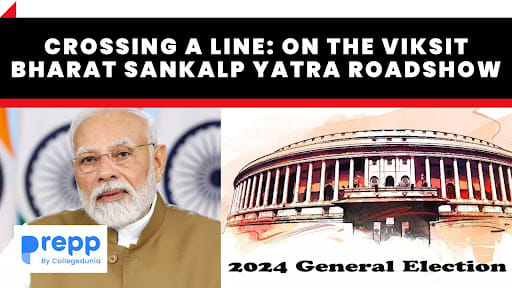
Crossing a line: On the Viksit Bharat Sankalp Yatra Roadshow
Primary Source: The Hindu
Click here for Daily Current Affairs
Prepp Prelims Booster: Doctrine of Separation of Power
Prepp Mains Booster: Separation of Powers between various organs, Role of Civil Services in a Democracy, Public/Civil Service Values and Ethics in Public Administration
Why in the news?
- The Centre has planned to launch a roadshow named "Viksit Bharat Sankalp Yatra" that aims to display the achievements of the last nine years, which aligns with the two terms of the Bharatiya Janata Party (BJP) since 2014.
- The campaign's timing aligns closely with the upcoming Lok Sabha elections in 2024.
- Officers from various ranks will be in charge of this roadshow, and the Ministry of Defence is creating 'selfie points' featuring the Prime Minister's picture in numerous public locations.
Table of Contents
- Details of the Roadshow
- Criticism from Opposition Parties
- What is meant by Politicization of Institutions?
- Several concerns arise from the politicization of institutions, such as
- Importance of Maintaining Separation Between Bureaucracy, Military, and Political Executive
- What is Separation of Powers?
- Conclusion
- FAQs
- MCQs
Details of the Roadshow
- The roadshow will run from November 20 to January 25, 2024.
- Joint Secretaries, Directors, and Deputy Secretaries to be appointed as Rath Prabharis (chariots in-charge).
- It's strategically timed ahead of the Lok Sabha election expected in April-May 2024.
- 822 'selfie points' will be established where citizens can take photos with a picture of Prime Minister Narendra Modi.
- Selfie points to be set up in areas with maximum footfall, including war memorials, railway stations, schools, tourist destinations, and more.
Criticism from Opposition Parties
- Politicization of the Bureaucracy and Military: The decision to involve Joint Secretaries, Directors, and Deputy Secretaries as Rath Prabharis (chariots in-charge) for the roadshow is seen as an attempt to push these bureaucratic officials into roles that promote the ruling party's achievements.
- Timing of the Campaign: The roadshow, showcasing the achievements of the last nine years (corresponding to the two terms of the BJP since 2014), is conveniently scheduled ahead of the Lok Sabha elections expected in April-May 2024. This has raised suspicions about the ulterior motives of the campaign, as it seems like a move to gain electoral advantages.
- Usage of Defence Establishments for Political Promotion: The Ministry of Defence's plan to set up 822 'selfie points' featuring a picture of Prime Minister Narendra Modi is viewed as an inappropriate use of defence-related establishments for political promotions.
- Undermining Institutional Integrity: The opposition feels that such directives blur these lines and compromise the integrity and impartiality of institutions, potentially causing irreversible damage.
What is meant by Politicization of Institutions?
- The politicization of institutions refers to the process where institutions, which are ideally expected to function neutrally and independently, are influenced or co-opted by political interests.
- This influence can manifest in various ways, such as appointments based on political affiliations rather than merit, decisions driven by partisan considerations rather than objective criteria, or the shaping of institutional norms and practices to serve political ends.
Several concerns arise from the politicization of institutions, such as:
- Loss of Credibility: Institutions lose their credibility when they are seen as merely extensions of political power rather than independent entities that serve the public good.
- Erosion of Trust: Public trust in institutions diminishes when these entities are perceived to be acting on behalf of specific political interests rather than upholding their mandated responsibilities.
- Diminished Effectiveness: Politicized institutions can become less effective, as decisions might be made based on political considerations rather than objective or evidence-based criteria.
- Threat to Democracy: Key democratic principles, such as checks and balances, can be undermined when institutions meant to provide oversight or balance are co-opted by political forces.
- Reduced Accountability: Politicized institutions might not hold individuals or groups accountable if such actions conflict with the interests of influential political actors.
Importance of Maintaining Separation Between Bureaucracy, Military, and Political Executive
- Upholding Democracy: Democracy thrives when institutions function as per their designated roles without undue interference.
- Preserving Institutional Integrity: Each of these institutions—the bureaucracy, the military, and the political executive—has a unique role to play. The separation ensures that they can fulfill their roles effectively without compromising their core functions or values.
- Checks and Balances: Separation provides a system of checks and balances. The bureaucracy, being permanent, offers continuity in administration irrespective of political changes. The military safeguards national sovereignty. Meanwhile, the political executive, elected by the people, provides direction to governance.
- Preventing Abuse of Power: By separating powers and functions, the constitution ensures that no single entity becomes overwhelmingly powerful, which could lead to authoritarian tendencies or the abuse of power.
- Protecting Civil Liberties: The military's primary role is defending the nation from external threats. Keeping it separate from the political executive ensures that it doesn't become a tool for suppressing internal dissent or curtailing civil liberties.
- Apolitical Bureaucracy and Military: Bureaucracy and the military are meant to serve the nation, not any specific political party. This separation ensures that they remain neutral and function impartially, irrespective of the party in power.
- Enhancing Public Trust: When institutions function as they are meant to, without overt political interference, it enhances public trust in the system.
- Promoting Stability: A clear demarcation of roles and responsibilities ensures a stable environment, even during political transitions.
What is Separation of Powers?
|
Conclusion
The main contention is that the roadshow is being criticized by opposition parties, particularly for seemingly politicizing the bureaucracy and the military. According to the Indian constitutional framework, there should be a clear demarcation between the bureaucracy, military, and the political executive to maintain impartiality and avoid partisan politics.
(*Click this link to read prelims specific weekly current affairs articles)
FAQs
Question: What is separation of powers?
Answer:
Separation of powers is a fundamental principle of governance that divides the responsibilities and functions of government into distinct branches or organs, each with its own roles, powers, and functions. This separation aims to ensure that no single branch becomes overly dominant and that each can check and balance the powers of the others. This system helps protect the rights and liberties of citizens by preventing the abuse of power.
Question: What is the "Viksit Bharat Sankalp Yatra"?
Answer:
The "Viksit Bharat Sankalp Yatra" is a roadshow initiative by the Centre to showcase its achievements across the country down to the village level. The roadshow runs from November 20 to January 25, 2024. The focus of this outreach is to highlight the achievements of the last nine years corresponding to the two terms of the Bharatiya Janata Party (BJP) that began in 2014.
Question: What is meant by Politicization of Institutions?
Answer:
The politicization of institutions refers to the process where institutions, which are ideally expected to function neutrally and independently, are influenced or co-opted by political interests. This influence can manifest in various ways, such as appointments based on political affiliations rather than merit, decisions driven by partisan considerations rather than objective criteria, or the shaping of institutional norms and practices to serve political ends.
UPSC Mains Practice Question:
|
MCQs
Question: Which one of the following factors constitutes the best safeguard of liberty in a liberal democracy? (UPSC 2021)
a) A committed judiciary
b) Centralization of powers
c) Elected government
d) Separation of powers
Answer: (d) See the Explanation
Separation of powers is the division of government's legislative, executive, and judicial duties. It reduces the likelihood of arbitrary government excesses by requiring the approval of all three branches for the creation, execution, and administration of legislation. The constitutional framework prohibits any branch of government from concentrating undue authority.
All sources of power are anchored in the will of the people in the liberal approach that is inherent in democracy. This approach strengthens the rule of law as one of the fundamental pillars of democracy; it affirms the separation of powers as a means of constraining them; and it promotes individuals' rights and freedoms as a precondition for their dignity.
Therefore, option (d) is the correct answer.
Question: In India, separation of judiciary from the executive is enjoined by (UPSC 2020)
(a) The Preamble of the Constitution
(b) A Directive Principle of state policy
(c) The Seventh schedule
(d) The conventional practice
Answer: (b) See the Explanation
Article 36 to Article 51 of the Indian Constitution addresses the Directive Principles of State Policy. Separation of the judiciary and the executive is mandated by Article 50. The Directive Principles of State Policy (DPSP) are not legally binding.
Therefore, option (b) is the correct answer.
Download the PREPP App and attempt FREE IAS Exam Mock Tests and get complete study material!

Full Test - 04: UPSC CSE Prelims CSAT (Paper-II)
Full Test - 03: UPSC CSE Prelims CSAT (Paper-II)
UPSC CSE Prelims 2026 GS Paper 1 Question Paper (24-May-2026)
UPSC CSE Prelims 2026 CSAT Paper 2 Question Paper (24-May-2026)

17 February 2025 | The Hindu Must Read Articles | Current Affairs

16 February 2026 | The Hindu Must Read Articles | Current Affairs

13 February 2026 | The Hindu Must Read Articles | Current Affairs









Comments