Court Can Not Issue The Direction To Frame Uniform Civil Code (UPSC Current Affairs)
Relevance: GS2 - Indian Constitution- Significant Provisions, Secularism. Structure, Organization and Functioning of the Executive and the Judiciary
(Source:The Hindu, 10/19/2022)
Click here for Daily Current Affairs
Why in the news?
- Recently, affidavits were filed by the Union Law Ministry in the Supreme court to the petitions seeking directions from the apex court to the government to remove "anomalies" and frame uniform divorce law and uniform guidelines for the adoption and guardianship of children.
- In its affidavit, the government said the power to make laws is exclusively that of the legislature. The court cannot give a “mandamus to Parliament to make particular laws”.
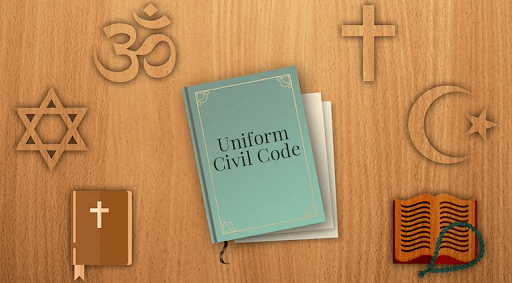
- The personal law of people relating to marriage, divorce, maintenance, custody and guardianship of children, inheritance and succession and adoption are covered under 'Uniform Civil Code'.
What the Affidavit of the Union Law Ministry says?
- Making law on particular issues is a matter for the elected representatives of the people to decide and no direction in this regard can be issued by the court.
- It is for the legislature to decide, to enact or not, a piece of legislation,
- On the matters of the Uniform Civil Code, the ministry held that "Citizens belonging to different religions and denominations follow different property and matrimonial laws which is an "affront to the nation's unity". Uniform Civil Code (Article 44) divests religion from social relations and personal law.
- In the past the Ministry had requested the Law Commission to examine "various issues relating to the Uniform Civil Code (UCC)" and make recommendations.
- Earlier, the 21st Law Commission had uploaded a consultation paper titled 'Reform of Family Law subsequently in August 2018.
- The subject matter will be placed before the 22nd Law Commission for its consideration.
What are the various regulations on the personal laws in India?
Parliament so far has been unable to enact the Uniform CIvil code. But Parliament has enacted the various legislation on personal laws related to marriage, divorce succussion and property for nearly all religions.
- For Religious Marriage: The Parliament also enacted a new law called the Hindu Marriage Act in 1955 to regulate religious marriages among the Hindus, Buddhists, Jains, and Sikhs.
- For Interfaith Marriage: Parliament enacted a Civil MarriageAct 1954, The Special Marriage Act and the Indian Succession Act. As a secular alternative, these enactments were made available to all Indian people. As a result, these acts collectively constitute an optional UCC for all Indians.
- For Succession: A Hindu Succession Act came into force regulating the properties of those covered by the Hindu Marriage Act 1955.
- Adoption: Adoption in India is regulated by CARA which is statutory authority under Juvenile Justice (Care and Protection of Children) Act, 2015,
What is Uniform Civil Code (UCC) ?
- The UCC is a set of personal laws relating to marriage, divorce, maintenance, custody and guardianship of children, inheritance and succession and adoption that all residents must abide by regardless of their gender, caste, or religion.
- It is based on the notion that there is no connection between religion and law in modern democracy.
- Constitutional Provisions: Article 44 under the Part IV (Directive Principles of State Policy) of the Constitution states that “the State shall endeavor to provide a Uniform Civil Code for its citizens throughout the territory”.
Why is there a need for a UCC in India?
- Strengthening Unity and Integrity of India: For the protection of India's most vulnerable citizens (women and religious minorities), as well as the promotion of national unity and solidarity, a single code is required.
- Protection of Vulnerable Sections of Society: The UCC attempts to safeguard the rights and interst of vulnerable sections of society- women, child and religious minorities, as envisioned by Ambedkar, while simultaneously boosting nationalistic ardor via unity.
- Creating a secular society: The UCC would break the relationship that binds law and religion, which is the goal that a secular, socialist society would value.
- Obligation under DPSP: Additionally, it is in compliance with constitutional requirements set forth in Article 44 of the Directive Principles of State Policy.
- Simplification of personal laws: The UCC will simplify and make the complicated laws of marriage ceremonies, inheritance, succession, and adoptions more accessible to everyone. All citizens, regardless of their faith, will be subject to the same civic personal laws.
- Constitutional Objective: The Preamble expresses the objective of secular India because a secular republic necessitates a common law for all citizens rather than differing norms depending on religious practices.
- Gender Justice: If the UCC is passed, all personal laws will be abolished and existing laws that discriminate against women will be repealed.
What are the issues associated with UCC?
- Constitutional Challenges: Implementation of UCC will lead to the violation of Fundamental Rights (FR).
- There is concern that the universal civil code will infringe on Article 25 (Right to Freedom Religion i.e Freedom of conscience, free profession, practise, and spread of faiths), and Article 26 (Right to administer religious affairs).
- The Right to Freedom of Religion (Article 25- 28) will contradict with the Right to Equality (article 14 -15)
- Additionally, under Article 25, a person's freedom of religion is constrained by "public order, health, and morals."
- Not recommended by Law Commission: According to a Report by a 21st Law Commission of India, the UCC is "not required nor desirable at this point" in India. According to the Commission, secularism cannot conflict with the nation's strong tradition of diversity.
- According to the same report, UCC contradicts the rights of tribals in practicing faith.
- Opposition from Religious groups: This is one of the most evident obstacles to overcome when bringing up the UCC. Fundamentalism, which is deeply established in many Indian religions, does not appear to be fading even in the twenty-first century.
- Diverse personal laws: Uniformity of any kind is difficult to attain due to the wide range of personal laws and the diversity in IndIA . Finding a common ground amongst diverse communities is difficult.
- False Perception of Secular society: There are still many people who don't understand what the unified civil code genuinely means. A rational conversation about its implementation is difficult since there are still false beliefs about it, especially among minorities.
- Lack of Political Willpower: The government may lack the willpower to face the consequences of repealing the personal laws of the major religions and convince the populace of the justice and reform they aim to bring about in society in order to advance as a country.
- Fear of encroachment on Religious Freedom: Numerous people believe that the Uniform Civil Code violates their right to freedom of religion, especially minorities. They fear that a uniform code will disregard the customs of minorities and impose rules heavily influenced by the main faith groupings.
Way Ahead
- Awareness: To change the present personal law reforms, significant public awareness campaigns are required, and these campaigns should be led by the communities themselves.
- Gradual approach: It is necessary to replace a disjointed civil code with a consistent one, but the transition must be gradual rather than abrupt. Therefore, the government will have to make reforms gradually.
- Law Commission’s recommendations: The Commission places a focus on initiatives to combine national diversity with claims about universal human rights.
- To expose bias and preconceptions across all religions, it argued for the codification of all personal laws.
- They will eventually be tested on the anvil of the fundamental rights of the constitution.
- It might contribute to the formulation of universal principles.
- These may facilitate putting equity first rather than imposing UCC.
- The better option would be to make little tweaks that would remove some of the underlying silliness of some personal rules and make them fit for the modern world.
- Examining religious variations is crucial as well. This could lay the foundation for the enactment of a UCC in the future.
(*Click this link to read prelims specific weekly current affairs articles)
Some Important FAQs
Question: What is Article 44 of the Constitution of India?
Answer:
Article 44 says, 'The State shall endeavour to secure for the citizens a Uniform Civil Code throughout the territory of India. ' The article is a part of the Directive Principles of State Policy.
Question: What is the status of Uniform Civil Code in India?
Answer:
In India, Goa is the only state to have a UCC regardless of gender, religion and caste.in Goa there is a common family law so we can say that Goa is the only state in India that has a Uniform civil code.
Question: What is the benefit of Uniform Civil Code?
Answer:
The UCC aims to provide protection to vulnerable sections as envisaged by Ambedkar including women and religious minorities, while also promoting nationalistic fervour through unity.
MCQs
Question: Constitution of India through which Article directs the State to provide a Uniform Civil Code in the country?
(a) Article 41
(b) Article 42
(c) Article 44
(d) Article 46
Answer: (c) See the Explanation
Article 44 of Part IV (Directive Principles of State Policy) of the Constitution states that the State shall endeavor to provide a Uniform Civil Code for its citizens throughout India's territory.
Therefore, option (c) is the correct answer.
Download the PREPP App and attempt FREE IAS Exam Mock Tests and get complete study material!

Full Test - 04: UPSC CSE Prelims CSAT (Paper-II)
Full Test - 03: UPSC CSE Prelims CSAT (Paper-II)
UPSC CSE Prelims 2026 GS Paper 1 Question Paper (24-May-2026)
UPSC CSE Prelims 2026 CSAT Paper 2 Question Paper (24-May-2026)

17 February 2025 | The Hindu Must Read Articles | Current Affairs

16 February 2026 | The Hindu Must Read Articles | Current Affairs

13 February 2026 | The Hindu Must Read Articles | Current Affairs









Comments