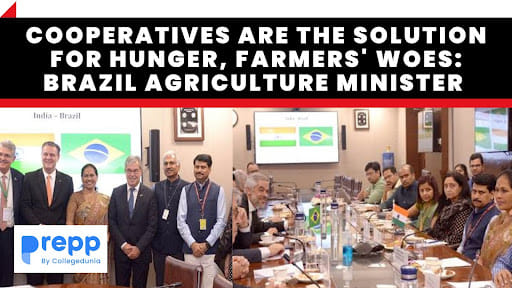
Cooperatives are the Solution for Hunger, Farmers' Woes: Brazil Agriculture Minister
Click here for Daily Current Affairs
Why in the news?
- Brazil’s Agriculture and Livestock Minister, Carlos Fávaro, during his visit to India, emphasized the role of cooperative production and marketing in the agricultural sector.
- This comes in the context of addressing the global trade crisis in food, exacerbated by conflicts in Ukraine and Gaza.
Table of Contents
What are Cooperatives?
|
What is Brazil’s Cooperative Model?
- Addressing Food Crisis: Cooperative production and marketing are seen as viable solutions to the global food trade crisis, exacerbated by conflicts like those in Ukraine and Gaza.
- Advocacy for Peace: It advocates for peace and can help resolve the food crisis.
- Support for Cooperatives: The Brazilian government supports the formation of cooperatives to empower small-hold farmers, enhance competitiveness, and enable the industrialization of their production.
- Technology and Knowledge Transfer: Brazil is committed to transferring technologies and knowledge, especially in agricultural and climatic research, to cooperatives to bolster their function and efficiency.
- Anti-War Stance and Hunger Solution: Brazil does not view war as an opportunity and is committed to assisting in the resolution of global hunger.
- Agricultural Transformation: Brazil has undergone a technological revolution in agriculture, moving from a food importer to a major exporter, and is working to increase productivity without compromising forest land.
Brazil's Agricultural Transformation
- Initiation of Technological Advances: The establishment of EMBRAPA in the 1970s marked the beginning of a technological revolution in Brazilian agriculture, leading to the development of new crop varieties and improved farming methods.
- Land Use Efficiency: Brazil converted large areas of the Cerrado and other pastures into productive agricultural land, boosting the cultivable area without heavily depending on deforestation.
- Productivity Boost: Through the use of advanced agricultural techniques and inputs, Brazil increased its foodgrain production by 580% over 50 years.
- Global Export Leadership: The country became a leading exporter of soybeans, beef, poultry, sugar, and coffee, significantly diversifying its agricultural exports.
- Environmental Measures: Amidst agricultural expansion, Brazil has undertaken measures to reduce deforestation by 50% and combat illegal forest fires.
- Infrastructure and Policy Support: Investments in infrastructure and supportive government policies have been crucial in enhancing the sector's domestic and international capabilities.
- Economic and Social Benefits: The agricultural sector's growth has driven economic development and reduced rural poverty, though it has also brought challenges such as land disputes and agrochemical concerns.
How Cooperatives Will End Hunger and Farmers’ Woes?
- Strengthening Food Security
- Pooling Resources: Cooperatives allow farmers to pool their resources, leading to better access to inputs, services, and markets.
- Reducing Costs: By buying in bulk, cooperatives can reduce the cost of seeds, fertilizers, and equipment, passing these savings on to their members.
- Improving Access to Markets: They often provide better access to local and international markets, helping farmers get fair prices for their produce.
- Enhancing Income Stability
- Collective Bargaining: Cooperatives strengthen the bargaining power of farmers with buyers, helping them secure better terms and prices for their products.
- Value Addition: By processing raw agricultural products, cooperatives can increase their value, leading to higher incomes for farmers.
- Mitigating Risks
- Risk Sharing: Cooperatives share the risks among their members, which can cushion individual farmers against crop failures or market fluctuations.
- Insurance Schemes: Many cooperatives offer insurance products to their members, providing a safety net in case of adverse events.
- Increasing Productivity
- Access to Technology: Cooperatives can provide access to modern farming techniques and technologies, improving crop yields.
- Knowledge Sharing: They facilitate the exchange of best practices among farmers, which can lead to more efficient and productive farming methods.
- Promoting Sustainable Practices
- Sustainable Techniques: Cooperatives often encourage and facilitate the adoption of sustainable agricultural practices, contributing to long-term food security.
- Resource Management: They can promote better management of natural resources, ensuring the sustainability of farming communities.
- Empowering Farmers
- Democratic Participation: Farmers in cooperatives have a voice in decision-making, empowering them to advocate for their needs and interests.
- Education and Training: Cooperatives often provide training to their members, which can improve farming practices and business management skills.
- Addressing Social Needs
- Community Development: Cooperatives often reinvest profits into community projects, such as building schools or healthcare facilities, which can help improve overall living conditions.
- Support Systems: They create networks of support for farmers, which can be particularly beneficial in times of crisis or hardship.
India-Brazil Relations
The Brazil government aims to enhance its relationship with India, extending beyond agriculture to commercial and industrial spheres.
Agriculture Sector
- Memorandums of Understanding: India and Brazil have signed two Memorandums of Understanding (MoUs) to cooperate in the domains of food safety and the vegetable oil industry, indicating a commitment to deepen collaboration.
- Agricultural and Climatic Research: There is an intention to fortify relations in agricultural and climate-related research. Brazil is prepared to share its technological advancements in these areas with India.
- Technology Transfer: The Brazilian government expresses a readiness to transfer technology, particularly in the area of cooperatives, to India, demonstrating a commitment to mutual development and tackling global challenges like hunger.
- Cooperative Engagement: Brazil is willing to formalize relations with Indian cooperatives. This approach is seen as a means to support small-scale farmers and enhance competitiveness.
- Peace and Collaboration: Brazil emphasizes peace as a foundational goal and rejects the notion of benefiting from conflicts. It is poised to assist in resolving global hunger issues.
- Agricultural Transformation: Brazil's shift from a food importer to an exporter, with significant surplus production, sets a precedent for collaborative efforts in ensuring global food security. The country is initiating a program to increase the productivity of 40 million hectares of land, promising not to exploit its forests for agricultural expansion.
- Viewing India as a Partner: The Brazilian government views India as a strategic partner in their plan to meet global food requirements, indicating a shared vision for future collaboration.
- Bioenergy: Brazil is a leader in bioenergy, particularly in the production of ethanol from sugarcane. India seeks to benefit from Brazil's expertise in this area to enhance its own biofuel production capabilities.
- Investment: Brazilian companies have shown interest in investing in the Indian agricultural sector, particularly in the supply of agricultural machinery and tools that can help in enhancing agricultural productivity in India.
- Food Security: Both countries work together on food security issues and collaborate through international forums such as BRICS (Brazil, Russia, India, China, South Africa) to promote the development of agriculture within their respective regions.
Commerce Sector
- Trade Relations: Both countries are part of the BRICS economic bloc and actively work to increase bilateral trade. They have been negotiating on reducing trade barriers and promoting easier access to each other's markets.
- Bilateral Trade: There is an emphasis on diversifying trade to include a wider range of goods. While traditionally commodities dominated the trade basket, efforts are being made to include more manufactured goods, pharmaceuticals, and services.
- Trade Agreements: They have been exploring the possibility of a preferential trade agreement or a free trade area, which would greatly enhance commercial exchanges.
- Joint Business Council: The India-Brazil CEO's Forum promotes joint ventures and business partnerships, providing a platform for the business community of both countries to discuss issues of mutual interest.
Industrial Sector
- Technology Transfer: Both countries are interested in technology transfer and the development of high-tech industries. There are collaborations in areas such as space research, where Brazil has used Indian satellite launch services.
- Pharmaceuticals: India's pharmaceutical sector has made inroads into the Brazilian market, often providing affordable generic drugs. Collaboration in research and development of new healthcare solutions is also a key area of mutual interest.
- Defense Industry: India and Brazil have explored potential partnerships in the defense sector. This includes not only the sale and purchase of defense equipment but also joint development of defense technology and products.
- Oil and Gas: Brazil’s expertise in deep-water oil drilling is of great interest to India. Both countries have state-controlled companies that have engaged in exploration and production activities, and there have been discussions about further partnerships in this sector.
- Mining and Minerals: With Brazil being rich in minerals and having a well-developed mining sector, there is potential for India to invest in Brazil's mining sector and for Brazilian companies to provide mining equipment and technology to India.
Conclusion
Cooperative models are a crucial strategy for solving the global food crisis and assisting farmers. With the intention to preserve the environment, Brazil is taking steps to increase agricultural productivity sustainably and has emphasized its readiness to work with India to fight hunger and ensure food availability worldwide.
(*Click this link to read prelims specific weekly current affairs articles)
FAQs
Question: What are Cooperatives?
Answer:
Cooperatives, also known as co-ops, are member-owned and democratically-controlled organizations designed to serve the common economic, social, and cultural needs and aspirations of their members. They are based on the values of self-help, self-responsibility, democracy, equality, equity, and solidarity.
Question: Which MoUs have been signed between India and Brazil recently?
Answer:
India and Brazil have signed two Memorandums of Understanding (MoUs) to cooperate in the domains of food safety and the vegetable oil industry, indicating a commitment to deepen collaboration.
UPSC Mains Practice Question:
|
MCQs
Question: In India, which of the following can be considered as public investment in agriculture? (UPSC 2020)
1) Fixing Minimum Support Price for agricultural produce of all crops
2) Computerization of Primary Agricultural Credit Societies
3) Social Capital development
4) Free electricity supply to farmers
5) Waiver of agricultural loans by the banking system
6) Setting up of cold storage facilities by the governments.
In India, which of the following can be considered as public investment in agriculture?
Select the correct answer using the code given below:
(a) 1, 2 and 5 only
(b) 1, 3, 4 and 5 only
(c) 2, 3 and 6 only
(d) 1, 2, 3, 4, 5 and 6
Answer: (c) See the Explanation
Fixing the Minimum Support Price for Agriculture for all crops and providing free power to farmers are both subsidies, and hence do not qualify as public investment in agriculture.
The banking system's forgiveness of agricultural loans is a concession or indirect support. As a result, it is not considered public investment in agriculture.
Because subsidies and incentives are not considered public investment, statements 2, 3 and 6 are correct.
Therefore, option (c) is the correct answer.
Question: Consider the following statements: (UPSC 2019)
1) In terms of short-term credit delivery to the agriculture sector, District Central Cooperative Banks (DCCBs) deliver more credit in comparison to Scheduled Commercial Banks and Regional Rural Banks.
2) One of the most important functions of DCCBs is to provide funds to the Primary Agricultural Credit Societies.
Which of the statements given above is/are correct?
(a) 1 only
(b) 2 only
(c) Both 1 and 2
(d) Neither 1 nor 2
Answer: (b) See the Explanation
Scheduled bank accounts for roughly 70-80% of agriculture and associated financing. Though cooperative organizations also have a substantial role in supplying finance to the farm sector (around 15-16%), which is less than Scheduled banks. Hence, statement 1 is incorrect.
Cooperative banking flourishes under either a three-tier or two-tier system.
- StCB, DCCB, and PACS are the three tiers of the structure.
- Only StCB and PACS are present in the two-tier system.
Lower level tiers, such as DCCB and PACS, offer credit to individual borrowers using their own funds/deposits and claim to refinance from the upper layer, such as PACS from DCCB/StCB and DCCB from CB, in the three-tier framework. Hence, statement 2 is correct.
PACS gives credit to individual borrowers and claims to refinance from StCB in the two-tier structure. In some situations, StCBs issue credit to individuals through its branches throughout the state.
Therefore, option (b) is the correct answer.
Download the PREPP App and attempt FREE IAS Exam Mock Tests and get complete study material!
Live Test : UPSC IAS : GS - Modern History - Subject Knowledge Test

Live Test : UPSC CSE Prelims CSAT (Paper-II) (Oct 14 - 17)
Full Test - 04: UPSC CSE Prelims CSAT (Paper-II)
Full Test - 03: UPSC CSE Prelims CSAT (Paper-II)
UPSC CSE Prelims 2026 GS Paper 1 Question Paper (24-May-2026)
UPSC CSE Prelims 2026 CSAT Paper 2 Question Paper (24-May-2026)

17 February 2025 | The Hindu Must Read Articles | Current Affairs

16 February 2026 | The Hindu Must Read Articles | Current Affairs

13 February 2026 | The Hindu Must Read Articles | Current Affairs









Comments