Congo Reports Biggest Mpox Outbreak With First Sexually Transmitted Cases In The World: WHO
Relevance: GS2 - Issues relating to development and management of Social Sector/Services relating to Health, Important International institutions, agencies and fora- their structure, mandate. Prelims - Current events of international importance
(Source: Down To Earth, 12/05/2023)
Click here for Daily Current Affairs
Why in the news?
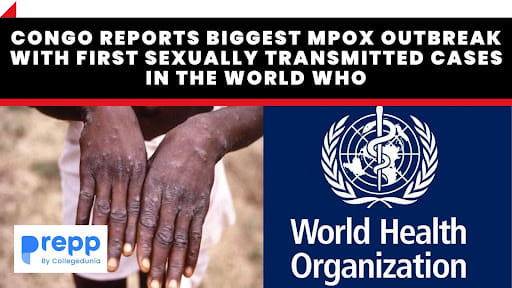
- Recently, a report by the WHO revealed that 12,569 suspected mpox cases, including 581 deaths, were reported in the Democratic Republic of Congo between January 1st and November 12th 2023.
- This was significant because it was the highest number of annual cases ever reported and included the first sexually transmitted infection of mpox in the world.
Table of Contents
What is mpox?
- Mpox is an infectious disease caused by the monkeypox virus (MPXV) with symptoms similar to smallpox but with less clinical severity.
- It was first discovered in 1958 following two outbreaks of a pox-like disease in colonies of monkeys kept for research. Hence the name ‘monkeypox’.
- It was first identified in humans in 1970 in the Democratic Republic of Congo (DRC).
- Symptoms:
- Rashes similar to those caused by chickenpox.
- Severe fever, malaise, and headache
- It can be distinguished from smallpox in the early stages based on the enlargement of the lymph gland.
- Transmission: The infection primarily spreads through direct contact with blood, bodily fluids, and cutaneous or mucosal lesions of an infected animal.
- Some experts have highlighted the risk posed by consuming inadequately cooked meat of infected animals.
- Mpox is endemic in the forested regions of west, central, and east Africa.
- This includes the northern and central regions of the DRC.
- However, an outbreak was reported in Kerala in 2022 making India the tenth country in Asia and the first in South Asia to report mpox.
- Treatment: Mpox is generally treated with supportive care but some countries have approved the use of vaccines and therapeutics developed for smallpox in some circumstances.
- For example, the EU has recommended Imvanex.
- In 2023, the WHO declared an end to the global health emergency for mpox.
- The WHO had declared mpox a public health emergency of international concern in July 2022 as the virus had spread to “non-endemic countries”.
What has the WHO report highlighted?
- Annual case burden: 12,569 suspected cases were reported in the DRC between January and November 2023.
- Deaths: 581 deaths were reported in the DRC in the same period.
- Spread: Infections were observed in previously unaffected areas such as Kinshasa, Lualaba, and South Kivu.
- Cases were reported in 22 out of 26 (85%) provinces in the DRC.
- The number of provinces identified as endemic for mpox increased from 11 to 22 as of November 2023.
How is the 2023 outbreak significant?
Highest number of annual cases of mpox ever recorded.
- The 2023 outbreak was the highest instance of annual cases recorded.
- The previous high was in 2020 when 4,594 suspected cases of mpox were recorded in 17 provinces between January 1 and September 13, 2020.
- In 2020, 171 deaths were reported from the 17 provinces.
First confirmed sexually-transmitted mpox infections
- There are two types of mpox virus (MPXV)
- Clade I also known as the Congo Basin Clade
- Clade II also known as the West African Clade.
- There are two sub-clades of Clade II - Clade IIa and Clade IIb.
- The WHO stated that only cases of mpox related to Clade I have been detected in the DRC.
- In March 2023, the first globally confirmed case of sexual transmission of Clade I was reported in the DRC.
- A Belgian traveler in Kwango province in DRC and their sexual contacts tested positive for the virus.
- Before this, no cases of sexual transmission of Clade I were registered globally.
First reported cases in Kinshasa, the capital of the DRC.
- In August 2023, mpox cases were confirmed in Kinshasa for the first time.
- Persons exposed in other provinces traveled to Kinshasa which led to local transmission with small clusters.
- The WHO claimed that the incidence and human-to-human transmission of mpox in a large urban area like Kinshasa was a clear example of the changes in the epidemiological nature of mpox in the DRC.
- The WHO and the Ministry of Health have undertaken a joint mission to assess the situation in the country.
WHO
- The World Health Organization (WHO) is the United Nations’ specialized agency for Health.
- It was founded in 1948 with its headquarters in Geneva, Switzerland.
- It began functioning on April 7, 1948, which is now celebrated as World Health Day.
- Membership: 194 Member States.
- Objectives:
- Lead and coordinate global efforts to expand universal health coverage.
- Focus on the areas of disease prevention, control, and elimination, and set global standards for public health
- Establish and maintain effective collaboration with specialized agencies, governmental health administrations, professional groups, and other organizations.
- Assist governments of members in strengthening health services on request.
- Promote cooperation among groups contributing to the advancement of health.
Democratic Republic of the Congo (DRC)
|
(*Click this link to read prelims specific weekly current affairs articles)
FAQs
Question: What is a clade?
Answer:
A clade is a group of organisms that are derived from a common ancestor and its lineal descendants. It also includes subtypes, genotypes, or groups that arise from a common ancestor.
Question: What is a global health emergency?
Answer:
A global health emergency is a situation that poses a serious threat to public health on an international scale. It is declared based on three criteria
- The spread is an Extraordinary Event
- It constitutes a Public Health Risk to other states
- It potentially requires a coordinated international response.
MCQs
Question: About three-fourths world’s cobalt, a metal required for the manufacture of batteries for electric motor vehicles, is produced by: (UPSC CSE 2023)
(a) Argentina
(b) Botswana
(c) the Democratic Republic of the Congo
(d) Kazakhstan
Answer: (c) See the Explanation
- The Democratic Republic of Congo (DRC) is the world's largest producer of cobalt.
- It accounts for around 70% of global production.
Therefore, option (c) is the correct answer.
Question: Which one of the following is a part of the Congo Basin? (UPSC 2023)
(a) Cameroon
(b) Nigeria
(c) South Sudan
(d) Uganda
Answer: (a) See the Explanation
The Congo Basin which passes through Central Africa spans six countries—Cameroon, Central African Republic, Democratic Republic of the Congo, Republic of the Congo, Equatorial Guinea, and Gabon.
Therefore, option (a) is the correct answer.
Question: Consider the following statements about mpox.
- It is a viral infection caused by the monkeypox virus (MPXV).
- It can be transmitted via sexual contact.
- It is endemic in central Africa and has not been reported from Asia.
How many of the above statements is/are correct?
(a) Only 1 statement
(b) Only 2 statements
(c) All 3 statements
(d) None of the above
Answer: (b) See the Explanation
- Mpox is a viral infection caused by the monkeypox virus (MPXV). Hence statement 1 is correct.
- It primarily spreads through direct contact with blood, bodily fluids, and cutaneous or mucosal lesions of an infected animal.
- In 2023 the first instance of sexually transmitted mpox was observed in the DRC. Hence statement 2 is correct.
- Mpox is endemic in the forested regions of west, central, and east Africa but an outbreak was reported in India in 2022.
- India was the tenth country in Asia to report an outbreak. Hence statement 3 is incorrect.
Therefore, option (b) is the correct answer.
Download the PREPP App and attempt FREE IAS Exam Mock Tests and get complete study material!

Full Test - 04: UPSC CSE Prelims CSAT (Paper-II)
Full Test - 03: UPSC CSE Prelims CSAT (Paper-II)
UPSC CSE Prelims 2026 GS Paper 1 Question Paper (24-May-2026)
UPSC CSE Prelims 2026 CSAT Paper 2 Question Paper (24-May-2026)

17 February 2025 | The Hindu Must Read Articles | Current Affairs

16 February 2026 | The Hindu Must Read Articles | Current Affairs

13 February 2026 | The Hindu Must Read Articles | Current Affairs









Comments