Commercial use of Lithium-Ion Battery Technology – Science & Technology Notes
Every day, lithium-ion batteries power the lives of millions of people. Lithium-ion technology has grown in part due to its ability to help improve productivity in demanding applications. It is long-lasting and fast-charging, robust and efficient. In this article, we will discuss in detail regarding Commercial use of Lithium-Ion Battery Technology which will be helpful for UPSC exam preparation.
Table of Contents
- Lithium-ion Battery – Background
- Lithium-ion Battery
- Working Principle of a Lithium-ion Battery
- Types of Lithium-ion Battery
- Commercial Applications of Lithium-ion Batteries
- Advantages of Lithium-ion Batteries
- Disadvantages of Lithium-ion Batteries
- Environmental Impact of Lithium-ion Batteries (LIB)
- Lithium-ion Battery Technology in India
- Potential Alternatives to Lithium-ion Technology
- Way Forward
- Conclusion
- FAQs
- MCQs
Lithium-ion Battery – Background
- John Goodenough decided to experiment with using lithium cobalt oxide as the cathode in the 1980s, doubling the energy potential.
- As a result, Akira Yoshino experimented with using a carbonaceous material, petroleum coke, and discovered that the battery was significantly safer with lithium metal.
- In addition, they received the Nobel Prize in Chemistry in 2019 for their meticulous research into practical lithium-ion batteries.
| Other Relevant Links | |
|---|---|
| NASA: Asteroid impact and deflection assessment mission | Hyperspectral imaging satellite |
| Water propulsion system in CUBESAT | Neutrino Observatory |
| Indian Space Vision-2025 | Major Policy Initiatives National Optical Fibre network |
| Spectrum Management | Cyber Law |
| Internet, Types of Network and e- Governance | Spectrum Policy in India |
| Mobile Spectrum | Cloud Computing |
| Big Data | Encryption |
| Biometrics | Virtual Reality |
What is a Lithium-ion Battery?
- A lithium-ion battery, also known as a Li-ion battery, is a rechargeable battery.
- In contrast to the metallic lithium used in non-rechargeable lithium batteries, lithium-ion batteries use an intercalated (the reversible inclusion or insertion of a molecule into materials with layered structures) lithium compound as one electrode material.
- The battery is made up of electrolyte, which allows for ionic movement, and two electrodes, which are the constituents of a lithium-ion battery cell.
- During discharge, lithium ions move from the negative electrode to the positive electrode and back again when charging.
- Many products use lithium-ion (Li-ion) batteries, including electronics, toys, wireless headphones, handheld power tools, small and large appliances, electric vehicles, and electrical energy storage systems.
- The increased market demand for Li-ion batteries can be attributed to the high "energy density" of this battery chemistry.
- While retaining the same amount of energy, lithium batteries can be smaller and lighter than other types of batteries.
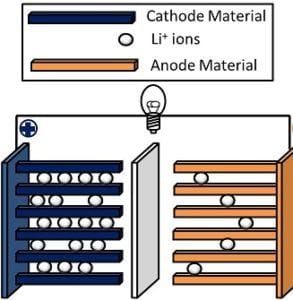
Schematic diagram of a Lithium-ion Battery
Working Principle of a Lithium-ion Battery
- An anode, cathode, separator, electrolyte, and two current collectors (positive and negative) comprise a battery.
- The lithium is stored in the anode and cathode.
- Through the separator, the electrolyte transports positively charged lithium ions from the anode to the cathode.
- The movement of the lithium ions in the anode generates free electrons, which generates a charge at the positive current collector.
- The electrical current then flows from the current collector to the negative current collector via a powered device (cell phone, computer, etc.).
- The separator prevents electrons from flowing inside the battery.
Charge/Discharge
- The anode releases lithium ions to the cathode while the battery discharges and provides an electric current, resulting in a flow of electrons from one side to the other.
- When the device is plugged in, the cathode releases lithium ions, which are received by the anode.
Energy Density vs Power Density
- The two most common battery concepts are energy density and power density.
- The amount of energy a battery can store in relation to its mass is measured in watt-hours per kilogramme (Wh/kg).
- Power density is measured in watts per kilogramme (W/kg) and is the amount of power that a battery can generate in relation to its mass.
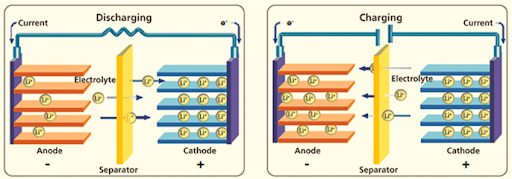
Working of a Lithium-ion Battery
Types of Lithium-ion Battery
1) Lithium Titanate (LTO)
- LTO has a long life span and a wide temperature range. They can handle large charge currents of more than 10C.
- They have one of the lowest energy densities (2.4V/Cell) and are one of the most expensive lithium batteries.
2) Lithium Cobalt Oxide (LCO)
- Because of its high energy density (3.6 V/Cell), LCO has grown in popularity.
- Cobalt is an extremely energy-dense material, but it is also extremely volatile and costly.
- It is a resource that is rapidly depleting due to recent increases in consumption.
- LCO has a number of drawbacks, including the inability to handle high charge currents, being temperature sensitive, and having a short cycle life.
3) Lithium Nickle Manganese Cobalt (NMC)
- The combination of nickel, manganese, and cobalt results in a very well-rounded battery.
- It has become one of the most desired batteries in the industry due to its high energy density (3.6V/Cell) and reduced use of cobalt.
- It is less dangerous than LCO due to its lower cobalt concentration. It has a longer life cycle than LCO but a shorter life cycle than LTO.
- It can handle charge currents of up to 2C and a wider temperature range.
- It is also important to understand that cobalt-containing batteries require more safety features, which raises the price of the batteries.
4) Lithium Iron Phosphate (LFP)
- LFP is widely used in industries with high usage and harsh environments.
- While this chemistry has a slightly lower energy density (3.2V/Cell), it is extremely durable.
- It has a long lifespan, is less expensive, and is much safer because it lacks cobalt. It can even withstand extremely high temperatures.
- Although LFP can withstand discharge currents of up to 20C, typical usage patterns include 1C.
- Overall, this is the most secure and dependable chemistry.
Commercial Applications of Lithium-ion Batteries
Power Backups/ Emergency Power/ UPS
- A lithium-ion battery provides instant backup power in the event of an emergency, allowing us to safely shut down or keep vital equipment running.
- These batteries are commonly used in computers, communication devices, and medical technology.
Solar Power Storage Units
Lithium-ion batteries are ideal for storing power at a solar power unit because they charge quickly, maximising solar power storage potential and allowing us to extract the most power from the sun.
Portable Power Source
Today, all of our electronic gadgets, such as mobile phones, bluetooth speakers, laptops, digital cameras, flashlights, and so on, are powered by rechargeable lithium-ion batteries, allowing us to use these devices freely.
Electric vehicles/mobility
- Vehicle emissions of fossil fuels are a major contributor to rising environmental pollution.
- Vehicles powered by lithium-ion batteries emit significantly less pollution, lowering our carbon footprint.
Drone System
- Lithium-ion batteries are also among the most popular drone battery types because they have a high energy density in relation to their size and weight.
- They also have a higher voltage per cell than their predecessors, allowing them to power the drone's on-board systems with fewer cells.
Advantages of Lithium-ion Batteries
- Increased Power Capacity: Lithium-ion power provides longer run times with no degradation in performance as the battery discharges. Lithium-ion batteries can keep cell voltage levels roughly three times higher than aqueous rechargeable chemistries.
- Less equipment maintenance: Unlike lead-acid batteries, which require much more manual attention to maintain, such as constant monitoring and adjusting of fluid and water levels, lithium-ion batteries have built-in technologies that reduce maintenance requirements.
- Extra space: Lithium-ion power eliminates the need to buy or store spare batteries, resulting in significant cost savings. Lithium-ion batteries offer high energy density and efficiency.
- Labour costs are reduced because lithium-ion batteries require less maintenance than lead-acid batteries, which require regular water maintenance.
- Charges faster: A rechargeable lithium-ion battery allows your devices to perform optimally.
- Li-ion batteries have no memory effect, which is a negative process in which a battery can 'remember' a lower capacity after repeated partial discharge/charge cycles. This is an advantage over Ni-Cd and Ni-MH, both of which exhibit this effect.
- Lithium-ion batteries have a low self-discharge rate of 1.5-2% per month.
- Also, since Lithium-ion Batteries do not contain toxic cadmium, they are easier to dispose of than Ni-Cd batteries.
Disadvantages of Lithium-ion Batteries
- Li-ion batteries overheat easily and can be damaged at high voltages. This can result in thermal runaway and combustion in some cases.
- Because of the risks associated with these batteries, several shipping companies refuse to ship batteries in bulk by plane.
- Li-ion batteries necessitate safety mechanisms to limit voltage and internal pressures, which can increase weight and, in some cases, limit performance.
- Li-ion batteries, like all batteries, age, which means they lose capacity and frequently fail after a few years.
- Another barrier to widespread adoption is their high cost, which is roughly 40% higher than Ni-Cd.
- The extraction of lithium and the manufacturing process of LIBs have a negative impact on the environment, and the use of toxic metals such as nickel, cobalt, magnesium, and others exacerbate the situation.
Environmental Impact of Lithium-ion Batteries (LIB)
| Positive Impact | Negative Impact |
|---|---|
|
|
Lithium-ion Battery Technology in India
- India, through a newly floated state-owned company Khanij Bidesh India Ltd, has signed an agreement with an Argentine firm to jointly prospect lithium in Argentina, a country with one of the world's largest lithium reserves.
- Khanij Bidesh India Ltd was formed in August 2019 by three state-owned companies, NALCO, Hindustan Copper, and Mineral Exploration Ltd, with the express purpose of acquiring strategic mineral assets such as lithium and cobalt from other countries.
- It is also said to be looking into options in Chile and Bolivia, two other major lithium producers.
- Lithium is a critical component of lithium-ion rechargeable batteries, which power electric vehicles (EVs), laptop computers, and mobile phones.
- India is currently heavily reliant on imports of these cells, and the move to ink sourcing pacts for lithium is seen as a move to reduce its reliance on China, which is a key source of both raw materials and cells.
- India is seen as a late entrant as it attempts to enter the lithium value chain, at a time when Electric Vehicles are expected to be a disruptor.
- The Indian Ministry of Electronics and Information Technology (MeitY) has transferred cost-effective lithium-ion battery recycling technology to nine recycling industries and start-ups as part of the Mission LiFE "Promote circularity campaign."
- Every year, India generates more than 50,000 tonnes of lithium-ion battery waste, which is increasing by 40-80%.
- Currently, India imports all of its Li from Australia and Argentina, as well as 70% of its Li-ion cell requirements from China and Hong Kong.
Recycling of Lithium-ion Battery
|
Potential Alternatives to Lithium-ion Technology
Graphene Batteries
Graphene batteries could be a viable alternative to lithium-ion batteries, which have limitations due to the frequency with which lithium must be charged. Graphene is a newly isolated and stabilised material.
Fluoride Batteries
They have the potential to last eight times as long as lithium batteries.
Sand Battery
- This lithium-ion battery alternative uses silicon to achieve three times the performance of current graphite Li-ion batteries.
- The battery is still lithium-ion, similar to that found in smartphones, but the anodes are made of silicon rather than graphite.
Ammonia-powered Batteries
- While ammonia-powered batteries are unlikely to appear anytime soon, the chemical commonly known as a household cleaner is a viable alternative to lithium in terms of powering fuel cells in vehicles and other equipment.
- If scientists can figure out how to produce ammonia without emitting the greenhouse gases that are currently produced, they will be able to ship it anywhere in the world to be converted into hydrogen to power those fuel cells.
Lithium-Sulfur Batteries
Researchers in Australia claim to have created the world's most powerful rechargeable lithium-sulfur battery, which is said to perform four times better than the strongest batteries currently available.
Solid-state Batteries
- It uses alternatives to aqueous electrolyte solutions, an innovation that could reduce the risk of fires, sharply increase energy density, and charge an EV in as little as 10 minutes, cutting recharging time by two-thirds.
- These cells can increase the driving range of a small electric vehicle while maintaining legroom - a significant advancement in battery technology.
Way Forward
- The Li-ion battery, which has been around for over 50 years, is still improving.
- Experts and researchers in the industry are constantly experimenting with new methods to push the limits and boundaries of current Li-ion technology.
- They are combining electrolytes, anodes, and cathodes to create a battery that is more energy-efficient, cost-effective, and significantly safer than the current version.
- The lithium-ion battery market is expected to grow at a CAGR of 13.1% from USD 44.5 billion in 2022 to USD 135.1 billion by 2031.
- As a result, lithium-ion battery manufacturers are feeling the market's pull as governments and OEMs around the world demand more energy and capacity at lower prices to meet current market demands.
- A second area with significant production potential is energy storage in relation to grid stabilisation and storage.
- Furthermore, environmentally responsible and sustainable methods of extracting lithium from nature that use less energy are being developed.
Conclusion
Lithium-ion battery technology has redefined how we store and utilize energy, becoming the cornerstone of modern innovation. India's initiatives in promoting electric mobility and advancing battery technology reflect its commitment to a cleaner, sustainable future. As we stand on the precipice of a technological revolution powered by lithium-ion batteries, their integration into various facets of our lives promises to reshape the world as we know it.
| Other Relevant Links | |
|---|---|
| Science & Technology Policy in India | Scientific Policy Resolution 1958 |
| Science & Technology Policy of 1983 | Science & Technology Policy of 2003 |
| Science, Technology and Innovation Policy 2013 | New Initiatives Aligned with the National Agenda |
| India and World collaboration in science projects | Technology Vision Document 2035 |
FAQs
Question: What are Lithium-ion batteries and how do they work?
Answer: Lithium-ion batteries are rechargeable energy storage devices that use lithium ions to move between the anode and cathode. They store and release electrical energy during charging and discharging, making them ideal for portable electronics and electric vehicles.
Question: What are the advantages of Lithium-ion batteries over other types of batteries?
Answer: Lithium-ion batteries are lighter, have higher energy density, and longer life cycles compared to other rechargeable batteries like lead-acid and nickel-cadmium, making them more efficient and cost-effective in various applications.
Question: What is the impact of Lithium-ion batteries on renewable energy?
Answer: Lithium-ion batteries play a key role in renewable energy by storing excess energy produced by solar and wind systems. This helps in stabilizing the grid and providing power during non-production periods, aiding in energy transition goals.
Question: What are the environmental concerns associated with Lithium-ion batteries?
Answer: The main environmental concerns are related to the extraction of lithium and cobalt, which can cause habitat destruction and pollution. Additionally, the disposal and recycling of these batteries present challenges due to hazardous chemicals.
Question: How can the performance of Lithium-ion batteries be improved?
Answer: Performance can be improved by enhancing the battery's anode and cathode materials, optimizing electrolyte solutions, and developing advanced charging technologies. Better thermal management also helps in increasing the efficiency and lifespan of the batteries.
MCQs
1. Which of the following is the primary component used in Lithium-ion batteries?
A) Lead
B) Nickel
C) Lithium
D) Zinc
Answer: (C) See the Explanation
Explanation: Lithium is the primary component used in Lithium-ion batteries, which are known for their lightweight, high energy density, and long life cycle compared to other battery types.
2. What is a key advantage of Lithium-ion batteries over lead-acid batteries?
A) Lower energy density
B) Higher energy density
C) Higher weight
D) Shorter lifespan
Answer: (B) See the Explanation
Explanation: Lithium-ion batteries have a much higher energy density compared to lead-acid batteries, allowing them to store more energy in a smaller, lighter package, making them ideal for use in electric vehicles and portable devices.
3. What is one of the major environmental concerns related to Lithium-ion batteries?
A) Excessive heat generation
B) Pollution from extraction of materials
C) Low energy density
D) High manufacturing costs
Answer: (B) See the Explanation
Explanation: The extraction of lithium and cobalt used in Lithium-ion batteries can cause significant environmental damage, including habitat destruction and pollution, which is a key concern in the battery’s lifecycle.
4. Which of the following applications primarily uses Lithium-ion batteries?
A) Solar power plants
B) Wind turbines
C) Electric vehicles
D) Fossil fuel plants
Answer: (C) See the Explanation
Explanation: Lithium-ion batteries are widely used in electric vehicles due to their high energy density, lightweight nature, and longer lifespan, which make them ideal for powering vehicles over long distances.
5. What is one solution to improve the environmental impact of Lithium-ion batteries?
A) Increased use of plastics
B) Better recycling processes
C) Reduced battery size
D) Lower energy density
Answer: (B) See the Explanation
Explanation: Improving recycling processes for Lithium-ion batteries can help reduce environmental impact by reusing valuable materials and reducing the need for mining, thereby lowering ecological damage.
GS Mains Questions and Model Answers
Q1: Discuss the role of Lithium-ion batteries in the transition to renewable energy. How can their adoption impact energy systems globally?
Answer: Lithium-ion batteries are essential in supporting renewable energy systems, particularly solar and wind, by providing energy storage solutions. They allow for energy to be stored during periods of excess production and used during periods of high demand or low production. Their adoption can enhance grid stability, reduce reliance on fossil fuels, and accelerate the shift towards a cleaner, more sustainable energy future. However, challenges such as battery disposal, material sourcing, and recycling need to be addressed to ensure long-term sustainability.
Q2: Evaluate the environmental and socio-economic challenges of Lithium-ion battery production. What measures can mitigate these challenges?
Answer: The production of Lithium-ion batteries presents environmental challenges, primarily due to the mining of lithium and cobalt, which can result in habitat destruction, pollution, and human rights issues. Additionally, the carbon footprint from battery manufacturing contributes to environmental degradation. Socio-economic challenges include the heavy reliance on limited geographic regions for raw materials, which can create supply chain vulnerabilities. Measures to mitigate these include adopting sustainable mining practices, improving recycling technologies, and promoting the use of alternative materials such as sodium-ion and solid-state batteries.
Q3: Analyze the potential of Lithium-ion batteries to support electric mobility in India. What are the key challenges and solutions?
Answer: Lithium-ion batteries are crucial to the growth of electric mobility in India, providing an efficient, sustainable, and cost-effective power source for electric vehicles (EVs). However, challenges include high battery costs, limited charging infrastructure, and the environmental impact of raw material extraction. Solutions include government incentives for EV adoption, investments in charging infrastructure, and research into more affordable and sustainable battery technologies. Additionally, improving recycling processes for used batteries can address environmental concerns.
Previous Year Questions on Lithium-ion Batteries
1. UPSC CSE Prelims 2022:
Question: Which of the following is the primary environmental concern associated with the production of Lithium-ion batteries?
A) CO2 emissions from manufacturing
B) Water usage in lithium extraction
C) Habitat destruction from mining raw materials
D) Air pollution from battery disposal
Answer: (C)
Explanation: The primary environmental concern is habitat destruction caused by the mining of raw materials like lithium and cobalt, which can lead to significant ecological damage.
2. UPSC CSE Mains 2020 (GS Paper 3):
Question: Analyze the challenges and solutions associated with the widespread adoption of Lithium-ion batteries in the transportation sector.
Answer: Lithium-ion batteries are key to the electric mobility revolution, offering high energy density and long lifespan. However, challenges such as high manufacturing costs, limited range, and environmental impact of raw material extraction need to be addressed. Solutions include advancing battery technology, expanding charging infrastructure, and improving recycling methods to reduce environmental harm. The development of alternative materials and more efficient recycling systems can help mitigate challenges in the long term.
Download the PREPP App and attempt FREE IAS Exam Mock Tests and get complete study material!
UPSC IAS : CSAT - Mini Live Test

Live Test : UPSC CSE Prelims CSAT (Paper-II) (Sep 20 - 23)
Full Test - 03: UPSC CSE Prelims CSAT (Paper-II)
Full Test - 02: UPSC CSE Prelims CSAT (Paper-II)
UPSC CSE Prelims 2026 GS Paper 1 Question Paper (24-May-2026)
UPSC CSE Prelims 2026 CSAT Paper 2 Question Paper (24-May-2026)

17 February 2025 | The Hindu Must Read Articles | Current Affairs

16 February 2026 | The Hindu Must Read Articles | Current Affairs

13 February 2026 | The Hindu Must Read Articles | Current Affairs









Comments