Coal Output Grew By 18.6% In October, Data Shows
Relevance: GS3 - Indian Economy, Growth and Development, Infrastructure; Mineral & Energy Resources
(Source: The Hindu, 11/04/2023)
Click here for Daily Current Affairs
Why in the news?
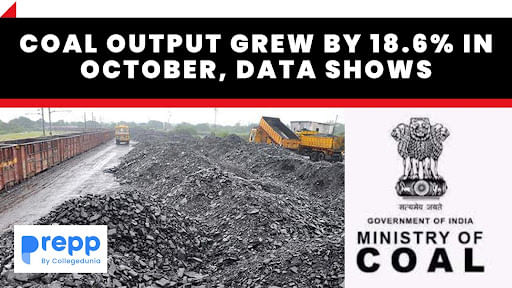
- Recently, the Coal Ministry released the coal output data for the month of October, which represents the fourth consecutive month of double-digit growth.
- The significant demand for coal from mining sites to various end-use industries suggests that electricity generation experienced sustained and robust growth in the past month.
Table of Contents
Key Points
- India experienced a substantial surge in coal production, reaching its highest growth rate in 16 months at 18.6% in October, resulting in a total output of 78.65 million tonnes (MT).
- This increase in production was accompanied by an 18.1% rise in coal deliveries to key consumers, including the power sector, reaching a total of 79.3 MT, surpassing previous figures.
- In September, Coal output had risen 16.1% while electricity generation rose 9.3%. The two infrastructure sectors have a combined weightage of 30.2% in the Index of Core Industries or ICI.
- The combined coal production from April to October 2023 has surged by 13.05%, reaching a total of 507.02 million tonnes (MT), in contrast to 448.49 MT during the equivalent period in the previous year.
About Coal Sector in India
- India has the fifth largest coal reserves, and is second in coal production after China.
- It is among the largest importer of coal mainly from Indonesia, South Africa and Australia.
- Coal accounts for almost 50% share in the total installed electricity generation capacity in India.
- The predominant use of the extracted coal is in the generation of electricity, while the remaining portion serves various industrial sectors, including cement, steel, and other industries.
- Import of Coal: According to the current import policy, coal can be freely imported (under Open General Licence) by consumers based on their commercial prudence and needs.
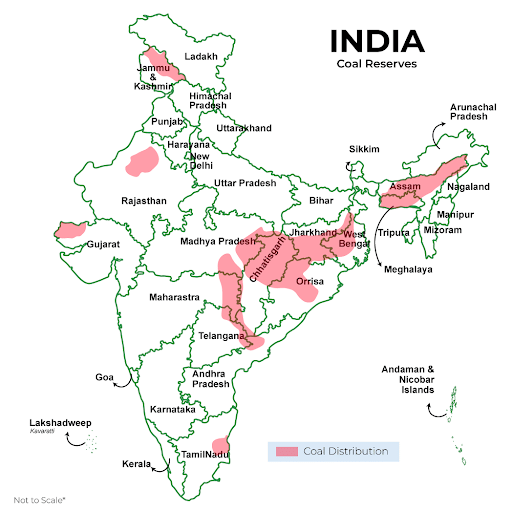
- Top five states in terms of total coal reserves in India are:
- Jharkhand
- Odisha
- Chhattisgarh
- West Bengal
- Madhya Pradesh
| Type of Coal | Description |
|---|---|
| Anthracite |
|
| Bituminous |
|
| Lignite |
|
| Subbituminous |
|
Formation of Coal
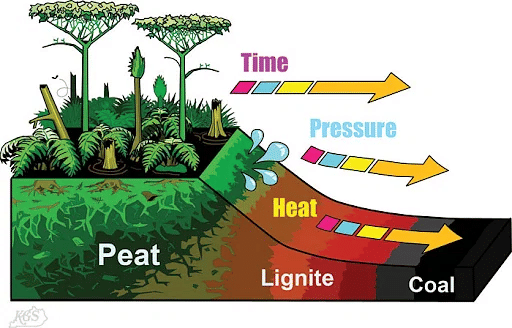
- Coal is formed when dead plant matter decays into peat, which is then converted to coal over millions of years by the heat and pressure of deep burial.
- Around 300 million years ago, when the earth was covered in swampy (marshy) forests, coal was formed.
- Some of the plants died and fell into the swamp waters as they grew.
- New plants sprouted in their place, and when those died, more sprouted.
- Over time, the swamp accumulated a thick layer of rotting plants.
- The earth's surface shifted, allowing water and dirt to wash in, halting the decaying process.
- More plants sprouted, but they died and fell as well, separating the layers.
- Many layers had formed over millions of years, one on top of the other.
- The weight of the top layers, as well as water and dirt, compacted the plant matter in the lower layers.
- Heat and pressure caused chemical and physical changes in the plant layers, forcing oxygen out and leaving rich carbon deposits in its place.
- The material that had been planted eventually turned into coal.
Government Initiatives
UTTAM: The Ministry of Coal launched the UTTAM (Unlocking Transparency through Third Party Assessment of Mined Coal) application for coal quality monitoring in April 2018. The app's goal is to increase transparency and efficiency in the coal quality monitoring process, as well as bring coal governance closer to the people.
Coal Linkage Policy: The Cabinet Committee on Economic Affairs (CCEA) has approved a new coal linkage policy that uses a reverse auction to ensure adequate fuel supply to power plants.The new policy will aid in ensuring that fuel is delivered to power plants in a timely and orderly manner.
Online Coal Clearances System: The Ministry of Coal has developed the Online Coal Clearances System to give its investors a single point of contact for all permissions, clearances, and approvals granted by the Ministry of Coal.
Coal Allocation Monitoring System (CAMS): It was created to track the transparent allocation of coal by CIL to States, States to SNA, and SNA to such consumers.
Commercial coal mining is being made available to Indian and foreign companies in the private sector.
(*Click this link to read prelims specific weekly current affairs articles)
FAQs
Question: What are Eight Core Industries?
Answer:
Natural Gas, Coal, Refinery Products, Crude Oil, Cement, Electricity, Steel, and Fertilizers are among the eight core industries. These industries are referred to as core industries because of their significant impact on general economic and industrial activities.
Question: Where is the largest coal reserve in India?
Answer:
Jharkhand has the largest reserves of coal in India followed by Odisha and Chhattisgarh.
Question: What is India's main source of energy?
Answer:
Coal, oil, and solid biomass account for more than 80% of India's energy needs. Coal has fueled the growth of electricity generation and industry, and it continues to be the most important fuel in the energy mix.
MCQ
Question: The Index of Industrial Production (IIP) is not calculated for which of the following industries?
(a) Coal industry
(b) Refinery sector
(c) Agriculture sector
(d) Steel industry
Answer: (c) See the Explanation
The Index of Industrial Production (IIP) is calculated using statistics from eight sectors, which includes all three sectors except agriculture.
Therefore, option (c) is the correct answer.
Download the PREPP App and attempt FREE IAS Exam Mock Tests and get complete study material!

Full Test - 04: UPSC CSE Prelims CSAT (Paper-II)
Full Test - 03: UPSC CSE Prelims CSAT (Paper-II)
UPSC CSE Prelims 2026 GS Paper 1 Question Paper (24-May-2026)
UPSC CSE Prelims 2026 CSAT Paper 2 Question Paper (24-May-2026)

17 February 2025 | The Hindu Must Read Articles | Current Affairs

16 February 2026 | The Hindu Must Read Articles | Current Affairs

13 February 2026 | The Hindu Must Read Articles | Current Affairs









Comments