Cloud Computing – Science & Technology Notes
Cloud computing is the delivery of computing services such as servers, storage, databases, networking, software, analytics, and intelligence via the Internet ("the cloud") in order to provide faster innovation, more flexible resources, and economies of scale. In this article, we will discuss regarding Cloud Computing which will be helpful for UPSC exam preparation.
Table of Contents
What is Cloud Computing?
- It is the delivery of various services via the Internet. Data storage, servers, databases, networking, and software are examples of these resources.
- Instead of storing files on a proprietary hard drive or local storage device, cloud-based storage allows them to be saved to a remote database.
- Cloud storage has grown in popularity among individuals who require more storage space and businesses looking for an efficient off-site data backup solution.
- Cloud storage allows you to save files to a remote database and retrieve them whenever you want.
- As long as an electronic device has internet access, it has access to data and the software programmes needed to run it.
- People and businesses like it for a variety of reasons, including cost savings, increased productivity, speed and efficiency, performance, and security.
- Services can be both public and private—public services are delivered online for a fee, whereas private services are delivered to specific clients via a network.
- Cloud security has grown in importance in the IT industry.
| Other Relevant Links | |
|---|---|
| NASA: Asteroid impact and deflection assessment mission | Commercial use of Lithium-Ionbattery technology |
| Hyperspectral imaging satellite | Water propulsion system in CUBESAT |
| Neutrino Observatory | Indian Space Vision-2025 |
| Major Policy Initiatives National Optical Fibre network | Spectrum Management |
| Cyber Law | Internet, Types of Network and e- Governance |
| Spectrum Policy in India | Mobile Spectrum |
| Big Data | Encryption |
| Biometrics | Virtual Reality |
What is Edge Computing?
|
How Does Cloud Computing Work?
- Companies can rent access to anything from applications to storage from a cloud service provider rather than owning their own computing infrastructure or data centres.
- One advantage of using cloud computing services is that businesses can avoid the upfront costs and complexity of owning and maintaining their own IT infrastructure by simply paying for what they use, when they use it.
- In turn, cloud computing service providers can benefit from significant economies of scale by providing the same services to a diverse set of customers.
Types of Cloud Computing – Deployment Models
Public Cloud
- Everything in a public cloud is stored and accessed via the internet.
- Anyone with the necessary permissions can access some of the applications and resources through this deployment system.
- The most exciting aspect of the public cloud is that you do not own any of its components, whether they are hardware, software, or applications.
- The provider manages all of the components in this case. Amazon Web Services and Microsoft Azure are two prominent public cloud examples.
Private Cloud
- A private cloud is used solely by businesses, which can run it locally or outsource it to other cloud service providers.
- This infrastructure operates solely on a private network, which means that it is only accessible to those who are present on the network.
- Some examples of private clouds include the VMware cloud and some AWS products.
Hybrid Cloud
- It is most likely the most fascinating type of Cloud Computing because it combines the functionality of both public and private clouds.
- Organisations that use the hybrid cloud can keep some of their data on-premises and some in the cloud.
- NASA is the most well-known example of a hybrid cloud organisation. It stores sensitive data in a private cloud and saves and shares data that is accessible to the public worldwide in the public cloud.
Multicloud
- The use of multiple cloud computing and storage devices in a single architecture distinguishes hybrid cloud from multicloud.
- A multicloud exists when an organisation uses multiple clouds from different providers.
- This has a lot of potential benefits. When you use multiple vendors, for example, you can mix and match features and functionality.
Types of Cloud Computing Services
Infrastructure as a Service (IaaS)
- IaaS provides the fundamental building blocks for cloud computing.
- It usually gives you access to networking features, computers (virtual or physical), and data storage space.
- IaaS provides you with the most flexibility and management control over your IT resources.
- It is most similar to existing IT resources that many IT departments and developers are already familiar with.
Platform as a Service (PaaS)
- PaaS eliminates the need for you to manage underlying infrastructure (typically hardware and operating systems), allowing you to focus on application deployment and management.
- This makes you more efficient because you don't have to worry about resource acquisition, capacity planning, software maintenance, patching, or any of the other undifferentiated heavy lifting associated with running your application.
Software as a Service (SaaS)
- SaaS provides you with a fully functional product that is operated and managed by the service provider.
- Most people who use the term SaaS are referring to end-user applications (such as web-based email).
- You don't have to worry about how the service is maintained or how the underlying infrastructure is managed when you use a SaaS offering.
- You only need to consider how you intend to use the software.
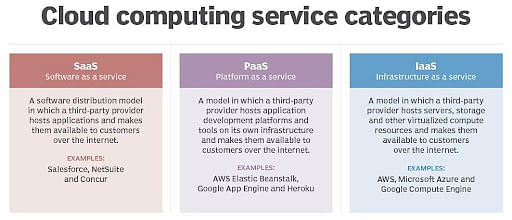
Different Types of Cloud Computing Services
AWS, Azure and Google Cloud – Major Players
|
Applications of Cloud Computing
Infrastructure Scaling
- Many organisations, including those in retail, have wildly varying compute capacity requirements. These fluctuations are easily accommodated by cloud computing.
Disaster Recovery
- Businesses use cloud computing to safely backup their digital assets rather than building more data centres to ensure continuity during disasters.
Data Storage
- Cloud computing relieves overburdened data centres by storing large amounts of data, making it more accessible, facilitating analysis, and simplifying backup.
Application Development
- Cloud computing provides enterprise developers with immediate access to tools and platforms for developing and testing applications, reducing time to market.
Big Data Analytics
- Cloud computing provides nearly limitless resources for processing large amounts of data in order to accelerate research and reduce time to insights.
Benefits of Cloud Computing
Flexible
- Because of the cloud computing architecture, businesses and their users can access cloud services from anywhere with an internet connection, scaling services up or down as needed.
Efficiency
- Enterprises can create new applications and deploy them quickly without having to worry about the underlying infrastructure.
Strategic Value
- Because cloud providers keep up with the latest innovations and offer them to customers as services, enterprises can gain more competitive advantages—and a higher return on investment—than if they invested in soon-to-be obsolete technologies.
Secure
- Because of the depth and breadth of the security mechanisms put in place by cloud providers, cloud computing security is generally regarded as stronger than that in enterprise data centres.
Cost Effective
- Enterprises only pay for the computing resources they use, regardless of the cloud computing service model used.
- They don't have to overbuild data centre capacity to handle unexpected spikes in demand or business growth, and they can redirect IT resources to more strategic initiatives.
Challenges of Cloud Computing
Cloud Security
- Security is frequently cited as the most difficult challenge in cloud computing.
- Organisations that rely on the cloud risk data breaches, API and interface hacking, compromised credentials, and authentication issues.
- Furthermore, there is a lack of transparency regarding the handling of sensitive data entrusted to the cloud provider.
Cost Unpredictability
- Pay-as-you-go cloud subscription plans, as well as scaling resources to accommodate fluctuating workload demands, can make it difficult to define and predict final costs.
- Cloud costs are also frequently interdependent, with one cloud service frequently utilising one or more other cloud services – all of which appear on the monthly recurring bill.
- This may result in additional unanticipated cloud costs.
Lack of Capability and Expertise
- Organisations are struggling to keep up with the growing demand for tools and employees with the necessary skill sets and knowledge to architect, deploy, and manage workloads and data in the cloud, as cloud-supporting technologies advance at a rapid pace.
IT Governance
- Because there is no control over provisioning, deprovisioning, or management of infrastructure operations in cloud computing, IT governance can be difficult.
- This can make it difficult to manage risks and security, IT compliance, and data quality effectively.
Compliance
- It can be difficult to manage compliance with industry regulations when transferring data from on-premises local storage to cloud storage via a third party.
- In order to maintain regulatory compliance and proper business governance, it is critical to understand where data and workloads are actually hosted.
Management of Multiple Clouds
- Because each cloud is unique, multi-cloud deployments can fragment efforts to address more general cloud computing challenges.
Cloud Performance
- The organisation contracting cloud services with a provider has little control over performance, such as latency.
- If organisations do not have contingency plans in place, network and provider outages can interfere with productivity and disrupt business processes.
Building a Private Cloud
- Architecting, building, and managing private clouds, whether for their own use or as part of a hybrid cloud strategy, can be a difficult task for IT departments and staff.
Cloud Migration
- The process of migrating applications and other data to the cloud is frequently fraught with complications.
- Migration projects frequently take longer than expected and cost more than expected.
- Workload and data repatriation (moving from the cloud to a local data centre) is frequently overlooked until unexpected cost or performance issues arise.
Vendor Lock-in
- Changing cloud providers can frequently cause significant problems.
- This includes technical incompatibilities, legal and regulatory constraints, and the significant costs associated with large data migrations.
Cloud Computing in India
- Cloud computing has found applications in India in recent years, as it is used in people's daily activities such as social networking, mail, online purchases, and large-scale MNC operations such as big data, Internet of Things (IoT), and so on.
- Cloud computing has enormous growth potential for Indian firms and is opening up new doors of opportunity.
- Retail, railways, manufacturing, banking, education, and healthcare have all begun to use cloud services.
- While the Indian Telegraph Act of 1885, the Civil Procedure Code of 1908, and the Telecom Regulatory Authority of India Act of 1997 all deal with this sector in some way, the Information Technology (IT) Act of 2000 is more relevant for regulating it.
- The IT Act of 2000 includes provisions for penalties for data and privacy violations. The Act addresses e-commerce and cybercrime in general, as well as data protection and privacy.
- While the laws mentioned above address some legal issues concerning cloud computing, they do not address the scope of cloud computing services and the issues that arise as a result of them.
Key Initiatives in Cloud Computing
E-Gram Panchayat
- The Panchayats are the face of governance for the majority of the Indian population, who live in villages.
- The Indian government launched an e-governance scheme known as ePanchayat to simplify and improve internal government operations in order to improve governance quality.
Indian Railways
- The Indian railway network, which is managed by the Central Railway Ministry of India, is the largest in Asia and the second-largest in the world.
- According to railway ministry research, only 1 million of 17 million passengers each day have confirmed rail tickets. This results in significant monetary loss.
- The Indian government decided to implement cloud technology for Indian railways in order to avoid loss.
- The central government now stores railway data in the cloud.
- RailCloud - The Indian Railways has launched RailCloud, a cloud-based service that will allow for faster connectivity at a low cost.
- Nivaran Grievance Portal - It is RailCloud's first IT application. It is a forum for serving and former railway employees to resolve service-related grievances.
Kisan Suvidha
- The Indian government created the portal Kisan Suvidha to provide farmers with timely information.
- It provides farmers with in-depth information about the weather, market prices, seeds, fertilisers, pesticides, agriculture machinery, dealers, agro advisories, plant protection, and IPM practises.
- It alerts them to extreme weather conditions and changes in market price.
DigiLocker
- DigiLocker is the Indian government's public cloud-based storage service for Indian citizens.
- It is much more than an online drive where you can upload documents to be accessed at your leisure.
- In a matter of seconds, the documents are digitally verified and signed by the government of India using an authentic DigiLocker verification seal.
- DigiLocker has proven to be one of the most successful cloud success stories in government, with over 57.13 million users and 4.27 billion issued documents.
eHospital
- eHospital is a cloud-based healthcare project implemented by the Indian government to simplify healthcare management.
- The system was designed to expedite services such as online registration, fee and appointment payment, online diagnostic reports, checking blood availability online, and so on.
- At the time of registration, each patient is assigned a unique identification number under this hospital model. The number can be used to access a specific patient's medical history.
Government e-Marketplace (GeM)
- The Government e-Marketplace (GeM), one of India's most significant initiatives, employs a multi-cloud architecture to ensure scalability.
- The GeM now serves over 50,000 buyer organisations and has a catalogue of over 19 lakh products and 80,000 services.
National Highway Authority of India (NHAI)
- Recently, the National Highway Authority of India (NHAI) has announced the launch of a groundbreaking cloud-based and AI-powered big analytics platform.
- All NHAI-related project documents and correspondence will be stored in a cloud-based data lake that is linked with GIS tagging and a unique project ID, allowing project data to be easily retrieved from any location.
Hospital Management Information System
- The Indian Railways has been tasked with deploying an open source Hospital Management Information System (HMIS), an integrated clinical information system, across the country for improved hospital administration and patient healthcare, using a cloud platform.
- The government's E-health vision includes incorporating the Health Information Exchange (HIE) mechanism via a cloud platform.
- An electronic HIE enables stakeholders to accurately assess and securely share medical information about patients electronically.
MeghRaj
- To capitalise on and reap the benefits of cloud computing, the Government of India has launched an ambitious initiative called "GI Cloud," also known as "MeghRaj."
- This initiative will implement various components, including governance mechanisms, to ensure the spread of cloud computing in government.
- The goal of this initiative is to accelerate the delivery of e-services in the country while also optimising the government's ICT spending.
- MeghRaj will optimise infrastructure utilisation and accelerate the development and deployment of eGov applications.
Infrastructure Sector
- The mission of smart cities is to facilitate local development through the use of technology such as cloud computing.
- Furthermore, the government has recognised the importance of cloud-based service delivery for Digital India because it integrates smart devices and infrastructure and processes a large amount of data in real-time from various sources.
Banking Sector
- The Reserve Bank of India (RBI) has been utilising technology to achieve 100% financial inclusion.
- The Reserve Bank of India (RBI) has been using cloud-based solutions, particularly for cooperative banks, to extend banking services across India via core banking solutions.
- The use of cloud computing in the banking sector will result in shorter timelines and a shift in cost from capital expenditure to operational expenditure, allowing banks to focus on core banking operations.
- The Indian Banking Community Cloud (IBCC) is the country's first community cloud initiative for the banking industry.
Manufacturing Sector
- CRM (Customer Relationship Management), supply chain applications, data warehousing, information security, green IT, Human Machine Interface (HMI), and other common Cloud Computing applications in the manufacturing sector.
Telecom Sector
- Deploying operations and business support systems on cloud platforms is a highly effective method for addressing the telecom sector's various business and technical challenges.
- Cloud platforms are an effective way for telecom companies to facilitate resource sharing, automation, monitoring, managing software upgrades, and improving operations.
Startups & SMEs
- The low capital investment and quick marketing time provided by cloud services encourage entrepreneurship in the country, allowing start-ups and small-medium businesses to start small and expand as demand dictates.
- Digital MSME Scheme - It offers cloud-based services to MSMEs in order to reduce costs by avoiding the construction of in-house IT infrastructure.
Conclusion
Cloud computing is a networked service that combines software and hardware-based computing resources. This IT-enabled service model provides 24/7 access to a shared pool of applications and resources. Cloud computing enables access to shared resources and common infrastructure while providing on-demand services over networks to meet changing business needs.
| Other Relevant Links | |
|---|---|
| Science & Technology Policy in India | Scientific Policy Resolution 1958 |
| Science & Technology Policy of 1983 | Science & Technology Policy of 2003 |
| Science, Technology and Innovation Policy 2013 | New Initiatives Aligned with the National Agenda |
| India and World collaboration in science projects | Technology Vision Document 2035 |
FAQs
Question: What is cloud computing?
Answer: Cloud computing refers to the delivery of on-demand computing resources, including storage, applications, and processing power, over the internet.
Question: What are the types of cloud computing?
Answer: Cloud computing is categorized into three types:
- Public Cloud: Services offered over the internet for multiple users.
- Private Cloud: Dedicated services for a single organization.
- Hybrid Cloud: A combination of public and private cloud models.
Question: What are the benefits of cloud computing?
Answer: Benefits include scalability, cost-efficiency, remote accessibility, real-time collaboration, and integration with emerging technologies.
Question: How does cloud computing support emerging technologies?
Answer: Cloud computing provides the infrastructure required for data-intensive technologies like AI, machine learning, big data analytics, and IoT.
Question: What are the challenges of cloud computing?
Answer: Challenges include data security risks, dependency on internet connectivity, and compliance with data privacy regulations.
MCQs
- What is the primary feature of cloud computing?
A) On-premise data storage
B) Real-time processing of data over the internet
C) Offline data analysis
D) Manual hardware maintenance
Answer: (B) See the Explanation
Cloud computing enables users to process and access data remotely in real time using internet-based services.
- Which of the following is a type of cloud computing?
A) Virtual Cloud
B) Public Cloud
C) Physical Cloud
D) Core Cloud
Answer: (B) See the Explanation
Public Cloud is a widely used model where services are delivered over the internet to multiple users.
- What does "scalability" in cloud computing refer to?
A) Increasing hardware requirements manually
B) On-demand adjustment of resources based on user needs
C) Limiting access to resources
D) Providing offline services
Answer: (B) See the Explanation
Scalability allows cloud services to expand or reduce resources depending on the user’s requirements.
- Which of the following industries has benefited significantly from cloud computing?
A) Education
B) Healthcare
C) Finance
D) All of the above
Answer: (D) See the Explanation
Cloud computing has transformed various industries, including education, healthcare, and finance, by enhancing efficiency and collaboration.
- What is the main challenge associated with cloud computing?
A) High initial investment
B) Data security risks
C) Limited technological applications
D) Absence of scalability
Answer: (B) See the Explanation
One of the primary challenges of cloud computing is ensuring data privacy and protection from cyber threats.
GS Mains Questions and Model Answers
Q1: Discuss the significance of cloud computing in the digital transformation of industries.
Answer: Cloud computing plays a pivotal role in the digital transformation of industries by providing on-demand computing resources, enabling scalability, and reducing infrastructure costs. It enhances efficiency through remote accessibility, real-time collaboration, and integration with emerging technologies like artificial intelligence (AI), big data analytics, and the Internet of Things (IoT). Industries such as healthcare, education, and finance leverage cloud computing for secure data storage, telemedicine, online learning platforms, and digital payments. Additionally, it supports small and medium enterprises (SMEs) by offering cost-effective solutions to access advanced technologies. Despite its benefits, challenges like data security risks and compliance with privacy regulations persist. Addressing these concerns through robust cybersecurity measures and clear regulatory frameworks can maximize the potential of cloud computing, making it a cornerstone of modern digital economies.
Q2: Analyze the advantages and challenges of adopting cloud computing in government services.
Answer: Cloud computing offers several advantages for government services, including cost-efficiency, scalability, and improved service delivery. By centralizing data storage and enabling inter-departmental collaboration, cloud solutions enhance transparency and efficiency. Governments can use cloud platforms for e-governance, disaster management, and citizen-centric services such as digital payments and online grievance redressal systems. Additionally, cloud computing supports large-scale data analysis, aiding in policy formulation and implementation. However, challenges include data security concerns, dependency on external service providers, and regulatory compliance issues. Governments must adopt robust cybersecurity frameworks and ensure data localization to address these challenges. Developing in-house cloud infrastructure and collaborating with trusted service providers can further enhance the adoption of cloud computing in public administration.
Q3: How does cloud computing facilitate the growth of emerging technologies like AI and IoT?
Answer: Cloud computing facilitates the growth of emerging technologies like Artificial Intelligence (AI) and the Internet of Things (IoT) by providing the necessary computational power and data storage infrastructure. AI applications require extensive data processing and machine learning capabilities, which cloud platforms support through scalable and cost-effective solutions. IoT, which connects devices for real-time data exchange, relies on cloud computing for data integration, analysis, and storage. Cloud services enable seamless communication between IoT devices, enhancing automation and efficiency in industries such as healthcare, manufacturing, and agriculture. Moreover, the combination of cloud computing and these technologies drives innovation, enabling advanced applications like smart cities, autonomous vehicles, and predictive analytics. By reducing barriers to technology adoption, cloud computing serves as the backbone for the proliferation of AI and IoT.
Previous Year Questions on Cloud Computing
1. UPSC CSE 2020
Question: "Discuss the role of cloud computing in enhancing e-governance initiatives in India."
Answer: Cloud computing enhances e-governance initiatives by centralizing data storage, enabling inter-departmental collaboration, and improving service delivery. Platforms like MeghRaj support scalable and cost-effective infrastructure, facilitating services like Aadhaar authentication, online grievance redressal, and digital payments.
2. UPSC CSE 2019
Question: "Evaluate the challenges of integrating cloud computing with cybersecurity frameworks."
Answer: Integrating cloud computing with cybersecurity frameworks is challenging due to risks like data breaches, dependency on external service providers, and compliance issues. Strengthening encryption, access control, and regulatory oversight is essential for secure cloud adoption.
Download the PREPP App and attempt FREE IAS Exam Mock Tests and get complete study material!

Full Test - 04: UPSC CSE Prelims CSAT (Paper-II)
Full Test - 03: UPSC CSE Prelims CSAT (Paper-II)
UPSC CSE Prelims 2026 GS Paper 1 Question Paper (24-May-2026)
UPSC CSE Prelims 2026 CSAT Paper 2 Question Paper (24-May-2026)

17 February 2025 | The Hindu Must Read Articles | Current Affairs

16 February 2026 | The Hindu Must Read Articles | Current Affairs

13 February 2026 | The Hindu Must Read Articles | Current Affairs









Comments