Climate Funding Fall Shows Action 'Stalling' As Needs Grows: UN
Relevance: GS3 - Conservation, environmental pollution and degradation, environmental impact assessment. Disaster and disaster management.
(Source: The Hindu, 11/04/2023)
Click here for Daily Current Affairs
Why in the news?
Recently, UN Secretary-General Antonio Guterres warned that international funding for climate resilience in developing countries had fallen despite the increasing frequency of climate change-related adverse events.
Table of Contents
What is the state of climate action?
- The United Nations Secretary-General highlighted the slowing down of climate action despite the increasing need for people to be protected from climate change.
- The increasing frequency of storms, fires, floods, drought, and extreme temperatures all over the world meant that there was an urgent need for action.
- Despite developing countries being the least responsible for climate change and global warming causing greenhouse gas emissions, they suffer from the disproportionate burden of the effects such as adverse weather events and rise in sea level.
Escalating Financial Needs
- According to the UN Environment Programme (UNEP), public finance for climate resilience in developing nations decreased by 15% to approximately $21 billion in 2021.
- At the same time, the UNEP projected that these countries would need between $215 to $387 billion per annum for climate adaptation in the present decade.
- The Executive Director of the UNEP has recommended in the Adaptation Gap Report that greenhouse gas emissions be cut urgently and adaptation efforts be increased in order to protect vulnerable populations
- However, this has not been happening sufficiently.
Role of the developed countries in funding climate change resilience
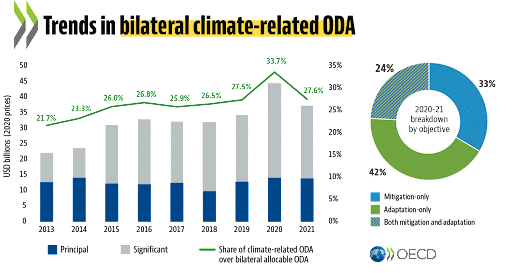
- In 2009, the world’s wealthier countries pledged to provide $100 billion annually to support adaptation and emissions reduction efforts in developing nations by 2020.
- However, data from the OECD revealed that only $89 billion was obtained by the set time.
- As a result, there has been an erosion of trust in international climate negotiations.
- Analysis by the UNEP revealed that public financing for adaptation declined from $25.2 billion in 2020 to $21.3 billion in 2021 despite the commitment made by wealthier nations at the UN climate talks in Glasgow to double annual adaptation funding by 2025.
- However, this trend could be attributed to challenging international events such as the Russia-Ukraine crisis and the aftermath of the COVID-19 pandemic.
Needs of the developing community
- The UNEP has developed the estimate of funds needed by developing countries based on the difference between the costs of adaptation calculated using computer models and financing needs implied by countries' published national climate plans.
- The estimated amount is equal to around 1% of the GDP in developing countries and around 2% of GDP in the least developed countries and in vulnerable small islands.
- UNEP has predicted that the gap between available funding and the needs of the at-risk countries would still be very high even if wealthy governments doubled adaptation finance by 2025.
- According to Harjeet Singh of the Climate Action Network International, developing countries are urgently in need of these funds in order to implement adaptation initiatives to safeguard their populations and prevent the loss of life and livelihoods.
- A recent study indicates that the 55 most climate-vulnerable economies have experienced losses and damages of more than $500 billion in the last two decades.
- Additional sources of money: The UNEP has suggested that international and private sector finance can be a source of funding to accommodate the deficit from the commitments of the wealthier nations.
- It also supported the proposals of developing countries to reform the World Bank and IMF to reflect climate priorities.
What does the UNEP say about adaptation?
- According to the UNEP, adaptation is a sound investment with economic and ecological benefits as the failure to cut emissions has intensified climate impacts, and led to increased losses and damages.
- According to research, every billion spent on adaptation against coastal flooding results in a $14 billion reduction in economic damages associated with these events.
- Adaptation refers to strategies to adjust to climatic change and involves appropriate measures to prevent the effect of climate change.
- It is localized and region-specific with long-term strategies.
UNEP
United Nations Environment Assembly (UNEA)
|
Conclusion
The declining international funding for climate resilience in developing countries poses a severe challenge in addressing the climate crisis as its effects are felt with increasing frequency.
(*Click this link to read prelims specific weekly current affairs articles)
FAQs
Question: What is the Adaptation Gap Report?
Answer:
The Adaptation Gap Report (AGR) has been published every year since 2014 by the UNEP to provide a science-based assessment of worldwide developments on adaptation planning, financing, and execution. It aims to enhance education about the state and patterns in climate adaptation at the global and regional levels.
Question: What is the OECD?
Answer:
The Organisation for Economic Co-operation and Development (OECD) is an international, intergovernmental economic organization of high-income economies with a very high Human Development Index (HDI) that are regarded as developed countries. It is headquartered in France and has 38 members. India is not a member but a key economic partner of the OECD.
UPSC Mains Practice Question:
|
MCQs
Question: Climate Action Tracker” which monitors the emission reduction pledges of different countries is a: (UPSC 2022)
(a) Database created by a coalition of research organizations
(b) Wing of “International Panel of Climate Change”
(c) Committee under “United Nations Framework Convention on Climate Change”
(d) Agency promoted and financed by the United Nations Environment Programme and the World Bank
Answer: (a) See the Explanation
- The Climate Action Tracker is an independent scientific database produced by two research organizations, Climate Analytics and NewClimate Institute, which have been tracking climate action since 2009.
Therefore, option (a) is the correct answer.
Question: With reference to the ‘Global Climate Change Alliance’, which of the following statements is/are correct? (UPSC 2017)
- It is an initiative of the European Union.
- It provides technical and financial support to targeted developing countries to integrate climate change into their development policies and budgets.
- It is coordinated by World Resources Institute (WRI) and World Business Council for Sustainable Development (WBCSD).
Select the correct answer using the code given below:
(a) 1 and 2 only
(b) 3 only
(c) 2 and 3 only
(d) 1, 2 and 3
Answer: (a) See the Explanation
- The European Union (EU) established the Global Climate Change Alliance (GCCA) in 2007 to strengthen dialogue and cooperation with developing countries, particularly least-developed countries (LDCs) and small island developing states (SIDS). Hence, statement 1 is correct.
- The GCCA also provides partner countries with technical and financial assistance in integrating climate change into their development policies and budgets, as well as in implementing projects that address climate change on the ground, promoting climate-resilient, low-emission development. Hence, statement 2 is correct.
- By fostering effective climate change dialogue and cooperation, the Alliance contributes to ensuring that poor developing countries most vulnerable to climate change increase their capacity to adapt to the effects of climate change, thereby supporting the achievement of the Millennium Development Goals (MDGs).
- There is no mention of WRI or WBCSD on the GCCA's official partner's page, despite the fact that many other institutions, such as FAO and UNDP, are mentioned. Hence, statement 3 is incorrect.
Therefore, option (a) is the correct answer.
Question: The ‘’Common Carbon Metric’’ supported by UNEP, has been developed for (UPSC 2021)
(a) Assessing the carbon footprint of building operations around the world
(b) Enabling commercial farming entities around the world to enter carbon emission trading.
(c) Enabling governments to assess the overall carbon footprint caused by their countries.
(d) Assessing the overall carbon footprint caused by the use of fossil fuels by the world in a unit time.
Answer: (a) See the Explanation
- The Common Carbon Metric is a protocol developed by the United Nations Environment Program’s Sustainable Buildings & Climate Initiative (UNEP-SBCI) for measuring energy use & reporting GHG emissions from Building Operations.
- It aims to support the reduction of greenhouse gas (GHG) emissions through accurate measurement of energy efficiency improvements in building operations.
Therefore, option (a) is the correct answer.
Download the PREPP App and attempt FREE IAS Exam Mock Tests and get complete study material!

Full Test - 04: UPSC CSE Prelims CSAT (Paper-II)
Full Test - 03: UPSC CSE Prelims CSAT (Paper-II)
UPSC CSE Prelims 2026 GS Paper 1 Question Paper (24-May-2026)
UPSC CSE Prelims 2026 CSAT Paper 2 Question Paper (24-May-2026)

17 February 2025 | The Hindu Must Read Articles | Current Affairs

16 February 2026 | The Hindu Must Read Articles | Current Affairs

13 February 2026 | The Hindu Must Read Articles | Current Affairs









Comments