Climate Change Is Causing More Frequent, Intense Cyclones On India’s Western Coast
Relevance: GS1 - Geographical Features and their Location; Important Geophysical Phenomena; GS3 - Climate Change
(Source: Indian Express, 10/06/2023)
Click here for Daily Current Affairs
Why in the news?
- According to a new study, changes in ocean and atmosphere warming are causing more frequent and severe tropical cyclones in the Eastern Arabian Sea, near India’s west coast.
- This research is part of the "Forecasting with Fishers" project, led by the Advanced Centre for Atmospheric Radar Research at Cochin University of Science and Technology (CUSAT).
Table of Contents
What are Cyclones?
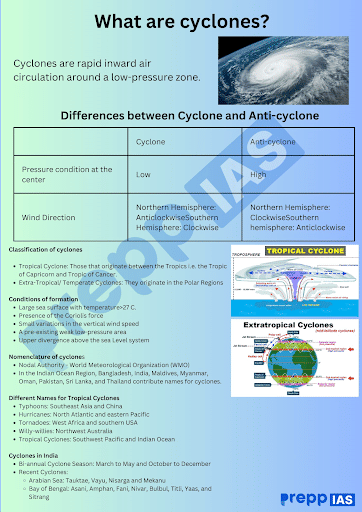
- Cyclones are a type of low-pressure environment with rapid inward air circulation.
- It is a type of tropical weather system characterized by strong winds and heavy rainfall.
- It can also cause storm surges, which are large waves that can inundate low-lying areas and cause flooding.
- Formation: An area of low pressure is formed when warm and moist air rises up and away from the ocean surface.
- Air from surrounding areas with higher pressure then moves towards the low-pressure area.
- In a continuous cycle, this cool air becomes warm and moist and rises up.
- The warm moist air which rises up, cools the water in the air and results in the formation of clouds.
- This whole system of clouds and winds spins and grows and the cycle results in a cyclone.
- This process is known as cyclogenesis.
Findings of the Study
- Changing Cyclone Patterns: Traditionally, tropical cyclones in the Arabian Sea occurred at the start of the southwestern monsoon season (March-June) and after the season (October-December). However, in 2019, the Arabian Sea experienced five cyclones, exceeding the usual count of three, particularly during a positive phase of the Indian Ocean dipole (IOD).
- Impact of Indian Ocean Dipole (IOD): The IOD, similar to El Nino, involves one part of the ocean becoming warmer than the other. During its positive phase, sea surface temperatures in the western Indian Ocean region increase, leading to more precipitation and rain in the eastern Indian Ocean.
- Human-Caused Climate Change: The recent increase in the frequency of extremely severe cyclonic storms is primarily due to human-caused climate change rather than natural variability, indicating that climate change is intensifying and increasing cyclone frequency.
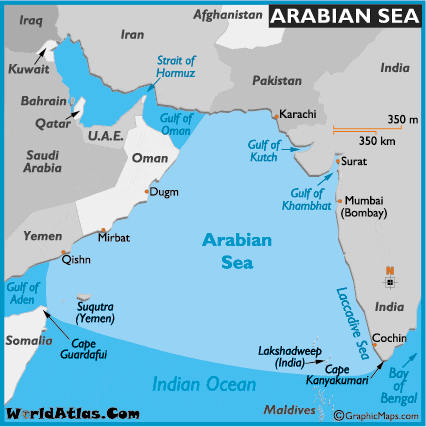
- Impacts on Western India: As cyclone intensity increases, western India's coastlines, from Gujarat to Thiruvananthapuram, face growing risks, including high winds, storm surges, heavy rainfall, and more.
- Coastal Communities Concerns: Cyclones present a serious danger to both human life and the economy due to their strong winds, heavy rainfall, and storm surges, which can result in loss of life and extensive damage to crops, livestock, and fisheries, resulting in significant economic losses.
Arabian Sea
Indian Ocean Dipole (IOD)
|
Conclusion
The study calls for changes in development strategies to address the dangers posed by more intense and frequent cyclones. Additionally, it underscores the need to develop new policies and technology initiatives related to storm warnings, impact-based local weather services, and reliable localized weather services.
(*Click this link to read prelims specific weekly current affairs articles)
FAQs
Question: What are Cyclones?
Answer:
Cyclones are powerful and destructive weather phenomena characterized by a rotating system of strong winds and intense low-pressure at the center. They are also known as hurricanes or typhoons in different parts of the world, but the terminology used depends on the region.
Question: What is El Nino?
Answer:
El Niño is a climatic phenomenon characterized by the atypical warming of surface waters in the eastern tropical Pacific Ocean. It represents the "warm phase" of a broader climate pattern known as the El Niño-Southern Oscillation (ENSO). Compared to La Niña, El Niño events tend to occur more frequently.
Question: What is Indian Ocean Dipole (IOD)?
Answer:
The Indian Ocean Dipole (IOD), also known as the Indian Nino, is a periodic oscillation of sea surface temperatures in which the western Indian Ocean becomes warmer (positive phase) and then colder (negative phase) than the eastern Indian Ocean.
UPSC Mains Practice Question:
|
MCQs
Question: Consider the following statements: (UPSC CSE 2020)
- Jet streams occur in the Northern Hemisphere only.
- Only some cyclones develop an eye.
- The temperature inside the eye of a cyclone is nearly 10C lesser than that of the surroundings.
Which of the statements given above is/are correct:
(a) 1 only
(b) 2 and 3 only
(c) 2 only
(d) 1 and 3 only
Answer: (c) See the Explanation
- Jet Stream occur in both the northern and southern hemispheres. Hence statement 1 is incorrect.
- Extra-tropical cyclones do not necessarily have an eye. Hence statement 2 is correct.
- The eye of the cyclone is warmer than the surrounding areas. Hence statement 3 is incorrect.
Therefore, option (c) is the correct answer.
Download the PREPP App and attempt FREE IAS Exam Mock Tests and get complete study material!

Full Test - 04: UPSC CSE Prelims CSAT (Paper-II)
Full Test - 03: UPSC CSE Prelims CSAT (Paper-II)
UPSC CSE Prelims 2026 GS Paper 1 Question Paper (24-May-2026)
UPSC CSE Prelims 2026 CSAT Paper 2 Question Paper (24-May-2026)

17 February 2025 | The Hindu Must Read Articles | Current Affairs

16 February 2026 | The Hindu Must Read Articles | Current Affairs

13 February 2026 | The Hindu Must Read Articles | Current Affairs









Comments