China Is The Biggest Security Anxiety For India And Australia
(Source: The Hindu,The Hindu, 11/21/2023)
Click here for Daily Current Affairs
Why in the news?
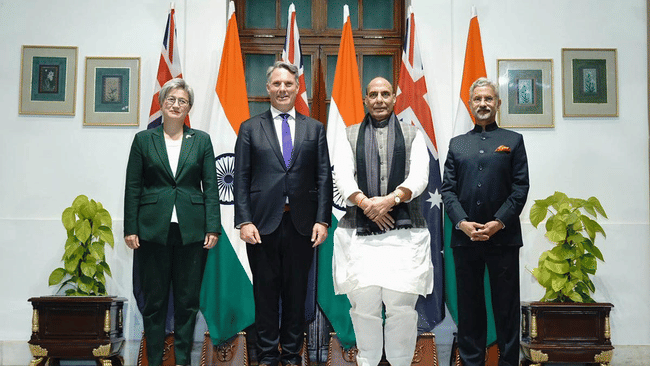
- Recently, Australian Defense Minister Richard Marles claimed at the 2+2 Summit that China was both the largest trading partner and security concern for India and Australia.
- The 2+2 Dialogue is a summit between the Foreign and Defense Ministers of the two countries with the aim of improving the bilateral strategic relationship.
- The India-Australia partnership is a critical element in the stability, security, and prosperity of the region.
- India and Australia have also been working to improve economic ties between the two countries through a Comprehensive Economic Cooperation Agreement.
- Recent events related to Chinese technology and Human rights violations have led to a strain in Australia-China relations while India’s ties with China have been tense due to clashes at the border and Chinese claims on Indian territory.
- India has expressed concern over steps taken by China to build closer ties with Sri Lanka, such as extending the China-Myanmar Economic Corridor (CMEC) to Sri Lanka and supporting debt restructuring, and their potential impact on India’s economy and foreign policy.
What was discussed at the recent 2+2 summit between India and Australia?
- China: The Australian Deputy Prime Minister described China as the largest trading partner and security concern for both India and Australia.
- China’s increasing aggressiveness in the region made the India-Australia strategic partnership significant for on a bilateral level and for the security, stability and prosperity of the Indo-Pacific region.
- Security: Defense has become the pillar of the strategic partnership between India and Australia.
- The bilateral relationship has a major role to play in the stability and security of the entire region due to the increasing polarization across the world.
- Australia has described India, as central to its vision of a peaceful, stable, prosperous, and sovereign Indo-Pacific region and expressed interest in cooperating with India to achieve these goals.
- Strategic alignment and transformation: India and Australia as oceanic neighbors have a shared history, common democratic traditions, mutual respect for the principles of rule of law and freedom of speech, and soft power synergies such as cricket.
- As a result, the bilateral relationship between India and Australia has evolved to become more closely aligned than ever before in their history.
- Economic ties: The Economic Cooperation and Trade Agreement (ECTA) between India and Australia entered into force in December 2022.
- This has led to an increase in trade between the two countries in 2023.
- The ongoing negotiations for a Comprehensive Economic Cooperation Agreement (CECA) between the two countries will be reviewed at the 14th Foreign Ministerial Framework Dialogue (FMFD).
- QUAD: India and Australia are partners in the Quadrilateral Security Dialogue which aims to promote regional security and economic cooperation in the Indo-Pacific region.
- The Indian External Affairs Ministers has described the QUAD as beneficial for the Indo-Pacific region and the bilateral relationship between the two countries.
2+2 Summit
|
What challenges have been identified in the relationship?
- The bilateral relationship between India and Australia has been facing numerous regional and global challenges.
- Challenges to the rule of law: As comprehensive strategic partners India and Australia have to plan for any exceptions to the rule of law.
- This includes human engineered situations and humanitarian assistance and disaster relief situations.
- Visa issues: India has expressed concern over difficulties and restrictions in obtaining visas for Indian students and professionals seeking opportunities to study or work in Australia.
- Russia-Ukraine crisis: India and Australia have adopted diverse positions on the Russian invasion of Ukraine.
- Australia has critized Russia’s actions and sided with the U.S.A. and its allies.
- India on the other hand has avoided criticizing Russia.
- As a result, there have been differences of opinion in the bilateral dialogue between the two countries.
- Lack of Uranium Supply: India and Australia have faced challenges in the supply of uranium.
- The first shipment of Uranium from Australia to India was sent in 2017 but it has been described as insufficient.
- Violence with Indian Diaspora: There has been an increase in the number of attacks on Indian Diaspora and temples in the recent past.
How are China’s actions in the IOR concerning India and Australia?
- Belt and Road Initiative: China has committed to extend the China Myanmar Economic Corridor to Sri Lanka as part of its aggressive strategy to expand the Belt and Road Initiative.
- The CMEC is the newest of the six land corridors under the BRI while its counterpart - the Bangladesh China India Myanmar (BCIM) corridor - has remained unfulfilled.
- Sri Lanka has also expressed support for the Global Development Initiative contribution.
- Australia and India have criticised the initiative for its “debt diplomacy" plank and the potential for it to adversely impact their security interests.
- Maldives: China has attempted to cooperate closely with the new government in the Maldives and build upon the anti-India sentiment in the island nation in order to strengthen its influence after the island nation’s pro-India approach under the previous government.
- This has coincided with the decision of the MAldoves to formally request India to withdraw its troops from the country.
- Debt treatment plan: Sri Lanka has been attempting to establish a debt treatment plan with its official creditors in order to avail the $3 billion deal agreed with the International Monetary Fund
- China has decided to stay out of the official creditors’ platform and remained an observer in deliberations with India and Paris Club members like Japan who have sought creditor parity.
- India and Australia have criticized China’s debt diplomacy for its impact on smaller countries such as economic crises and distress.
India Australia ties
|
(*Click this link to read prelims specific weekly current affairs articles)
FAQs
Question: What is the Bangladesh-China-India-Myanmar corridor?
Answer:
The Bangladesh-China-India-Myanmar corridor (BCIM) is a 2800 km long corridor that has been proposed to connect Kunming (China) with Kolkata (India) through Mandalay (Myanmar) and Dhaka (Bangladesh). It aims to establish as thriving economic belt based on cross-border transport, energy and telecommunication networks in the region.
Question: What is a Comprehensive Economic Partnership Agreement (CEPA)?
Answer:
A Comprehensive Economic Partnership Agreement (CEPA) is a more comprehensive trade agreement when compared to a Free Trade Agreement. In comparison to an FTA, the CEPA also considers the regulatory aspect of trade.
|
UPSC Mains Practice Questions Q.1) The newly tri-nation partnership AUKUS is aimed at countering China’s ambitions in the Indo-Pacific region. Is it going to supersede the existing partnerships in the region? Discuss the strenght and impact of AUKUS in the present scenario. (UPSC GS2 2021) Q.2) Quadrilateral Security Dialogue (QUAD)’ is the transforming itself into a trade bloc from a military alliance, in present times – Discuss. (UPSC GS2 2020) Q.3) India is an age-old friend of Sri Lanka.’ Discuss India’s role in the recent crisis in Sri Lanka in the light of the preceding statement. (UPSC GS2 2022) |
MCQs
Question: With reference to India’s projects on connectivity, consider the following statements:
- East-West Corridor under Golden Quadrilateral Project connects Dibrugarh and Surat.
- Trilateral Highway connects Moreh in Manipur and Chiang Mai in Thailand via Myanmar.
- Bangladesh – China -India – Myanmar Economic Corridor connects Varanasi in Uttar Pradesh with Kunming in China.
How many of the above statements are correct? (UPSC CSE 2023)
(a) Only one
(b) Only two
(c) All three
(d) None
Answer: (d) See the Explanation
- The Golden Quadrilateral Project is a major highway development project in India that aims to connect the four major metropolitan cities: Delhi, Mumbai, Chennai, and Kolkata.
- The East-West Corridor is a part of this project and connects Silchar in Assam to Porbandar in Gujarat. Hence statement 1 is incorrect.
- The IMT Trilateral Highway connects Moreh in the Indian state of Manipur with Mae Sot in Thailand and passes through Myanmar. Hence statement 2 is incorrect.
- The Bangladesh-China-India-Myanmar Economic Corridor (BCIM) Corridor is a proposed connectivity project that aims to enhance economic cooperation and trade between Bangladesh, China, India, and Myanmar. Hence statement 3 is incorrect.
Therefore, option (d) is the correct answer.
Question: With reference to 'Indian Ocean Rim Association for Regional Cooperation (IOR-ARC)', consider the following statements: (UPSC CSE 2015)
- It was established very recently in response to incidents of piracy and accidents of oil spills.
- It is an alliance meant for maritime security only.
Which of the statements given above is / are correct?
(a) 1 only
(b) 2 only
(c) Both 1 and 2
(d) Neither 1 nor 2
Answer: (d) See the Explanation
- The Indian Ocean Rim Association for Regional Cooperation (IOR-ARC) is an inter-governmental organization established in 1997 to promote economic and technical cooperation among the Indian Ocean Rim countries. Hence statement 1 is incorrect.
- The organization aims to strengthen trade and investment ties, promote sustainable development, and improve maritime safety and security in the region.
- The member countries of IOR-ARC work together on various issues such as trade and investment, tourism, fisheries management, disaster risk management, academic and cultural exchange, and more. Hene statement 2 is incorrect.
Therefore, option (d) is the correct answer.
Download the PREPP App and attempt FREE IAS Exam Mock Tests and get complete study material!

Full Test - 04: UPSC CSE Prelims CSAT (Paper-II)
Full Test - 03: UPSC CSE Prelims CSAT (Paper-II)
UPSC CSE Prelims 2026 GS Paper 1 Question Paper (24-May-2026)
UPSC CSE Prelims 2026 CSAT Paper 2 Question Paper (24-May-2026)

17 February 2025 | The Hindu Must Read Articles | Current Affairs

16 February 2026 | The Hindu Must Read Articles | Current Affairs

13 February 2026 | The Hindu Must Read Articles | Current Affairs









Comments