Chandrayaan I & II – Science & Technology Notes
The Indian Lunar Exploration Programme is known as Chandrayaan. It translates to "Moon craft" in Sanskrit. The Indian Space Research Organisation (ISRO) created it. Chandrayaan is a multi-mission programme that will be carried out in three phases: Chandrayaan 1, Chandrayaan 2, and Chandrayaan 3. The Chandrayaan 1 (2008) was an orbiter/impactor, the Chandrayan 2 (2019) cosisted of soft landers/rovers, and the Chandrayaan 3 (2023) to conduct in situ sampling are all planned. In this article, we will discuss in detail regarding Chandrayaan I & II which will be helpful for UPSC exam preparation.
Table of Contents
- Chandrayaan – Background
- Chandrayaan 1
- Chandrayaan 1 – Objectives
- Scientific Payloads
- Key Findings / Achievements
- Chandrayaan 2
- Chandrayaan 2 – Objectives
- Chandrayaan 2 – Key Findings
- Chandrayaan 2 - Achievements
- Challenges of Chandrayaan 2
- How is Chandrayaan 1 different from Chandrayaan 2?
- Conclusion
- FAQs
- MCQs
Chandrayaan – Background
- The idea of an Indian scientific mission to the Moon was first discussed at a meeting of the Indian Academy of Sciences in 1999, followed by discussions at the Astronautical Society of India in 2000.
- The Indian Space Research Organisation (ISRO) established a National Lunar Mission Task Force based on the recommendations of these forums' learned members.
- Leading Indian scientists and technologists took part in the Task Force's deliberations, which provided an assessment of the feasibility of an Indian mission to the Moon as well as a focus for such a mission and its possible configuration.
- Following extensive deliberation, it was unanimously recommended that India undertake the Moon Mission, particularly in light of the renewed international interest in the moon, with several exciting missions planned for the new millennium.
- Furthermore, such a mission could provide the necessary impetus to basic science and engineering research in the country, as well as new challenges to ISRO to go beyond Geostationary Orbit.
- Furthermore, such a project could aid in attracting young talent to the field of fundamental research. Participation in such a project would be intellectually rewarding for academia as well.
- In November 2003, the Government of India approved ISRO's proposal for the first Indian Moon Mission, dubbed Chandrayaan-1.
| Other Relevant Links | |
|---|---|
| GSLV and Various Engine | Recent National and International Space Missions |
| Cryogenic rockets | Scramjet Engine |
| GSLV Mk III-D1 OR GSAT-19 Mission | ISRO’s World Record PSLV C37 Launch |
| Global Positioning System | Galileo |
| GLONASS | IRNSS |
| GAGAN | Mars Orbiter Mission |
What is Chandrayaan 1?
- On October 22, 2008, India's first mission to the Moon, Chandrayaan-1, was successfully launched from SDSC SHAR in Sriharikota.
- The spacecraft was orbiting the Moon at a height of 100 kilometres above the lunar surface to map the Moon's chemical, mineralogical, and photo-geologic composition.
- The spacecraft carried 11 scientific instruments built in India, the United States, the United Kingdom, Germany, Sweden, and Bulgaria.
- After completing all major mission objectives successfully, the orbit was raised to 200 km in May 2009.
- The satellite completed more than 3400 orbits around the moon before communication with the spacecraft was lost on August 29, 2009.
| Launch Vehicle |
|
| Spacecraft |
|
| Ground Segment |
|
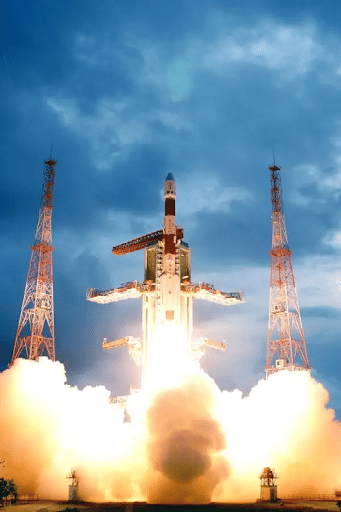
Chandrayaan 1 Lift-off
Chandrayaan 1 – Objectives
Mission Objectives
- The mission goal of harnessing the science payloads, lunar craft, and launch vehicle with appropriate ground support systems, including the Deep Space Network station, must be met.
- To realise the integration and testing, launch and achieve a lunar polar orbit of about 100 km, in-orbit experiment operation, communication/telecommand, telemetry data reception, quick look data, and archival for scientific investigation by a designated group of scientists.
Scientific Objectives
- To create a three-dimensional atlas of the Moon's near and far sides (with a high spatial and altitude resolution of 5-10 m).
- Conduct chemical and mineralogical mapping of the entire lunar surface with high spatial resolution for the distribution of mineral and chemical elements such as Magnesium, Aluminium, Silicon, Calcium, Iron, and Titanium, as well as high atomic number elements such as Radon, Uranium, and Thorium.
Scientific Payloads
The primary goals of the eleven payloads carried onboard the Chandrayaan-1 mission are summarised below.
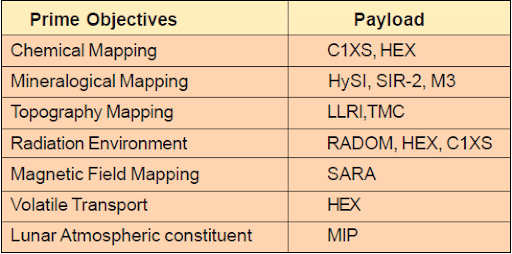
Scientific Payloads
Key Findings / Achievements
- Water molecules have been confirmed on the moon's surface, particularly in the polar regions. This discovery called into question previous assumptions about the moon's dryness and opened the door to future human colonisation and resource utilisation.
- Mineral identification and mapping, including the presence of magnesium, aluminium, calcium, and iron, which provided valuable insight into the moon's geological history and composition.
- High-resolution images of the moon's surface that will enable scientists to study its topography and identify potential landing sites for future missions.
- Collaboration with international space agencies such as NASA, ESA, and the Bulgarian Academy of Sciences, enhancing India's reputation in the global space community.
- The groundbreaking mission of Chandrayaan 1 laid the groundwork for subsequent lunar missions, including the highly successful Chandrayaan 2, which launched in 2019.
- This mission's data and knowledge continue to contribute to our understanding of the moon and its potential for future exploration and scientific research.
What is Chandrayaan 2?
- On July 22, 2019, India's GSLV MkIII-M1 successfully launched the Chandrayaan-2 spacecraft into its planned orbit with a perigee (nearest point to Earth) of 169.7 km and an apogee (farthest point to Earth) of 45,475 km.
- The launch took place from the Satish Dhawan Space Centre SHAR's Second Launch Pad in Sriharikota.
- The Chandrayaan-2 mission is a highly complex mission that represents a significant technological leap over ISRO's previous missions.
- It included an Orbiter, Lander, and Rover to explore the Moon's unexplored South Pole.
- Lander (Vikram): After landing, it will remain stationary and will primarily study the moon's atmosphere. It will also keep an eye out for seismic activity.
- Rover (Pragyan): Once on the Moon, the Rover, a six-wheeled solar-powered vehicle, will detach and slowly crawl across the surface, collecting data and making observations. It will investigate the surface composition near the lunar landing site and determine the abundance of various elements.
- While the Lander and Rover are only designed to operate for 14 days (1 lunar day), the Orbiter, a 2,379-kg spacecraft equipped with seven instruments, would remain in orbit for a year.
- On August 14th, the spacecraft entered Lunar Transfer Trajectory (LTT) after a series of Earthbound manoeuvres.
- On August 20th, the Lunar Orbit Insertion (LOI) manoeuvre was completed, and Chandrayaan-2 was successfully inserted into an elliptical orbit around the Moon. This was followed by a series of manoeuvres to reduce the orbit to a circular polar orbit around the Moon.
- The Vikram lander separated from the Orbiter on September 2nd, and a de-orbiting manoeuvre was performed to reduce the orbit to 35 km x 101 km.
- Vikram attempted a landing on September 7th, following the planned descent trajectory from its orbit of 35 km to around 2 km above the surface. Contact with the lander and ground station was lost.
- Chandrayaan-2 carried eight experiment payloads for studying the Moon's surface geology, composition, and exospheric measurements.
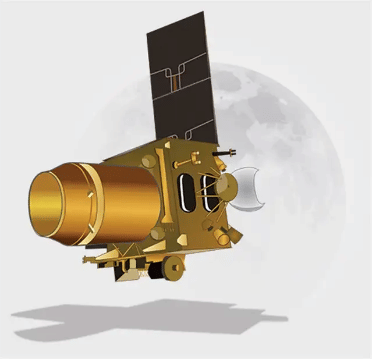
Orbiter
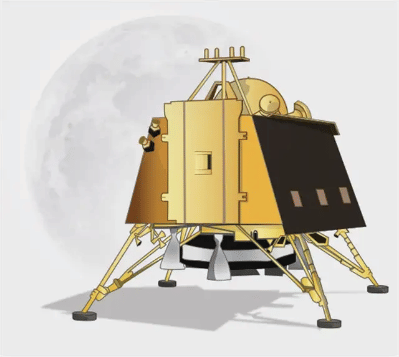
Lander (Vikram)

Rover (Pragyan)
Chandrayaan 2 – Objectives
Mission Objective
- The Chandrayaan-2 lander's primary goals were to demonstrate the ability to soft-land and operate a robotic rover on the lunar surface.
- Using improved instruments, the Chandrayaan-2 orbiter hopes to build on the data collected during the Chandrayaan-1 mission.
Scientific Objective
- To investigate lunar topography, mineralogy, elemental abundance, the lunar exosphere, and hydroxyl and water ice signatures.
- Investigate the thickness of the lunar regolith on the surface and the amount of water ice in the south polar region.
- Map the lunar surface and assist in the creation of 3D maps of it.
Chandrayaan 2 – Key Findings
- Successful Orbital Insertion: Chandrayaan 2 spacecraft was successfully inserted into lunar orbit, demonstrating India's capability to reach the Moon and perform complex manoeuvres.
- Lunar Surface Composition: The orbiter carried several scientific instruments that provided detailed information about the lunar surface's composition and mineralogy. The presence of water molecules and hydroxyl ions on the Moon's surface was confirmed, enhancing our understanding of lunar resources.
- Imaging and Mapping: The orbiter captured high-resolution images of the lunar surface and mapped it, providing valuable data for future lunar missions and research.
- Thermal Mapping: Chandrayaan 2's instruments helped in generating thermal maps of the Moon, which are crucial for understanding its geology and surface processes.
- Solar X-ray Monitor: The orbiter carried a solar X-ray monitor that studied X-rays emitted by the Moon when exposed to solar X-rays. This data provided insights into the Moon's surface and its interaction with solar radiation.
- Lunar Atmosphere: The orbiter studied the thin lunar exosphere, helping scientists understand the Moon's atmosphere and its interactions with the solar wind.
- International Collaboration: Chandrayaan 2 mission facilitated international cooperation, with NASA contributing its Deep Space Network for communication support during the mission.
Chandrayaan 2 - Achievements
- The first space mission to land softly on the Moon's south polar region.
- The first Indian expedition to attempt a soft landing on the moon's surface using indigenous technology.
- The first Indian mission to explore the lunar terrain using indigenous technology.
- After the United States, Russia, and China, China is the fourth country to soft-land on the moon's surface.
- The goal of this effort is to improve our understanding of the Moon, which will benefit both India and humanity as a whole.
- This lunar expedition's discoveries and experiences may inspire future expeditions to the farthest reaches of the universe.
Challenges of Chandrayaan 2
- The launch of its heaviest rocket, the GSLV-Mark III, was a success.
- Maintaining trajectory accuracy over such a long distance. It will carry out a series of orbital manoeuvres to raise the module into higher orbits until it reaches the "Earth to Moon" transfer orbit.
- ISRO had never performed a soft landing on a space object. The lunar surface is covered in craters, rocks, dust, and hot gases, and it experiences extreme temperature variations. As a result, the environment for lander and rover operations is extremely hostile.
- Furthermore, the Moon's South Pole region receives less sunlight than the equatorial region, which is required by solar-powered instruments.
How is Chandrayaan 1 different from Chandrayaan 2?
| Chandrayaan 1 | Chandrayaan 2 |
|---|---|
|
|
|
|
|
|
|
|
|
|
Conclusion
Previous ISRO missions had a variety of applications in fields such as telecommunications, military, remote sensing, and so on. The Chandrayaan-2 mission serves as a forerunner to more ambitious missions such as Gaganyaan Project, Aditya L1, etc. India is already in talks with Japan's JAXA (Japan Aerospace Exploration Agency) about a future mission called Chandrayaan-3, which will return soil and rock samples from the Moon's South Pole. Future missions are expected to investigate new areas of deep space technology. The Moon is an ideal testing ground for technologies needed for future space exploration.
| Other Relevant Links | |
|---|---|
| Science & Technology Policy in India | Scientific Policy Resolution 1958 |
| Science & Technology Policy of 1983 | Science & Technology Policy of 2003 |
| Science, Technology and Innovation Policy 2013 | New Initiatives Aligned with the National Agenda |
| India and World collaboration in science projects | Technology Vision Document 2035 |
FAQs
Question: What were the main objectives of Chandrayaan I mission?
Answer: Chandrayaan I, launched by ISRO in 2008, aimed to survey the Moon’s surface, map its minerals, and search for water ice in the lunar poles. The mission made significant contributions, including confirming the presence of water molecules on the Moon’s surface. It helped India establish itself as a prominent player in lunar exploration.
Question: What were the key advancements brought by Chandrayaan II mission compared to Chandrayaan I?
Answer: Chandrayaan II, launched in 2019, expanded upon the success of Chandrayaan I by introducing a lander (Vikram) and a rover (Pragyan) to explore the Moon's surface. Unlike its predecessor, Chandrayaan II's mission aimed for a soft landing on the Moon’s south pole, an area previously unexplored by other missions. Though the lander lost communication, the orbiter continues to send back valuable data.
Question: What was the major achievement of Chandrayaan I?
Answer: Chandrayaan I’s major achievement was its discovery of water molecules on the Moon’s surface. Using its Moon Mineralogy Mapper (M3), the spacecraft identified water ice in the lunar poles. This discovery opened new possibilities for lunar resource utilization and lunar exploration for future missions.
Question: How did Chandrayaan II contribute to India's space exploration capabilities?
Answer: Chandrayaan II was a significant milestone for India's space exploration ambitions. By attempting a soft landing on the Moon’s south pole, it showcased ISRO’s ability to conduct advanced missions with high technological complexity. Despite the lander’s failure, the orbiter continues to provide critical data, reinforcing India’s growing capabilities in space research and exploration.
Question: Why was Chandrayaan II’s soft landing on the Moon's south pole significant?
Answer: The south pole of the Moon is of great scientific interest because it is believed to contain large amounts of water ice in permanently shadowed craters. The soft landing would have enabled scientists to study this area closely, offering potential for future human missions to the Moon. The south pole is also a key target for lunar resource utilization and long-term exploration.
MCQs
1. What was the primary objective of Chandrayaan I mission?
A) To land on the Moon's south pole
B) To map lunar minerals and identify water
C) To study the Earth from the Moon
D) To establish a lunar base
Answer: (B) See the Explanation
Explanation: The primary objective of Chandrayaan I was to map the minerals on the Moon's surface and search for water ice, particularly at the lunar poles. This mission provided significant data on lunar geology and water presence, marking a key achievement in lunar exploration.
2. Which instrument aboard Chandrayaan I detected water molecules on the Moon?
A) Lyman Alpha Scattering Experiment (LASER)
B) Moon Mineralogy Mapper (M3)
C) Chadrayaan Infrared Spectrometer (CIS)
D) Lunar Reconnaissance Orbiter (LRO)
Answer: (B) See the Explanation
Explanation: The Moon Mineralogy Mapper (M3) onboard Chandrayaan I was responsible for detecting the presence of water molecules on the lunar surface. This breakthrough discovery had a major impact on future lunar exploration missions.
3. What was the main feature of the Chandrayaan II mission that differed from Chandrayaan I?
A) It was solely an orbiter mission
B) It included a lander and rover for surface exploration
C) It focused on the Earth’s atmosphere
D) It launched from a different country
Answer: (B) See the Explanation
Explanation: Chandrayaan II differed from its predecessor by including a lander (Vikram) and a rover (Pragyan) for surface exploration. The mission aimed to achieve a soft landing on the Moon’s south pole, a region never before explored by other lunar missions.
4. What happened to the lander Vikram during the Chandrayaan II mission?
A) It successfully landed on the Moon
B) It lost communication with the orbiter before landing
C) It crashed due to a mechanical failure
D) It was destroyed on launch
Answer: (B) See the Explanation
Explanation: The lander Vikram lost communication with the ground station just before its scheduled soft landing on the Moon. This was a setback in the Chandrayaan II mission, although the orbiter continues to operate successfully and send data back to Earth.
5. Why is the south pole of the Moon considered an important area for lunar exploration?
A) It has the highest levels of solar radiation
B) It contains valuable minerals that could be mined
C) It is thought to harbor water ice in permanently shadowed regions
D) It is the only area where life could exist
Answer: (C) See the Explanation
Explanation: The south pole of the Moon is considered important due to the possibility of water ice being present in permanently shadowed craters. This ice could be used for future lunar missions, both for supporting life and as a resource for fuel and oxygen.
GS Mains Questions and Model Answers
Q1: Analyze the scientific significance of Chandrayaan I and II missions in advancing lunar exploration.
Answer: Chandrayaan I and II have played pivotal roles in advancing lunar exploration. Chandrayaan I’s discovery of water molecules on the Moon was a groundbreaking achievement, which fundamentally altered our understanding of the Moon’s composition and the possibilities for future human habitation. Chandrayaan II built upon this by attempting a soft landing on the Moon’s south pole, an area of immense scientific interest due to the potential presence of water ice. While the lander failed to achieve its objective, the orbiter continues to provide valuable data, furthering our understanding of lunar geology, mineral composition, and the Moon's polar environment. Both missions highlight India's capabilities in space research and exploration.
Q2: Discuss the challenges faced by ISRO during the Chandrayaan II mission and their implications for future space missions.
Answer: The Chandrayaan II mission faced several challenges, the most significant being the failure of the lander Vikram to make a soft landing on the Moon. The loss of communication during the final phase of the descent was a major setback. Despite this, the mission’s orbiter continued to perform its tasks, providing critical data on the Moon’s surface. The challenges faced by ISRO underline the complexities involved in lunar exploration, especially when attempting soft landings. However, the knowledge gained from this mission will be invaluable in improving the precision and reliability of future space missions, particularly in the context of landing technologies and autonomous navigation systems.
Q3: Explain the role of the Chandrayaan missions in positioning India as a global leader in space exploration.
Answer: The Chandrayaan missions, particularly Chandrayaan I and II, have significantly enhanced India's position as a global leader in space exploration. The success of Chandrayaan I, particularly the discovery of water molecules on the Moon, demonstrated India’s advanced space capabilities. Chandrayaan II further showcased India’s ambition, with ISRO attempting a complex soft landing on the Moon's south pole. Despite setbacks, these missions have reinforced India’s growing expertise in space research, making significant contributions to international scientific knowledge. India's cost-effective approach to space missions, coupled with these technological milestones, has established ISRO as one of the leading space agencies in the world.
Previous Year Questions on Chandrayaan Missions
1. UPSC CSE 2020:
Question: What were the primary objectives and scientific outcomes of the Chandrayaan I mission?
Answer: Chandrayaan I primarily aimed to survey the Moon's surface, map its minerals, and explore water ice at the lunar poles. It achieved significant success by confirming the presence of water molecules on the Moon, fundamentally changing lunar exploration. The mission provided critical data that informed subsequent lunar missions worldwide.
2. UPSC CSE 2019:
Question: Analyze the objectives, challenges, and outcomes of the Chandrayaan II mission.
Answer: Chandrayaan II aimed to expand upon the success of Chandrayaan I by adding a lander and rover to explore the Moon’s surface, especially its south pole. Despite the failure of the lander, the orbiter continues to send valuable data. The mission’s main contribution lies in testing ISRO's capabilities in complex lunar landings, and its scientific outcomes have furthered understanding of the Moon’s geology and water distribution.
Download the PREPP App and attempt FREE IAS Exam Mock Tests and get complete study material!

Full Test - 04: UPSC CSE Prelims CSAT (Paper-II)
Full Test - 03: UPSC CSE Prelims CSAT (Paper-II)
UPSC CSE Prelims 2026 GS Paper 1 Question Paper (24-May-2026)
UPSC CSE Prelims 2026 CSAT Paper 2 Question Paper (24-May-2026)

17 February 2025 | The Hindu Must Read Articles | Current Affairs

16 February 2026 | The Hindu Must Read Articles | Current Affairs

13 February 2026 | The Hindu Must Read Articles | Current Affairs









Comments