Chandra X-Ray Observatory – Science & Technology Notes
The Chandra X-ray Observatory (formerly known as Advanced X-ray Astrophysics Facility) was launched in 1999 by Space Shuttle Columbia. The Chandra X-ray Observatory is part of NASA's "Great Observatories" fleet, which also includes the Hubble Space Telescope and the Spitzer Space Telescope. The telescope is named after Indian astrophysicist Subrahmanyan Chandrasekhar, who won the Nobel Prize in physics. In this article, we will discuss in detail regarding Chandra X-Ray Observatory which will be helpful for UPSC exam preparation.
Table of Contents
What is Chandra X-Ray Observatory?
- The Chandra X-ray Observatory has been NASA's flagship mission for X-ray astronomy since its launch on July 23, 1999, taking its place in the fleet of "Great Observatories."
- The Chandra X-ray Observatory is a NASA telescope designed specifically to detect X-ray emission from extremely hot regions of the Universe such as exploded stars, clusters of galaxies, and matter surrounding black holes.
- Because X-rays are absorbed by the Earth's atmosphere, Chandra must orbit above it at a height of 139,000 kilometres (86,500 miles).
- The Smithsonian Institution's Astrophysical Observatory in Cambridge, MA, houses the Chandra X-ray Centre, which operates the satellite, processes data, and distributes it to scientists all over the world for analysis.
- Chandra carries four extremely sensitive mirrors that are nestled inside each other.
- The X-rays are focused onto electronic detectors at the end of the 9.2-m (30-ft.) optical bench after striking the insides of the hollow shells.
- Depending on the detector used, extremely detailed images or spectra of the cosmic source can be created and analysed.
| Other Relevant Links | |
|---|---|
| Space Organisations | Space race/Space junk |
| South Asia Satellite: Significance | Solar Mission- ADITYA |
| Spitzer Space Telescope | Multi Application Solar Telescope |
| Thirty Metre Telescope | Resourcesat-2A |
| Astrosat | Sunspot |
| Magnetars | Neutron stars |
| Air-breathing propulsion system | Space Junk |
| Graveyard Orbit | Supercluster of galaxies known as “Saraswati” |
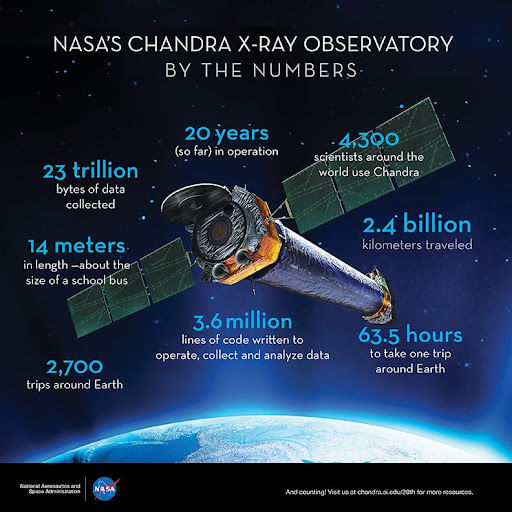
Data of Chandra X-Ray
Chandra X-Ray Astronomy
- The "X-ray universe" is the universe as seen through telescopes that detect X-rays.
- When matter is heated to millions of degrees, it emits X-rays into the universe.
- Such temperatures occur in areas with strong magnetic fields, extreme gravity, or explosive forces.
- A vast cloud of hot gas in a galaxy cluster can span millions of light years and contain enough matter to form hundreds of trillions of stars.
- X-ray telescopes can also detect X-rays from matter swirling as close as 90 kilometres from the event horizon of a stellar black hole or trace hot gas from an exploding star.
- When charged particles collide or undergo sudden changes in motion, they produce bundles of energy known as photons, which travel at the speed of light away from the scene of the accident.
- They are, in fact, light, or electromagnetic radiation to use a technical term.
- Because electrons are the lightest known charged particle and the most fidgety, they account for the majority of photons produced in the universe.
- The Chandra X-ray Observatory, launched by Space Shuttle Columbia in 1999, can better define hot, turbulent areas of space.
- This increased clarity can help scientists answer fundamental questions about the universe's origin, evolution, and fate.
Components of Chandra X-ray Observatory
The Observatory is composed of three major components:
- the X-ray telescope, whose mirrors focus X-rays from celestial objects;
- the science instruments, which record the X-rays so that X-ray images can be produced and analysed; and
- the spacecraft, which provides the environment for the telescope and the instruments to function.
X-ray Telescope
- The Chandra telescope system is made up of four mirror pairs and their support structure.
- X-ray telescopes must differ significantly from optical telescopes.
- Because of their high energy, X-ray photons penetrate mirrors in the same way that bullets do.
- Scientists and engineers at Raytheon Optical Systems in Danbury, Connecticut, polished and ground the four pairs of Chandra mirrors to the smoothness of a few atoms.
- X-rays will ricochet off mirrors in the same way that bullets do when they hit a wall at a grazing angle.
- The mirrors must be perfectly shaped and nearly parallel to the incoming X-rays. As a result, they resemble glass barrels rather than the familiar dish shape of optical telescopes.
Science Instruments
- To capture and investigate X-rays from astronomical sources, the Chandra X-Ray Observatory combines mirrors with four science instruments.
- The mirrors focus the incoming X-rays to a tiny spot (about half the width of a human hair) on the focal plane, about 30 feet away.
- ACIS and HRC, the focal plane science instruments, are well matched to capture the sharp images formed by the mirrors and provide information about the incoming X-rays: their number, position, energy, and time of arrival.
- The LETG and HETG spectrometers are two additional science instruments that provide detailed information about X-ray energy.
- These are grating arrays that can be flipped into the X-ray path just behind the mirrors to redirect (diffract) the X-rays according to their energy.
Spacecraft
- The spacecraft system provides the necessary support structure and environment for the telescope and science instruments to function as an observatory.
- Chandra has two sets of thrusters to provide motion to the observatory: one for propulsion and the other for momentum unloading.
- The propulsion thrusters were activated immediately after launch to assist in propelling Chandra into its final orbit, which is elliptical and extremely high in altitude.
- The momentum unloading thrusters are used on a regular basis to apply torques to Chandra, lowering the accumulated momentum in its reaction wheels, which are used to control Chandra's attitude.
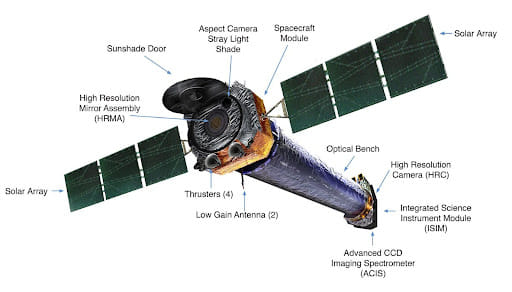
Components of Chandra Spacecraft
Working of Chandra X-Ray Observatory
- The Chandra X-ray Observatory is currently in orbit around Earth, peering out into space in search of extremely hot events.
- These events emit X-rays, which are highly energised forms of light that are invisible to human eyes.
- Because X-rays cannot pass through the Earth's atmosphere, astronomers must use space-based X-ray telescopes like the Chandra to study them.
- The Chandra collects X-rays from as far away as ten billion light years away and interprets them using a high resolution camera (HRC).
- Scientific instruments on the Chandra can also measure the strength and temperature of X-rays.
- Because X-rays would be absorbed directly into the dish-shaped mirrors commonly used in visible-light telescopes, the Chandra uses barrel-shaped mirrors with reflecting surfaces that run almost parallel to the X-rays.
- The X-rays barely bounce off the mirrors before being focused on a point half the width of a human hair, where they are recorded and measured.
Important Discoveries by Chandra
- Chandra has captured images of the spectacular, glowing remains of exploded stars, as well as spectra that show the dispersal of elements.
- Chandra has observed the region surrounding our Milky Way's supermassive black hole and discovered black holes throughout the Universe.
- Chandra has traced the separation of dark matter from normal matter in a cluster collision of galaxies and is contributing to the studies ofboth dark matter and dark energy.
Top 10 Facts about Chandra X-Ray
|
Conclusion
With images 25 times sharper than previous X-ray images, Chandra has begun an exploration of the hot turbulent regions of space. Chandra's increased sensitivity will allow for more detailed studies of black holes, supernovas, and dark matter, as well as a better understanding of the universe's origin, evolution, and fate.
| Other Relevant Links | |
|---|---|
| Science & Technology Policy in India | Scientific Policy Resolution 1958 |
| Science & Technology Policy of 1983 | Science & Technology Policy of 2003 |
| Science, Technology and Innovation Policy 2013 | New Initiatives Aligned with the National Agenda |
| India and World collaboration in science projects | Technology Vision Document 2035 |
FAQs
Question: What is the Chandra X-ray Observatory?
Answer: The Chandra X-ray Observatory is a space telescope launched by NASA to observe X-ray emissions from high-energy regions of the universe, including black holes, supernova remnants, and galaxy clusters.
Question: Why is the Chandra X-ray Observatory important for astronomy?
Answer: It provides critical data on the X-ray emissions from celestial objects, offering insights into high-energy phenomena that are invisible in other wavelengths like visible light.
Question: When was the Chandra X-ray Observatory launched?
Answer: The Chandra X-ray Observatory was launched on July 23, 1999, aboard the Space Shuttle Columbia.
Question: What kind of objects does the Chandra X-ray Observatory study?
Answer: It studies high-energy phenomena such as black holes, neutron stars, supernova remnants, and clusters of galaxies, which emit X-rays.
Question: How does the Chandra X-ray Observatory capture X-rays?
Answer: Chandra uses a high-resolution mirror system to focus X-rays onto detectors, which then convert the X-rays into data that can be analyzed.
MCQs
1. What is the main purpose of the Chandra X-ray Observatory?
A) To study visible light emissions
B) To observe X-ray emissions from celestial objects
C) To explore the surface of the Moon
D) To map the Earth's atmosphere
Answer: (B) See the Explanation
Explanation: The Chandra X-ray Observatory is primarily designed to observe X-ray emissions from various high-energy astronomical sources like black holes, neutron stars, and supernova remnants.
2. Which space agency launched the Chandra X-ray Observatory?
A) ESA (European Space Agency)
B) NASA
C) ISRO
D) Roscosmos
Answer: (B) See the Explanation
Explanation: The Chandra X-ray Observatory was launched by NASA in 1999, and it continues to operate as one of the most advanced space telescopes for X-ray astronomy.
3. What type of radiation does the Chandra X-ray Observatory primarily detect?
A) Radio waves
B) Visible light
C) X-rays
D) Infrared radiation
Answer: (C) See the Explanation
Explanation: The Chandra X-ray Observatory is designed to detect X-rays, a form of high-energy radiation, emitted by objects like black holes, neutron stars, and supernovae.
4. When was the Chandra X-ray Observatory launched?
A) 1997
B) 1998
C) 1999
D) 2000
Answer: (C) See the Explanation
Explanation: The Chandra X-ray Observatory was launched on July 23, 1999, aboard the Space Shuttle Columbia, to study high-energy astrophysical phenomena in the universe.
5. What is the main component of the Chandra X-ray Observatory?
A) Gamma-ray detectors
B) X-ray telescopes with high-resolution mirrors
C) Infrared cameras
D) Visible light telescopes
Answer: (B) See the Explanation
Explanation: Chandra's main component is its high-resolution mirror system, which focuses X-rays onto detectors to provide detailed images and spectra of distant astronomical sources.
GS Mains Questions and Model Answers
Q1: Discuss the scientific importance of the Chandra X-ray Observatory and its contribution to understanding high-energy astrophysics.
Answer: The Chandra X-ray Observatory has provided invaluable insights into high-energy astrophysics by observing X-ray emissions from some of the most extreme environments in the universe. It has contributed significantly to our understanding of black holes, neutron stars, and supernova remnants, revealing the complex processes occurring in these objects. Chandra's ability to observe X-rays, which are absorbed by Earth's atmosphere, has enabled detailed studies of galaxy clusters, the birth and death of stars, and the behavior of matter under extreme conditions. Its discoveries have expanded our knowledge of the universe, shedding light on phenomena that are not observable in other wavelengths of light, such as visible or radio waves.
Q2: How does the Chandra X-ray Observatory complement other space telescopes like Hubble and Spitzer in studying the universe?
Answer: The Chandra X-ray Observatory complements telescopes like the Hubble Space Telescope and the Spitzer Space Telescope by focusing on different regions of the electromagnetic spectrum. While Hubble observes visible, ultraviolet, and near-infrared light, and Spitzer focuses on infrared radiation, Chandra specializes in X-ray observations. This multi-wavelength approach allows scientists to study celestial objects from a variety of perspectives, providing a more complete understanding of their nature. For example, while Hubble can observe the visible light emitted by stars, Chandra can reveal the high-energy processes occurring around black holes or in supernova remnants. Together, these telescopes provide a holistic view of the universe.
Q3: What are the challenges faced by the Chandra X-ray Observatory in observing X-rays from space, and how are they overcome?
Answer: Observing X-rays from space presents several challenges, including the difficulty in detecting such high-energy radiation from Earth's surface due to atmospheric absorption. Chandra overcomes this by being placed in orbit, above the Earth's atmosphere, where X-rays can be observed without interference. Additionally, Chandra's X-ray mirrors are designed to focus X-rays with high precision, despite their high-energy nature. The observatory’s detectors are extremely sensitive, allowing it to capture faint X-ray emissions from distant astronomical sources. These design innovations have made Chandra one of the most successful X-ray observatories, providing detailed data about some of the most energetic phenomena in the universe.
Previous Year Questions on Chandra X-ray Observatory
1. UPSC CSE Mains 2018 (GS Paper 3):
Question: "Discuss the role of space-based observatories like the Chandra X-ray Observatory in advancing our understanding of high-energy astrophysical phenomena."
Answer: Space-based observatories like Chandra are crucial for studying high-energy astrophysical phenomena, as they can observe X-rays that are absorbed by Earth’s atmosphere. Chandra has contributed to understanding cosmic events such as black hole formations, supernova explosions, and galaxy clusters. Its detailed imaging of X-ray emissions has allowed scientists to study objects in extreme environments, providing insights into the behavior of matter and energy under extreme conditions, which cannot be studied with ground-based telescopes.
2. UPSC CSE Mains 2020 (GS Paper 3):
Question: "Evaluate the contribution of Chandra X-ray Observatory to modern astrophysics and its impact on space exploration."
Answer: The Chandra X-ray Observatory has made significant contributions to modern astrophysics by providing detailed images and data on X-ray emissions from celestial objects. It has enhanced our understanding of high-energy astrophysics, particularly the behavior of matter near black holes, neutron stars, and in supernova remnants. Its discoveries have expanded the knowledge of the universe, revealing processes such as cosmic radiation, the formation of stars, and the evolution of galaxies, impacting the broader field of space exploration.
Download the PREPP App and attempt FREE IAS Exam Mock Tests and get complete study material!

Full Test - 04: UPSC CSE Prelims CSAT (Paper-II)
Full Test - 03: UPSC CSE Prelims CSAT (Paper-II)
UPSC CSE Prelims 2026 GS Paper 1 Question Paper (24-May-2026)
UPSC CSE Prelims 2026 CSAT Paper 2 Question Paper (24-May-2026)

17 February 2025 | The Hindu Must Read Articles | Current Affairs

16 February 2026 | The Hindu Must Read Articles | Current Affairs

13 February 2026 | The Hindu Must Read Articles | Current Affairs









Comments