Challenges in Port Development - Geography Notes
A port is a location on a coast or shore with one or more harbors where ships can dock. They are also used to transport people and goods to and from the land. All Indian ports are located in nine coastal states: Kerala, Karnataka, Maharashtra, Goa, Gujarat, West Bengal, Odisha, Andhra Pradesh, and Tamil Nadu. The main challenge with regulation are that major and minor ports are governed by different authorities. This article will explain to you about the Challenges in Port Development which will be helpful in Geography preparation for the UPSC Civil service exam.
|
Table of Contents |
Port Development in India
- The infrastructure of ports is essential to the development of any country. India has a roughly 7,500 km-long coastline.
- Ports handle about 90% of India's external trade in terms of volume and 70% in terms of value. Iron ore, coal, crude petroleum, and other basic commodities are all imported via the sea route. India's coastline is home to 205 minor ports and 12 major ports.
- India has 12 major ports and about 200 minor ports that are respectively managed by the Central and State Governments.
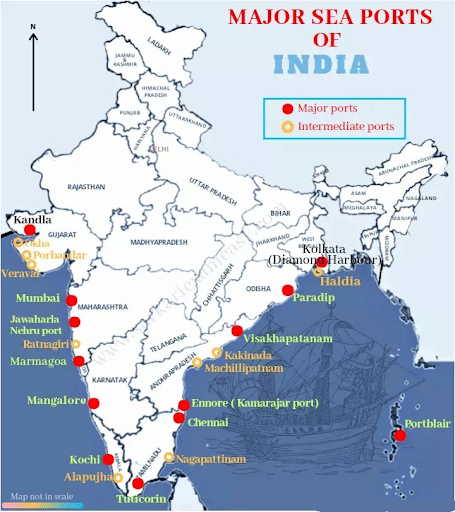
Ports in India
- India's blue economy, which is estimated to contribute 4% to GDP, supports 95% of the nation's transportation-related business.
- Port-led development is essential to enhancing cross-border trade efficiency.
- Port development makes import and export efficient and affordable.
- India must build important transshipment ports, provide last-mile connectivity to ports, create connections with new regions, and improve multimodal connectivity with ports in order to achieve this.
- Over 80 percent of India's trans-shipment cargo uses facilities at ports in Singapore, Colombo, Sri Lanka, and Klang, Malaysia, which together handle nearly 25 percent of the country's maritime trade.
- Transshipment expenses cause the Indian port industry to lose Rs 15 billion every year. India can thus fully utilize its enormous potential for port utilization.
Examples of Port led Development
|
|
|
|
|---|---|
| Inland: National Waterways | Shipping industry in India |
| Factors affecting Inland waterways | Major Ports of World and India |
| Significance and Challenges | Ports: Inclusive centres of economic development |
| Jal Marg Vikas Project | Sagarmala Project |
| Coastal Shipping | International Sea Routes |
| Shipping Canals | The Panama Canal |
| The Suez Canal | Environmental issues of maritime shipping |
Challenges in Port Development
- High turnaround times: Indian ports struggle with long ship turnaround times.
- For Example, the typical ship turnaround time in Singapore is under a day. However, it takes more than two days in India.
- Port congestion: Port congestion is a major concern because of the volume of containers, a lack of handling equipment, and ineffective operations.
- Sub-optimal Transport Modal Mix: A poor modal mix of transportation is caused by a lack of the necessary infrastructure for evacuation from major and minor ports.
- Limited Hinterland Linkages: Only a few hinterlands links Poor hinterland connectivity via rail, road, highways, coastal shipping, and inland waterways results in inefficiency.
- As a result, transportation and cargo movement become more expensive.
- Lengthy inspection and scrutiny: Inspections and scrutiny continue to be drawn out for cargo and other shipping operations, despite the fact that India's customs operations are quickly going paperless and becoming digital.
- Inadequate infrastructure and Technology
- Another issue is the lack of adequate berthing facilities, berth numbers, and sufficient length for proper berthing of the vessels at the Non-Major Ports.
- Most non-major ports lack the necessary material handling tools that would enable a quick turnaround.
- The inability of Indian terminals and ports to accommodate vessels larger than Panamax (Draft over 13 metres) size, which is increasingly dictating international trade, is another significant restriction on draft.
- Most Indian ports lack the necessary machinery to handle large volumes.
- Additionally, many ports lack adequate IT systems, facilities, and navigational aids.
- Issues with Regulations
- The main issue with regulations is that they place different jurisdictions on major and non-major ports. The regulatory framework is also strict.
- Indian laws against piracy remained stringent. Foreign-flagged ships are not permitted to transport cargo between Indian ports because that is still domestic shippers' exclusive territory.
- For non-major ports, specific challenges include land acquisition and environmental clearances.
- Problems with the PPP Model
- The majority of port PPPs place severe restrictions on what private operators are able to do, typically in the form of the types of cargo they are permitted to handle.
- Other issues, up until recently, related to tariff regulation and the lack of dispute resolution mechanism
- Discriminatory provisions for Indian vessels
- Indian vessels must pay the bunker fuel duty, whereas foreign vessels are exempt from this duty.
- Those working on foreign vessels are not subject to this tax, but those working aboard vessels flying the Indian flag are.
- Environmental impact
- Due to lax enforcement of environmental laws and standards, spills or leaks from the loading and unloading of cargo as well as oil pollution are frequent during port operations.
- Marine ecosystems are at risk from the discharge of ballast water and water used for ship cleaning.
- Increased sedimentation brought on by dredging has an adverse effect on local water productivity and fisheries.
- Effects of port development on society
- Most port development and projects result in displacement (such as Gangavaram Port in Andhra and Mundra in Gujarat).
- Along with displacement, access to fishing grounds near ports is another significant issue raised by fishing communities.
- Labour and Manpower Issues: Significant problems include inadequate training, declining manpower quality, and resistance to reform.
- Analysisists have raised concerns about the growth of multiple ports handling similar cargo in close proximity, as this could result in ports competing for the same cargo arrivals.
Government initiatives - To overcome the Challenges
- Sagarmala program: It focuses on expanding and modernizing ports, improving port connectivity, assisting coastal communities, and promoting industrialization linked to ports.
- Sagarmala aims to lower logistics costs for both domestic and international trade. In the modal mix, it also aims to double the proportion of water transportation.
- The Jal Marg Vikas Project (JMVP) is an initiative to expand India's national waterways.
- It was put into place as a step toward national integration with the intention of lowering carbon emissions, congested roads and rails, and resource depletion to a minimum.
- Central Infrastructure and Road Fund: In order to include a list of projects and infrastructure sub-sectors, including inland waterways, for which the CRF could be used, the Ministry of Finance amended the Central Road Fund Act, 2000.
- Since then, the Central Road and Infrastructure Fund have replaced the moniker CRF.
- The Inland Vessels Bill 2021: The bill seeks to include a single national law in place of various regulations made by the states.
- There will be no need for state approvals because the registration certificate will be accepted all across the nation.
- Additionally, it creates a single database for keeping track of crew and vessel details on an online portal.
- Marine Aids to Navigation Bill 2021: The Parliament approved it, incorporating international obligations, technological advancements, and best practices from around the world.
- The Draft Indian Ports Bill 2022: The goal of the Draft Indian Ports Bill 2021 is to consolidate state governments' current management of minor ports.
Way Forward
- To encourage foreign investment, the port sector needs to standardize and implement environmental clearances, tariff rules, land acquisition, etc.
- To ensure seamless multimodal transportation and boost efficiency, it is critical to provide rail and road connectivity to major and minor ports.
- Expanding capacity and enhancing operational effectiveness should take precedence. Installing advanced cargo handling procedures, scalability of procedures, and mechanisation of port operations should all be prioritized.
- Big data and cutting-edge GPS navigation systems should be used to their full potential for improved port functionality.
- Less rigidity and complexity should be added to the regulatory regime. For the comprehensive development of India's ports, there should also be vertical integration of all stakeholders.
- As part of the Sagarmala project, port modernization and new port development, port connectivity improvement, port-linked industrialization, and coastal community development have enormous potential to lower transportation and logistics costs and increase export competitiveness.
- In order to increase and maintain draught depth at ports, attract large vessels, and make them hub ports, the government must open up the dredging market to attract more players, particularly international players.
Conclusion
A port is a place on a coast or shore where ships can dock. Ports can have one or more harbours. They are also employed for the transportation of cargo and people to and from land. To make Indian ports more appealing and cost-effective for their customers, Indian ports should enhance the level of port service provided and the intermodal infrastructure that can effectively serve the containerized foreign trade from door to door.
|
|
|
|---|---|
| Geography Notes | Human Geography |
| Transport, Communication and Trade in India | Water Transport |
| Role of Transport in Regional Development | Human Settlements |
| Transcontinental Railways | Human Development |
FAQs
Q1: What are the major challenges faced in port development?
Answer: Major challenges in port development include inadequate infrastructure, congestion, limited hinterland connectivity, environmental concerns, high logistics costs, and issues related to modernization and technology adoption. Addressing these challenges is crucial for efficient port operations.
Q2: How does inadequate infrastructure impact port development?
Answer: Inadequate infrastructure leads to congestion, delays in cargo handling, inefficiencies in operations, and increased costs. It restricts the capacity to handle large volumes of trade and limits the competitiveness of ports on the global stage.
Q3: Why is hinterland connectivity important for port development?
Answer: Hinterland connectivity ensures the smooth movement of goods between ports and inland areas through road, rail, and inland waterways. Poor connectivity can lead to delays, higher logistics costs, and reduced efficiency in the supply chain.
Q4: What are the environmental concerns related to port development?
Answer: Port development can lead to environmental concerns such as habitat destruction, pollution from shipping activities, increased emissions, and disruption of coastal ecosystems. Addressing these issues through sustainable practices is essential for balanced development.
Q5: How can technology help overcome challenges in port development?
Answer: Technology can improve port efficiency through automation, real-time tracking, digitalization of processes, and enhanced logistics management. Adopting smart port solutions and using data-driven decision-making can reduce congestion, enhance productivity, and lower operational costs.
MCQs
- Which of the following is a major challenge in port development?
A) High consumer demand
B) Limited hinterland connectivity
C) Easy access to foreign investments
D) None of the above
Answer: (B) See the Explanation
- What is one of the primary issues caused by inadequate port infrastructure?
A) Lower transportation costs
B) Efficient cargo handling
C) Congestion and operational inefficiencies
D) Reduction in trade volume
Answer: (C) See the Explanation
- Why is environmental sustainability a concern in port development?
A) Ports contribute to greenhouse gas emissions and habitat destruction
B) Ports promote green technology exclusively
C) Environmental concerns are not applicable to ports
D) Ports prevent all coastal activities
Answer: (A) See the Explanation
- How does technology benefit port development?
A) By reducing automation
B) By increasing manual labor dependency
C) By improving efficiency through digitalization and smart solutions
D) By eliminating trade regulations
Answer: (C) See the Explanation
- What role does hinterland connectivity play in port development?
A) It increases the isolation of ports
B) It ensures smooth cargo movement between ports and inland areas
C) It reduces the need for rail and road networks
D) It is not relevant for ports
Answer: (B) See the Explanation
GS Mains Questions and Model Answers
Q1: Analyze the challenges faced by ports in India and suggest measures to overcome them.
Answer: Ports in India face challenges such as inadequate infrastructure, congestion, limited hinterland connectivity, environmental concerns, and high logistics costs. Inadequate infrastructure results in inefficiencies, while poor connectivity with the hinterland hinders the smooth movement of goods. Environmental impacts, including pollution and habitat disruption, also pose significant issues. Measures to overcome these challenges include modernizing port infrastructure, enhancing road, rail, and waterway connectivity, adopting sustainable practices, and implementing smart port technologies. The Sagarmala project, which aims to develop port-linked industrial clusters and improve connectivity, is a step in the right direction to address these challenges and promote efficient port operations.
Q2: Explain the importance of sustainable practices in port development.
Answer: Sustainable practices in port development are essential to balance economic growth with environmental conservation. Ports contribute to greenhouse gas emissions, pollution, and habitat destruction, posing threats to coastal ecosystems. Sustainable development practices, such as adopting green technologies, reducing emissions through cleaner fuels, enhancing waste management, and protecting biodiversity, help mitigate these impacts. Sustainable ports contribute to long-term environmental health, reduce operational costs through energy efficiency, and comply with international environmental standards. By focusing on sustainability, ports can ensure a positive social, economic, and environmental impact.
Q3: Discuss the role of technology in addressing the challenges faced by ports.
Answer: Technology plays a vital role in addressing challenges faced by ports, such as congestion, inefficiencies, and high logistics costs. Automation of cargo handling, real-time tracking of shipments, and digitalization of processes reduce delays and enhance productivity. Smart port solutions, including Internet of Things (IoT) devices, data analytics, and artificial intelligence, optimize logistics and streamline operations. Technology also improves safety, reduces human errors, and minimizes environmental impacts by promoting energy efficiency. The adoption of digital tools and innovative solutions transforms ports into efficient, competitive, and environmentally friendly hubs, addressing various operational challenges.
Previous Year Questions on Shipping industry in India
1. UPSC CSE 2020
Question: Evaluate the impact of infrastructure inadequacies on port efficiency and suggest ways to address these challenges.
Answer: Infrastructure inadequacies significantly impact port efficiency by causing congestion, delays in cargo handling, and increased logistics costs. Limited capacity to handle large cargo volumes reduces competitiveness and affects trade flow. To address these challenges, investments in modernizing port infrastructure, expanding capacity, and enhancing connectivity with hinterlands are essential. The adoption of automation, digital tools, and better equipment improves operational efficiency. Government initiatives such as the Sagarmala project aim to develop port infrastructure and promote integrated logistics solutions, thereby reducing costs and enhancing overall efficiency.
2. UPSC CSE 2019
Question: Discuss the challenges of ensuring environmental sustainability in port development and ways to mitigate the impacts.
Answer: Ensuring environmental sustainability in port development presents challenges, such as controlling emissions, managing waste, and protecting coastal ecosystems. Ports contribute to pollution and habitat destruction, which necessitate careful planning and sustainable practices. Mitigation measures include adopting green technologies, transitioning to cleaner fuels, improving waste management, and protecting biodiversity through environmental impact assessments and sustainable design. Ports can also implement energy-efficient practices, such as using renewable energy sources and reducing carbon footprints. Collaborative efforts between governments, stakeholders, and environmental organizations can further enhance sustainable port development.
Download the PREPP App and attempt FREE IAS Exam Mock Tests and get complete study material!

Live Test : UPSC CSE Prelims CSAT (Paper-II) (Oct 20 - 23)
Full Test - 04: UPSC CSE Prelims CSAT (Paper-II)
Full Test - 03: UPSC CSE Prelims CSAT (Paper-II)
UPSC CSE Prelims 2026 GS Paper 1 Question Paper (24-May-2026)
UPSC CSE Prelims 2026 CSAT Paper 2 Question Paper (24-May-2026)

17 February 2025 | The Hindu Must Read Articles | Current Affairs

16 February 2026 | The Hindu Must Read Articles | Current Affairs

13 February 2026 | The Hindu Must Read Articles | Current Affairs









Comments