Centre to Invite Bids for 20 Critical Minerals Blocks
Relevance: Prelims: Rare Earth Elements, Critical Minerals; Mineral and Energy Resources, Lithium, Graphite, Niobium, Rare Earth Elements, Critical Minerals, Geographical distribution of these minerals in India and their significance, Role of lithium and REEs in renewable energy, Mineral Blocks
Primary Source: The Hindu
Click here for Daily Current Affairs
Why in the news?
- The Indian government plans to invite bids for 20 critical mineral blocks, including lithium and graphite mines.
- This initiative is a part of India's broader strategy to enhance its capabilities in mining and processing critical minerals.
- Recent discoveries of LIthium and Rare earth elements at various places in India.
What are Critical Minerals?
- Critical minerals are a group of minerals that are essential to a country's economic and national security, yet they face potential supply risks.
- These minerals are vital for the manufacturing of high-tech devices, military equipment, renewable energy technologies, and various other important industrial applications.
- The supply of these minerals is often concentrated in a few countries, which can lead to vulnerability in supply chains.
- Common examples include rare earth elements (REEs), Lithium, Graphite, Niobium, and Cobalt.
- Many critical minerals are essential for renewable energy technologies and are thus important for the global transition to cleaner energy and achieving net-zero emissions goals.
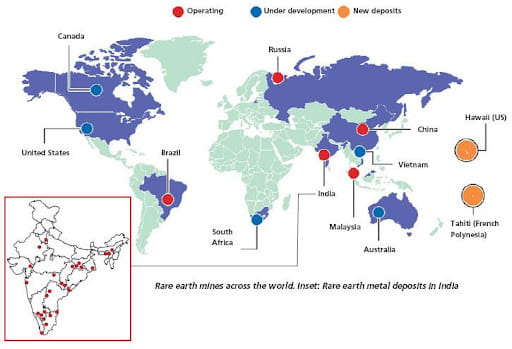
List of 30 Critical Minerals in India
- The Centre has classified 30 important minerals as critical to the country's economic development and national security in a strategic move. These minerals are:
- Antimony
- Beryllium
- Bismuth
- Cobalt
- Copper
- Gallium
- Germanium
- Graphite
- Hafnium
- Indium
- Lithium
- Molybdenum
- Niobium
- Nickel
- PGE
- Phosphorous
- Potash
- REE
- Rhenium
- Silicon
- Strontium
- Tantalum
- Tellurium
- Tin
- Titanium
- Tungsten
- Vanadium
- Zirconium
- Selenium
- Cadmium
India’s Roadmap for Critical minerals
- Invitation for Bids: The government will invite bids for 20 critical mineral blocks, which include important minerals like lithium and graphite.
- Focus on Specific Minerals: The auction primarily targets minerals classified as critical, with a specific focus on lithium and graphite, which are essential for various technological and energy applications.
- National Strategy Development: Following the auction, a national-level strategy will be formulated to effectively mine and process these critical minerals.
- Economic and National Security: The move is seen as crucial for India’s economic development and national security, particularly in the context of the global tech and renewable energy sectors.
- Supporting Policies: Accompanying this initiative, the government has set royalty rates for these minerals, with 3% each for lithium and niobium, and 1% for Rare Earth Elements (REEs).
- Alignment with Environmental Goals: This strategy is also aligned with India's commitment to energy transition and its aim to achieve net-zero emissions by 2070, highlighting the importance of these minerals in renewable energy technologies.
Legislative provisions: Mines and Minerals Bill 2023 – Key Provisions Related to Critical Minerals
- Expansion of Reconnaissance Activities: The amended Mines and Minerals Development and Regulation (MMDR) Act of 2015 currently limits reconnaissance to activities like aerial surveys and geological mapping. The Mines and Minerals Bill of 2023 broadens this definition to include pitting, trenching, drilling, and sub-surface excavation, which were earlier not permitted.
- Reclassification of Atomic Minerals: The Bill removes the exclusive government restriction on six atomic minerals - beryl, beryllium, lithium, niobium, titanium, tantalum, and zirconium. These can now also be explored and prospected by private entities.
- Exploration Licenses (EL): The Bill introduces a new type of license, EL, for private exploration activities. Exploration licenses will be granted through competitive bidding and will be issued for specified critical, strategic, and deep-seated minerals.
- Private Participation in Exploration Rights: The Bill allows private sector engagement in the exploration of critical and strategic minerals previously reserved for government entities.
- Centralized Auctions by the Central Government: The central government will oversee auctions for composite licenses and mining leases for critical and strategic minerals like lithium, cobalt, nickel, phosphate, potash, and tin. Concessions for these will still be issued by state governments.
- Revenue Model: ELs aim to generate revenue through a share of the premium paid by the miner after successfully auctioning a mined deposit.
Challenges Related to Critical Minerals
India lacks many of these mineral reserves, or its needs can exceed supply, making it necessary to rely on outside partners in order to meet local demands.
- Monopolisation by China: Over time, China has come to dominate the international market for rare earths; at one point, it was producing 90% of all the rare earths required worldwide.
- Currently, though, it only makes up 60%, with the Quad (Australia, India, Japan, and the United States) producing the remaining 40%.
- Nevertheless, China accounts for the majority of processed rare earth shares.
- Russia-Ukraine War: The conflict affects critical supply routes for minerals. Nickel, palladium, titanium sponge metal, and the rare earth element scandium are all produced in large quantities in Russia.
- In addition to having substantial lithium, cobalt, graphite, and rare earth element reserves, Ukraine is a major producer of titanium.
- The two countries' prolonged war raises concerns about the stability and availability of these vital minerals in global supply networks.
- China-Russia Cooperation and Disparity in International Initiatives: The shifting balance of power between countries and continents endangers critical mineral supply lines, owing principally to China and Russia's strategic relationship.
- This collaboration could have an impact on the stability and supply of essential minerals. As a result, wealthier countries have established joint measures such as the Minerals Security Partnership (MSP) and the G7's Sustainable Critical Minerals Alliance.
- However, developing countries have been passive participants in these projects, thereby missing out on the benefits and protection provided by these collaborations.
How are Nations Globally Ensuring a Steady Supply of Critical Minerals?
UNFC-1997 Classification System
- A globally recognized framework for reporting solid fuel and mineral reserves/resources.
- Developed by the UN Economic Commission for Europe.
Supply Chain Resilience Initiative (SCRI)
- Governmnts of India, Japan and Australia have formally launched the Supply Chain Resilience Initiative (SCRI).
- Aim is to establish a positive cycle that strengthens the resilience of the supply chain, aiming to ultimately achieve robust, sustainable, equitable, and inclusive growth in the Indo-Pacific region.
Mineral Security Partnership (MSP):
- Major economies like the U.S., UK, Japan, and the EU have established the MSP to ensure supply chain resilience for critical minerals.
- India joined this partnership to secure access to these resources.
Strategic Lists
- Countries are compiling lists of critical minerals based on their economic needs and supply risks, aligning with their industrial strategies. This aims to secure stable access to these resources.
Capacity Enhancement
- India: To assure a steady supply of critical and strategic minerals to the Indian domestic market, India established KABIL (Khanij Bidesh India Limited), a joint venture of three public sector firms (National Aluminium Company Ltd., Hindustan Copper Ltd., and Mineral Exploration Company Ltd.).
- It ensures the nation's mineral security while also contributing to the larger goal of import substitution.
- US: It has refocused its attention on increasing domestic mining, manufacturing, processing, and recycling of critical minerals and materials and ordered an examination of the weaknesses in its supply chains for these minerals.
- Australia: In order to guarantee a consistent supply of critical minerals to India, its Critical Minerals Facilitation Office (CMFO) and KABIL recently inked a Memorandum of Understanding.
- UK: It has opened a new Critical Minerals Intelligence Centre to research the future supply and demand for these minerals and will soon be announcing its critical mineral strategy.
Multilateral Minerals Security Partnership (MSP)
|
India-Australia Critical Minerals Investment Partnership
|
Conclusion
The upcoming auction and subsequent strategies indicate India's proactive approach in securing critical mineral resources. This move is aligned with India's economic development goals and its commitment to environmental sustainability and energy transition.
(*Click this link to read prelims specific weekly current affairs articles)
FAQs
Question: What are critical minerals?
Answer:
Critical minerals are a group of minerals that are essential to a country's economic and national security, yet they face potential supply risks. These minerals are vital for the manufacturing of high-tech devices, military equipment, renewable energy technologies, and various other important industrial applications.
Question: What are Rare Earth Elements (REEs)?
Answer:
Rare Earth Elements (REEs) refer to a set of 17 chemical elements on the periodic table that are vital to numerous high-tech and industrial applications. These elements are sought after for their distinct physical and chemical properties that make them critical for advanced technologies.
Question: What are the royalty rates set for lithium and REEs?
Answer:
The government has set royalty rates, with 3% each for lithium and niobium, and 1% for Rare Earth Elements (REEs).
UPSC Mains Practice Question:
|
MCQs
Question: With reference to India, consider the following statements: (UPSC 2022)
- Monazite is a source of rare earths.
- Monazite contains thorium.
- Monazite occurs naturally in the entire Indian coastal sands in India.
- In India, Government bodies only can process or export monazite.
Which of the statements given above are correct?
(a) 1, 2 and 3 only
(b) 1, 2 and 4 only
(c) 3 and 4 only
(d) 1,2, 3 and 4
Answer: (b) See the Explanation
Monazite is a primarily reddish- brown phosphate mineral that contains rare-earth elements. Due to variability in composition, monazite is considered a group of minerals. Hence, statement 1 is correct.
In addition to the rare-earth elements, thorium (Th) can be extracted from monazite ore. Thorium is a slightly radioactive metal, identical to uranium. Hence, statement 2 is correct.
Atomic Minerals Directorate for Exploration and Research (AMD), a constitute unit of Department of Atomic Energy (DAE) has estimated the presence of 11.93 million tonnes of monazite resourcesin the beach sand mineral placer deposits along the coastal tracts of India. Hence, statement 3 is incorrect.
Monazite is a mineral mainly containing rare earths and thorium-a prescribed substance to be handled by the Department of Atomic Energy (DAE). Accordingly, Indian Rare Earths Ltd. (IREL) wholly owned by the Govt. of India, under the administrative control of the Dept. of Atomic Energy (DAE) utilises monazite mainly for production of rare earth compounds, and thorium, as needed in theDepartment of Atomic Energy. Hence, statement 4 is correct.
Therefore, option (b) is the correct answer.
Question: Consider the following minerals: (UPSC 2020)
- Bentonite
- Chromite
- Kyanite
- Sillimanite
In India, which of the above is/are officially designated as major minerals?
(a) 1 and 2 only
(b) 4 only
(c) 1 and 3 only
(d) 2, 3 and 4 only
Answer: (d) See the Explanation
Minerals are divided into major and minor minerals, according to the National Account Statistics (2007).
Major minerals include the following:
- Fuel minerals include coal, lignite, natural gas, and petroleum (crude).
- Metallic Minerals include Bauxite, Chromite, Copper Ore, Gold, Iron Ore, Lead (Concentrates), Zinc (Concentrates), Manganese Ore, Silver, Tin (Concentrates), Tungsten (Concentrates) are examples of metallic minerals.
- Non-Metallic Minerals include Agate, Andalusite, Apatite, Asbestos, Ball Clay, Barytes, Calcite, Chalk, Clay, Corundum, Calcarious sand, Diamond, Diaspore, Dolomite, Kyanite, Laterite, Limestone, Limestone Kankar, Lime Shell,Magnesite, Mica (crude), Ochre, Pyrites, Pyrophyllite, Phosphorite, Quartz, impure quartz, Quartzite, Fuchsite Quartzite, Silica Sand, Salt (Rock), Salt (Evaporated), Shale, Slate, Steatite, Sillimanite, Vermiculite, Wollastonite.
Minor Minerals include Bentonite, Boulder, Brick Earth, Building Stones, Chalcedony or Corundum, Fuller's Earth, Gravel, Lime Stone, Dunite, Felspar, Fire Clay, Felsite, Flourite (Graded), Flourite (Concentrates), Gypsum, Garnet (Abrasives), Garnet (Gem), Graphite run-on-mines, Jasper, Kaolin, Marble, Murram, Ordinary Clay, Ordinary Sand, Ordinary Earth, Pebbles or Kankar, Quartzite and Sand stone, Road Metal, Salt Petre, Shale, Shingle, Slate.
Therefore, option (d) is the correct answer.
Question: With reference to the management of minor minerals in India, consider the following statements: (UPSC 2019)
- Sand is a 'minor mineral' according to the prevailing law in the country.
- State Governments have the power to grant mining leases of minor minerals, but the powers regarding the formation of rules related to the grant of minor minerals lie with the Centre Government.
- State Governments have the power to frame rules to prevent illegal mining of minor minerals.
Which of the statements given above is/are correct?
(a) 1 and 3 only
(b) 2 and 3 only
(c) 3 only
(d) 1, 2 and 3 only
Answer: (a) See the Explanation
Sand is classified as a minor mineral under section 3 (e) of the Mines and Minerals (Development and Regulation) Act of 1957 (MMDR Act). Hence, statement 1 is correct.
Section 15 of the MMDR Act authorizes state governments to create rules governing the grant of mineral concessions for minor minerals and for related purposes. As a result, the regulation of the grant of mining concessions for minor minerals falls under the legislative and administrative purview of state governments. State governments have created their own minor minerals concession guidelines using the authority granted to them by Section 15 of the MMDR Act. Hence, statement 2 is incorrect.
Section 23C of the MMDR Act of 1957 authorizes state governments to develop laws to prohibit illicit mining, transportation, and storage of minerals, as well as other related objectives. Controlling unlawful mining falls under the legislative and administrative purview of state governments. Hence, statement 3 is correct.
Therefore, option (a) is the correct answer.
Question: Recently, there has been a concern over the short supply of a group of elements called ‘rare earth metals’. Why? (UPSC 2012)
- China, which is the largest producer of these elements, has imposed some restrictions on their export.
- Other than China, Australia, Canada and Chile, these elements are not found in any country.
- Rare earth metals are essential for the manufacture of various kinds of electronic items and there is a growing demand for these elements.
Which of the statements given above is/are correct?
(a) 1 only
(b) 2 and 3 only
(c) 1 and 3 only
(d) 1, 2 and 3
Answer: (c) See the Explanation
The 17 chemical elements known as rare earth elements, or rare earth metals, are the 15 lanthanides plus scandium and yttrium, which are often found in the same ore deposits as the lanthanides and have comparable chemical properties.
Cerium (Ce), dysprosium (Dy), erbium (Er), europium (Eu), gadolinium (Gd), holmium (Ho), lanthanum (La), lutetium (Lu), neodymium (Nd), praseodymium (Pr), promethium (Pm), samarium (Sm), scandium (Sc), terbium (Tb), thulium (Tm), ytterbium (Yb), and yttrium (Y). these are the seventeen rare earths.
These components play a significant role in a number of technologies, including national defense, clean energy, advanced transportation, consumer electronics, computers and networks, communications, and healthcare. Hence, statement 3 is correct.
Rare Earth mining in China began in the 1950s. China currently refines around 80%-90% of the world's Rare Earths, giving them significant influence over their supply. According to the Australian Strategic Policy Institute, when China's Cultural Revolution ended, the country shifted its priority to exploitation of its natural resources. Hence, statement 1 is correct.
10 nations that, according to the most recent statistics from the US Geological Survey, mined the most rare earth metals in 2019 are:
- China
- USA
- Myanmar
- Australia
- India
- Russia
- Madagascar
- Thailand
- Brazil
- Vietnam Hence, statement 2 is correct.
Therefore, option (c) is the correct answer.
Download the PREPP App and attempt FREE IAS Exam Mock Tests and get complete study material!

Full Test - 04: UPSC CSE Prelims CSAT (Paper-II)
Full Test - 03: UPSC CSE Prelims CSAT (Paper-II)
UPSC CSE Prelims 2026 GS Paper 1 Question Paper (24-May-2026)
UPSC CSE Prelims 2026 CSAT Paper 2 Question Paper (24-May-2026)

17 February 2025 | The Hindu Must Read Articles | Current Affairs

16 February 2026 | The Hindu Must Read Articles | Current Affairs

13 February 2026 | The Hindu Must Read Articles | Current Affairs









Comments