Centre Clears ₹19,744-Crore Green Hydrogen Mission (UPSC Current Affairs)
Relevance: GS2 - Government policies and interventions for development in various sectors and issues arising out of their design and implementation; GS 3 - Infrastructure
(Source: The Hindu,01/05/23)
Click here for Daily Current Affairs
Why in the news?
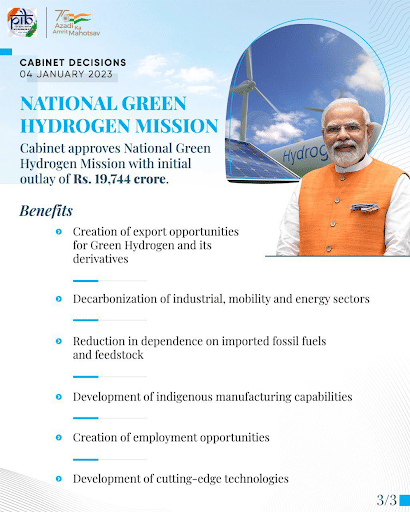
The government has formally approved the National Green Hydrogen Mission with a mission outlay of Rs 19,744 crore, with the aim of making India a global hub for the production of green hydrogen.
National Green Hydrogen Mission
- The total outlay for the mission is ₹19,744 crore, out of which the government has allocated ₹17,490 crore for the Strategic Interventions for Green Hydrogen Transition (SIGHT) program, ₹1,466 crores for the upcoming pilot projects, ₹400 crore for R&D, and ₹388 crores towards other mission components.
- On August 15, 2021, the National Hydrogen Mission was launched to reduce carbon emissions and boost the usage of renewable energy sources.
- The guidelines for implementing the plan will be developed by the Ministry of New and Renewable Energy (MNRE).
- The mission will result in the following likely outcomes by 2030:
- Development of green hydrogen production capacity of at least 5 MMT (Million Metric Tonne) per annum with an associated renewable energy capacity addition of about 125 GW in the country
- Over Rs. Eight lakh crore in total investments
- Creation of over Six lakh jobs
- The cumulative reduction in fossil fuel imports over Rs. One lakh crore
- Abatement of nearly 50 MMT of annual greenhouse gas emissions
- R&D: Additionally, the mission will assist the Strategic Hydrogen Innovation Partnership (SHIP), a platform for public-private R&D partnerships.
- The objectives, deadlines, and magnitude of R&D initiatives shall be appropriate for creating globally competitive technology.
- Skill development program: Additionally, a coordinated skill-development program will be implemented.
- Adopt targeted and coordinated actions: To guarantee the effective accomplishment of the mission objectives, all responsible ministries, departments, agencies, and institutions of the Central and State Governments will adopt targeted and coordinated actions.
- The mission's overall coordination and execution will be handled by the Ministry of New and Renewable Energy.
- Strategic Interventions for Green Hydrogen Transition Programme (SIGHT)
- Two unique financial incentive mechanisms will be offered under the Mission of the Strategic Interventions for Green Hydrogen Transition Programme (SIGHT),
- Targeting domestic manufacturing of electrolyzers and
- Production of Green Hydrogen – will be provided under the Mission.
- Additionally, the Mission will assist pilot initiatives in developing end-use industries and distribution channels.
- Regions that can sustain large-scale hydrogen generation and use will be found and developed as Green Hydrogen Hubs.
Benefits of Mission
- According to an official statement, the mission will have numerous advantages, including the opening up of export markets for green hydrogen and its derivatives,
- the decarbonization of the industrial, mobility, and energy sectors,
- the reduction of reliance on imported fossil fuels and feedstock,
- the improvement of domestic manufacturing capabilities,
- the creation of job opportunities, and the advancement of cutting-edge technologies
- The mission will make it easier to produce, use, export, and create new demand for green hydrogen.
Green Hydrogen
- Hydrogen generated using electrolyzers powered by renewable power sources is called green hydrogen.
Advantages of Green Hydrogen
- It is a clean-burning molecule that can decarbonize a number of industries, including transportation, chemicals, and iron and steel.
- Renewable energy that cannot be stored or used to create hydrogen can be directed through the grid.
- In the future, green hydrogen might replace fossil fuels and feedstocks derived from fossil fuels in the manufacturing of fertilizers, steel, and transportation.
Challenges
- High cost of technology,
- the possibility of unfavourable sunk costs, and
- a lack of public awareness.
- Technologies to adopt hydrogen fuel cell are immature in India
- India Currently lacks required number of electrolysers and cheap renewable energy.
- 8.92 litres of demineralized water are required for every kilogramme of hydrogen. Given that water is a scarce resource with many uses, its availability in sufficient streams is essential.
- Hydrogen Leaks easily and liquid hydrogen reacts explosively with air incurring significant transport and storage costs.
Way Forward
- Hydrogen can play an important role by the mid-century as the goalpost of going green shifts from merely reducing GHG emissions to achieving net-zero emissions.
- The success of government initiatives lies in administering the right mix of intra and inter-sectoral policies.
- It is undoubtedly clear that policymakers’ decisions today will have a long-lasting impact on the country’s energy story.
(*Click this link to read prelims specific weekly current affairs articles)
Some Important FAQs
Question: What is a fuel Cell?
Answer:
A fuel cell converts chemical energy into electrical energy using oxidising agents through an oxidation-reduction reaction. Fuel cell-based vehicles most commonly combine hydrogen and oxygen to produce electricity to power the electric motor on board.
Question: What is Net Zero?
Answer:
Net zero means cutting greenhouse gas emissions to as close to zero as possible, with any remaining emissions re-absorbed from the atmosphere, by oceans and forests for instance.
Question: What are the different types of Hydrogen?
Answer:
Grey hydrogen, which makes up the majority of the hydrogen produced today, is derived from fossil fuels. Blue hydrogen is produced using fossil fuels with options for carbon capture and storage, whereas green hydrogen is produced using electrolyzers fueled by renewable energy sources.
MCQs
Question: Consider the following statements:
- Grey hydrogen is derived from fossil fuels.
- Blue hydrogen is produced using fossil fuels with options for carbon capture and storage.
- Green hydrogen is produced using electrolyzers fueled by renewable energy sources.
Which of the above statements is/are correct?
(a) 1 and 2 only
(b) 2 and 3 only
(c) 1 and 3 only
(d) 1,2 and 3
Answer: (d) See the Explanation
- Grey hydrogen, which makes up the majority of the hydrogen produced today, is derived from fossil fuels. Hence, statement 1 is correct.
- Blue hydrogen is produced using fossil fuels with options for carbon capture and storage, whereas green hydrogen is produced using electrolyzers fueled by renewable energy sources. Hence, both statements 2 and 3 are correct.
- Therefore, option (d) is the correct answer.
Download the PREPP App and attempt FREE IAS Exam Mock Tests and get complete study material!

Full Test - 04: UPSC CSE Prelims CSAT (Paper-II)
Full Test - 03: UPSC CSE Prelims CSAT (Paper-II)
UPSC CSE Prelims 2026 GS Paper 1 Question Paper (24-May-2026)
UPSC CSE Prelims 2026 CSAT Paper 2 Question Paper (24-May-2026)

17 February 2025 | The Hindu Must Read Articles | Current Affairs

16 February 2026 | The Hindu Must Read Articles | Current Affairs

13 February 2026 | The Hindu Must Read Articles | Current Affairs









Comments