Centre Approves Rs.22,303 Crore Subsidy On Key Fertilizers
Relevance: Prelims; GS3 - Direct & Indirect Farm Subsidies
(Source: The Hindu, 10/26/2023)
Click here for Daily Current Affairs
Why in the news?
Recently, the Union Cabinet approved a ₹22,303-crore subsidy for phosphatic and potassic (P&K) fertilisers and the nutrient-based subsidy (NBS) rates for nitrogen, phosphorus and potassium (NPK) fertilisers for the 2023-24 Rabi season.
Table of Contents
What is Fertiliser Subsidy?
- A fertiliser subsidy is a financial assistance or support provided by the government to farmers or agricultural producers for the purchase of fertilisers.
- Fertilizer use in India has increased dramatically since the Green Revolution (mid-1960s).
- To encourage and facilitate the use of fertilisers, the government has provided farmers with fertiliser subsidies.
- It has evolved into a critical component of agricultural input support.
- Some of the important types of fertilizers include:
- Nitrogenous (Urea, Ammonium Nitrate, Ammonium Sulphate)
- Potassic (Potassium Nitrate, Chile Saltpetre)
- Phosphatic (Super Phosphate, Triple Phosphate)
About Nutrient Based Subsidy (NBS) Scheme
- Nutrient Based Subsidy Scheme for fertilizers was initiated in 2010 by the Department of Fertilizers.
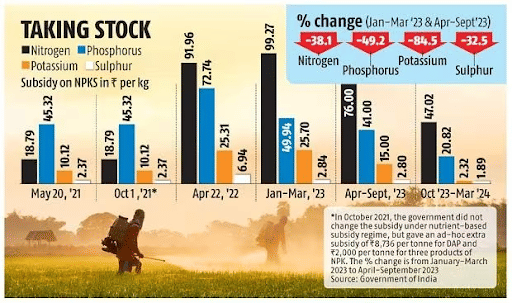
- This policy entails the government annually setting predetermined subsidy rates for specific nutrients, which include Nitrogen (N), Phosphate (P), Potash (K), and Sulphur (S).
- Its objective is to achieve a balanced utilization of fertilizers, enhance agricultural productivity, stimulate the growth of the domestic fertilizer industry, and alleviate the subsidy burden.
Mechanism of Subsidies in India
- Subsidies are currently provided to fertilizer companies, but their ultimate beneficiaries are the farmers who benefit from reduced Maximum Retail Prices (MRPs) compared to market rates.
- With the implementation of the Direct-Benefit Transfer (DBT) system, subsidy payments to these companies will only be made after they have sold fertilizers to farmers through retailers.
- Under this system, each retailer is equipped with a point-of-sale (PoS) machine that is connected to the Department of Fertilizers' e-Urvarak DBT portal.
- To purchase subsidized fertilizers, individuals must provide either their Aadhaar unique identity or Kisan Credit Card number. Only when the sale is recorded on the e-Urvarak platform can a fertilizer company claim the subsidy.
What are the issues related to Fertiliser Subsidy?
- Price Imbalance of Fertilizers: Heavy subsidies on urea and DAP result in significantly lower prices for these fertilizers compared to others. This leads to increased urea and DAP usage, as decontrolled fertilizers have become more expensive.
- Low Nitrogen Use Efficiency: It is a prevalent issue in India, particularly in the case of Urea fertilizer. This inefficiency results in the overapplication of Urea, leading to both excessive usage and groundwater contamination.
- Fiscal Health Concerns: Fertilizer subsidies strain national budgets, especially in agrarian economies, and costs can escalate due to population growth, evolving agricultural methods, and global fertilizer price fluctuations.
- Import dependence: The total demand for urea in the country is about 35 million tonnes whereas the domestic production is about 25 million tonnes.
Challenges associated with Subsidies
- Market distortions: Subsidies can distort market dynamics by creating artificial demand and supply, leading to overconsumption of subsidized goods or services.
- Fiscal burden: Subsidies impose a significant burden on the government's fiscal resources. The cost of subsidies often exceeds the allocated budget, leading to fiscal deficits and increased government debt. This can crowd out spending on critical sectors like education, healthcare, and infrastructure.
- Lack of data and monitoring: The government often lacks the data and monitoring systems necessary to effectively implement and manage subsidy programs. This can lead to leakages and corruption, and it can also make it difficult to assess the effectiveness of subsidy programs.
- Ineffective targeting: Subsidies are often poorly targeted, meaning that they benefit the wealthy and well-connected more than the poor and vulnerable. This lack of precision in targeting can lead to inefficiencies and inequities.
What are the related initiatives for Fertilisers?
- PM PRANAM: It aims to bring down the subsidy burden on chemical fertilisers. The scheme will have no separate budget and will be financed through the “savings of existing fertiliser subsidy” under schemes run by the Department of Fertilizers.
- Soil Health Card Scheme: It was launched in 2015 to assist State Governments to issue soil health cards to all farmers in the country.
- Direct Benefit Transfer (DBT): Under this scheme, fertilizer businesses receive a 100% subsidy on various fertilizer grades based on the retailer's sale to the beneficiaries.
- Neem-coated Urea: The Government of India promotes fertilizer efficiency and has added neem-coated urea to FCO. Over normal urea, neem-coated urea is more effective. This might aid in lowering pollution levels in the air and water.
- One Nation One Fertiliser Scheme: Under the scheme, all fertiliser companies, State Trading Entities and Fertiliser Marketing Entities will be required to use a single “Bharat” brand for fertilisers and logo under the Pradhanmantri Bhartiya JanurvarakPariyojna (PMBJP).
- New Urea Policy 2015: The New Urea Policy was released in May 2015. The Policy seeks to increase indigenous urea production,promote energy efficiency in urea production, and reduce subsidy burden on the Central government.
(*Click this link to read prelims specific weekly current affairs articles)
FAQs
Question: What is a Nutrient based subsidy?
Answer:
According to the NBS policy, the government annually announces a fixed rate of subsidy (in terms of per kg basis) on the nutrients nitrogen (N), phosphate (P), potash (K), and sulphur (S). For the various P&K fertilizers covered by the policy, the per-kilogram subsidy rates for nutrients are converted into per-tonne subsidies.
Question: What are Rabi Crops?
Answer:
Rabi crops are winter-sown and spring-harvested crops. They include wheat, barley, mustard, chana (gram), masur (lentil), peas, potato, tomato, beet, cabbage, garlic, onion, cumin, coriander, linseed, sunflower, and cauliflower, typically sown in mid-November.
Question: What is DAP?
Answer:
Di-ammonium Phosphate is popularly known as DAP in India. It contains both Nitrogen and Phosphorus which are primary macro-nutrients and part of 18 essential plant nutrients. DAP Contains 18% Nitrogen and 46% Phosphorus (P2O5). It is manufactured by reacting Ammonia with Phosphoric acid under controlled conditions in fertilizer plants.
UPSC Mains Practice Question:
|
MCQ
Question: With reference to chemical fertilizers in India, consider the following statements: (UPSC 2020)
- At present, the retail price of chemical fertilizers is market-driven and not administered by the Government.
- Ammonia, which is an input of urea, is produced from natural gas.
- Sulphur, which is a raw material for phosphoric acid fertilizer, is a by-product of oil refineries.
Which of the statements given above is/are correct?
(a) 1 only
(b) 2 and 3 only
(c) 2 only
(d) 1, 2 and 3
Answer: (b) See the Explanation
- The Government of India subsidies fertilisers to guarantee that farmers have access to them and that the country stays self-sufficient in agricultural output.
- This has mostly been accomplished through managing the price of fertiliser and the volume of produce. Hence, statement 1 is incorrect.
- Natural gas has been used to create ammonia (NH3). Natural gas molecules are converted to carbon and hydrogen during this process.
- After that, the hydrogen is purified and combined with nitrogen to form ammonia.
- This synthetic ammonia is used as fertiliser, either directly as ammonia or indirectly as urea, ammonium nitrate, and monoammonium or diammonium phosphates following synthesis. Hence, statement 2 is correct.
- Sulphur is a significant byproduct of oil and gas operations. Most crude oil grades include some sulphur, the majority of which must be removed during the refining process in order for refined products to fulfil tight sulphur content limitations.
- This is accomplished by hydrotreating, which produces H2S gas, which is then transformed into elemental sulphur.
- Sulphur may also be extracted from naturally existing subterranean reserves, although this is more expensive than sourcing from oil and gas and has mostly been abandoned.
- Both Monoammonium Phosphate (M A P) and Diammonium Phosphate are made using sulfuric acid (DAP). Hence, statement 3 is correct.
Therefore, option (b) is the correct answer.
Download the PREPP App and attempt FREE IAS Exam Mock Tests and get complete study material!

Full Test - 04: UPSC CSE Prelims CSAT (Paper-II)
Full Test - 03: UPSC CSE Prelims CSAT (Paper-II)
UPSC CSE Prelims 2026 GS Paper 1 Question Paper (24-May-2026)
UPSC CSE Prelims 2026 CSAT Paper 2 Question Paper (24-May-2026)

17 February 2025 | The Hindu Must Read Articles | Current Affairs

16 February 2026 | The Hindu Must Read Articles | Current Affairs

13 February 2026 | The Hindu Must Read Articles | Current Affairs









Comments