Can Universal Basic Income Tackle India’s Poverty
Relevance: GS2 - Welfare schemes for vulnerable sections of the population by the Centre and States and the performance of these schemes; mechanisms, laws, institutions and Bodies constituted for the protection and betterment of these vulnerable sections. GS3 - Indian Economy and issues relating to planning, mobilization, of resources, growth, development and employment. Inclusive growth and issues arising from it.
(Source: Down To Earth, Down To Earth, 10/27/2023)
Click here for Daily Current Affairs
Why in the news?
This article discusses the concept of Universal Basic Income and its significance as a tool for addressing income inequality and unlocking the country’s demographic potential.
Table of Contents
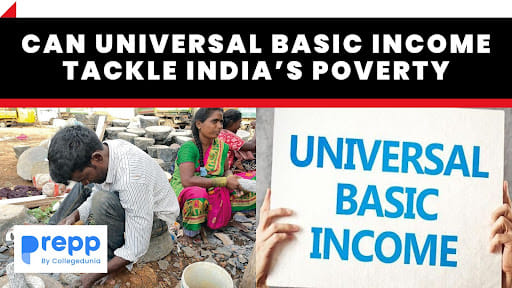
What is Universal Basic Income?
- The idea of Universal Basic Income (UBI) involves beneficiaries receiving a guaranteed income in the form of an unconditional transfer payment on a regular basis.
- UBI is a regular cash payment made individually to each member of a political community, without conditions such as examining their means and work requirements.
- In 2022, the Economic Advisory Council to the Prime Minister recommended the Universal Basic Income (UBI) programme to help close the income gap and ensure an equitable distribution of incomes in the labor market.
- Principles of a UBI programme
- Unconditional support
- Periodic payments as opposed to lump sum transfers
- Direct cash transfer instead of coupons or cash equivalents
- Individual beneficiaries rather than households.
What are the pros and cons of a UBI scheme?
Pros
- Lowers poverty: The Economic Survey 2016-17 revealed that studies from six developing countries showed no significant drop in labor supply for men and women alike following the introduction of a UBI scheme.
- UBI contributes to lowering poverty and income inequality and enables access to basic needs such as food, health, education, housing, etc to vulnerable and marginalized groups.
- Improvements in public health: The provision of a UBI results in improved physical and mental well-being, sanitation, and nutrition.
- Stress, anxiety, and depression tied to poverty can be tackled.
- Efficient system: A UBI scheme can streamline existing welfare programs, thereby reducing administrative costs, and making the welfare system more efficient.
- Economic stimulus: The UBI scheme directly puts money in the hands of the beneficiaries.
- This boosts consumer spending which helps promote local businesses leading to the generation of employment and entrepreneurship opportunities.
Cons
- Fiscal Sustainability: According to critics, the UBI comes with high costs which could necessitate increased taxes, spending cuts, and debt leading to inflation, distortions in the labor market, and reduced economic growth.
- Adverse inspiration: It could demotivate people belonging to the working-age population, thereby reducing the productivity and efficiency of the economy.
- This would increase dependency on government support and discourage skill development.
- However, studies have revealed that an unconditional cash transfer has no negative effects on people’s desire to work.
- Inflationary Pressures: A fixed income for all the citizens of the country could result in an increase in the prices of most goods and services in the country.
- Negative behavior: Cash incentives to the poor may lead them to misuse it for alcohol, drugs, and other anti-social habits.
- However, a review of data by Nobel laureate Abhijit Banerjee and colleagues found that recipients displayed reduced substance abuse.
Why is a UBI scheme beneficial for India?
- Diversity of India: India is a diverse society which means it is nearly impossible to create a uniform policy to address the diverse and distinct needs of the population.
- These policies do not recognize the different needs and are often narrow and targeted, creating inefficiencies in governance and populist interventions.
- For example, a free bus ticket policy will not benefit people belonging to areas without public transport coverage.
- Similarly, the distribution of sewing machines to empower women does not consider whether employment is the challenge faced by them or whether tailoring is their desired occupation.
- Universality of cash: On the other hand, cash which is the universal medium of exchange can provide each beneficiary with an economic base that will empower them to meet their needs.
- A cash-based support in addition to quality and accessible government services will enhance people’s capacity to access better services that are not essential and ensure wider coverage.
- Reduced government workload: The universality and unconditionality of the scheme means that the government does not need to spend time and resources in assessing the eligibility of the potential beneficiaries.
- This also reduces the paperwork requirements of potential beneficiaries, who are often less literate.
- In countries like India where awareness and documentation are significant challenges, especially in rural areas, a UBI scheme ensures robust coverage.
- Increased resilience and advancement: A basic income will also enable beneficiaries to survive crises such as health shocks, employment termination, natural disasters, deaths, etc which expose the poor to extreme poverty, exploitation, and vicious debt traps.
- Cash transfer and basic income programs allow beneficiaries to invest in better housing, healthcare, education, and savings, thereby reducing their reliance on credit and increasing their contribution to the economy.
- Women have been able to use the benefits to negotiate themselves out of exploitative daily wage work and invest in small businesses.
- Addressing challenges: People around the world are increasingly at risk due to challenges such as automation, unemployment, climate change, pandemics, declining female labor force participation, and growing inequality.
- In such a situation, UBI and improved government services will help ensure the delivery of benefits to the poorest and weakest sections, giving them the freedom to pursue constructive opportunities.
Case studies
- SEWA Pilot
- A pilot program conducted by SEWA in Delhi and Madhya Pradesh provided beneficiaries ₹1,000 a month.
- Findings:
- 64% of beneficiaries spent the benefits only on food.
- School enrollment increased from 69.6 to 70.6%.
- Usage of cleaner fuels rose from 68 to 84%.
- 73% of the beneficiaries cleared loans and debts
- 27 % of women thought access to direct money enabled more control over household expenditure.
- In Madhya Pradesh, the experiment covered 6,000 people from 12 villages including one inhabited by tribal communities.
- Findings:
- Adults and children were provided ₹300 and ₹150 per month respectively for 17 months.
- In 2013, Ghoda Khurd in Indore district found that about 14.3% of the households spent the money to build toilets while others mainly spent on access to private water resources for drinking purposes.
- 14.5% of beneficiaries in Ghoda Khurd improved access to electricity while food expenditure rose from 52% to 78% of income.
- A 2017 study found a drop in liquor intake, particularly in Ghoda Khurd, and a decline in child labor in agriculture by 71%.
- Change of energy sources: 24.3% of beneficiaries in non-tribal villages and 16% of those in the tribal village used the money to change the source of energy used by them.
- WorkFREE pilot
- The WorkFREE pilot project is implemented by the University of Bath, UK; Montfort Social Institute, Hyderabad; and India Network for Basic Income.
- It has been funded by the European Research Council.
- It supports around 1,250 residents in five slums of Hyderabad by providing adults with ₹1,000 and children ₹500 a month for 18 months.
- The beneficiary communities have been chosen from those involved in work such as garbage collection, domestic work, or roadside hawking, and those from Scheduled Castes and those without any tenancy rights.
- Findings:
- An increase in health insurance coverage among participants.
- Recipients used the money to expand economic activities or pay for emergency needs instead of relying on debts.
- A survey conducted in 2023 found that 66% of beneficiary households used the cash to buy food, fuel, clothes, and to pay utility bills.
- 36% spent the money for education fees while 40 per cent added it to their savings and 23 per cent repaid debts.
- It was also used to invest in new businesses, assets, and vehicles.
- 43% of households spent cash on medicines, diagnostic tests, and doctor visits.
Conclusion
- Universal Basic Income holds the potential to address income inequality and poverty in India by providing a regular, unconditional income to its citizens.
- It offers numerous advantages including improved public health and economic stimulus but critics have raised concerns such as fiscal sustainability and negative incentives.
- It requires urgent attention from necessary authorities due to it being a viable solution to enhance the well-being and resilience of the population.
(*Click this link to read prelims specific weekly current affairs articles)
FAQs
Question: What is the Economic Advisory Council to the Prime Minister?
Answer:
The Economic Advisory Council to the Prime Minister (PMEAC) is a non-constitutional, non-permanent, and independent body constituted to advise the Prime Minister and Government of India on economic matters. It consists of a Chairperson, Member Secretary, and two part-time members and is supported in its functions by a team of officials and administrators.
Question: What is SEWA?
Answer:
SEWA or Self Employed Women’s Association is a low-income, self-employed women’s trade union that was formed under the initiative of Ela Bhatt in 1972. It grew out of the Textile Labour Association (TLA), founded by Anasuya Sarabhai and Mahatma Gandhi in 1920. It incorporates the Gandhian principles of Satya, Ahimsa, Sarvadharma, and Khadi to achieve self-reliance and full employment.
UPSC Mains Practice Question:
|
MCQs
Question: India has experienced persistent and high food inflation in the recent past. What could be the reasons?
- Due to a gradual switchover to the cultivation of commercial crops, the area under the cultivation of food grains has steadily decreased in the last five years by about 30%.
- As a consequence of increasing incomes, the consumption patterns of the people have undergone a significant change.
- The food supply chain has structural constraints. (UPSC CSE 2011)
Which of the statements given above are correct?
(a) 1 and 2 only
(b) 2 and 3 only
(c) 1 and 3 only
(d) 1, 2 and 3
Answer: (b) See the Explanation
- There has been an increase in production and productivity of the cereals. Hence statement 1 is incorrect.
- Increasing incomes has led to changes in consumption patterns, there has been a switch over to processed foods, milk and milk products, and so on. This increase in demand for different products has led to an increase in the cost of high-end products. Hence statement 2 is correct.
- Structural constraints like cold chain infrastructure, transportation (rising fuel prices), etc increase the cost of supply contributing to inflation. Hence statement 3 is correct.
Therefore, option (b) is the correct answer.
Question: Consider the following statements: Other things remaining unchanged, market demand for a good might increase if
- Price of its substitute increases
- Price of its complement increases
- The good is an inferior good and the income of the consumers increases
- Its price falls
Which of the above statements is/are correct? (UPSC CSE 2022)
(a) 1 and 4 only
(b) 2, 3 and 4
(c) 1, 3 and 4
(d) 1, 2 and 3
Answer: (a) See the Explanation
- The demand for a good increases if the price of one of its substitutes rises. Hence statement 1 is correct.
- The demand for a good decreases if the price of one of its substitutes falls.
- The demand for a good increases if the price of one of its complements falls. Hence statement 2 is incorrect.
- The demand for an inferior good decreases if income increases. The demand for a normal good increases if income increases. Hence statement 3 is incorrect.
- If the Price of the good falls, then its demand increases. Hence statement 4 is correct.
Therefore, option (a) is the correct answer.
Download the PREPP App and attempt FREE IAS Exam Mock Tests and get complete study material!

Full Test - 04: UPSC CSE Prelims CSAT (Paper-II)
Full Test - 03: UPSC CSE Prelims CSAT (Paper-II)
UPSC CSE Prelims 2026 GS Paper 1 Question Paper (24-May-2026)
UPSC CSE Prelims 2026 CSAT Paper 2 Question Paper (24-May-2026)

17 February 2025 | The Hindu Must Read Articles | Current Affairs

16 February 2026 | The Hindu Must Read Articles | Current Affairs

13 February 2026 | The Hindu Must Read Articles | Current Affairs









Comments