Birth and Life of Buddha (563 - 483 BC) - Ancient India History Notes
The Birth and Life of Buddha, also known as Siddhartha Gautama, is a pivotal chapter in the history of humanity and spirituality. His journey from birth to enlightenment, leading to the foundation of Buddhism, is a remarkable story that has inspired millions across the globe. Siddhartha Gautama was a Hindu prince who renounced his position and wealth to seek enlightenment as a spiritual ascetic, attained his goal, and founded Buddhism in India in the 6th-5th centuries BCE by preaching his path to others. This article delves into the various stages of Buddha's life, shedding light on his early life, spiritual quest, teachings, and lasting impact on the world which will be helpful in Ancient History preparation for the UPSC Civil service exam.
Table of Contents
Early Life and Background
- Siddhartha Gautama was born in 563 BCE in Lumbini Garden near Kapilavastu, present-day Nepal.
- He was born into the Shakya dynasty, with his father Suddhodana being a king and his mother Maya Devi, a queen.
- His mother died during childbirth, so he was raised by his aunt Prajapati Gautami.
- It is said that astrologers predicted either a great king or a spiritual leader at his birth.
- Fearing his son's reflective nature, his father married him at a young age to the lovely Yasodhara, from whom he had a son, Rahula.
| Other Relevant Links | |
|---|---|
| Noble truths or ariya-saccani | Eightfold path or ashtangika marg. |
| Triratnas | Panchsheel of buddha |
The Spiritual Calling
- Siddhartha was shielded from the harsh realities of life, living within the palace walls.
- His encounters with an old man, a sick person, a corpse, and a wandering ascetic exposed him to suffering and prompted his spiritual quest.
- At the age of 29, Siddhartha left behind his princely life to seek answers to the nature of suffering and existence.
- Siddhartha engaged in rigorous ascetic practices under various spiritual teachers.
- He realized that extreme asceticism as well as indulgence were not the paths to enlightenment.
- He adopted the Middle Path – moderation in all aspects of life.
- At the age of 35, Siddhartha meditated under the Bodhi Tree in Bodh Gaya, where he attained enlightenment and became the Buddha, the "Awakened One."
- He spent the rest of his life teaching dhamma, or the path of righteous living.
Teachings and Philosophy
- The Four Noble Truths (Arya-Satyas) represent the fundamental principle of Buddha's teachings:
- Dukkha (Suffering): Suffering is inherent in human existence.
- Samudaya (Origin): Suffering arises from attachment and desire.
- Nirodha (Cessation): Suffering can be ended by overcoming attachment.
- Magga (Path): The Eightfold Path leads to the cessation of suffering.
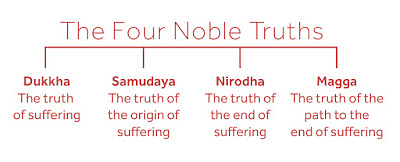
Four Noble Truths
- The Eightfold Path outlines ethical and mental practices for achieving enlightenment and liberation. It consists of the following:
- Right View
- Right Thought
- Right Speech
- Right Action
- Right Livelihood
- Right Effort
- Right Mindfulness
- Right Concentration
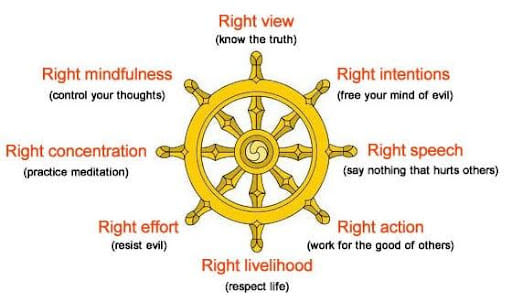
Eight Fold Path
- Buddha summed up the entire process in three words: Sila (right conduct), Samadhi (right concentration), and Prajna (right knowledge).
- The ultimate goal of life is to achieve nirvana, the eternal state of peace and bliss that entails freedom from further birth and death.
- He placed a strong emphasis on the law of karma. He contended that man's condition in this life is determined by his own actions.
- Buddha's teachings emphasized compassion for all sentient beings and non-violence.
- Even in the face of the greatest adversity, he displayed no rage or hatred, instead conquering everyone with his love and compassion.
- Buddha neither acknowledges nor denies the existence of God.
Spread of Buddhism
- Buddha delivered his first sermon, known as the Dhammacakkappavattana Sutta, at Deer Park in Sarnath.
- He established the Sangha, a community of monks and nuns who propagated his teachings.
- Membership was open to anyone, male or female, and there were no caste restrictions.
- Buddhism spread across India and neighboring regions through the efforts of his disciples.
- This religion was accepted by Magadha, Kosala, Kausambi, and several republican states in North India.
- Around two hundred years after Buddha's death, the famous Mauryan Emperor Asoka converted to Buddhism.
- Emperor Ashoka played a crucial role in spreading Buddhism across the Indian subcontinent and beyond.
- As a result, a local religious sect became a world religion.
Last Days of Buddha
- In the year 483 BC, Buddha died at the age of 80 in Kushinagar.
- The ashes of Buddha were distributed among his followers following his cremation.
- Stupas were built over the ashes, which were kept in caskets. One such example is the Sanchi Stupa.
- Buddhism grew rapidly both during and after the Buddha's lifetime, as it appealed to many people who were dissatisfied with existing religious practises and perplexed by the rapid social changes occurring around them.
- The emphasis on metta (fellow feeling) and karuna (compassion), particularly for those younger and weaker than oneself, drew men and women to Buddhist teachings.
Legacy and Impact
- Buddha's teachings laid the foundation for Buddhist philosophy, emphasizing mindfulness, meditation, and ethical conduct.
- Buddhist art and architecture, seen in stupas and monasteries, reflect the spiritual and artistic legacy of the religion.
- Buddhism's principles of compassion, tolerance, and non-attachment continue to influence individuals worldwide.
- It promoted education by establishing residential universities such as Taxila, Nalanda, and Vikramasila.
- Pali and other local languages evolved as a result of Buddhist teachings.
- It also aided in the spread of Indian culture throughout Asia.
Names of buddha
- Buddha had several names and titles throughout his life and in Buddhist texts:
- Clan Name: Gautama (Sanskrit) or Gotama (Pali). He belonged to the Shakya clan, hence he is often called Shakyamuni, which means "the sage of the Shakya clan."
- Given Name: Siddhartha (Sanskrit) or Siddhattha (Pali), which means "he who achieves his aim."
- Epithets and Titles:
- Bhagavat: Often translated as "Lord" or "the Blessed One."
- Tathagata: This term has several interpretations, including "one who has thus come" or "one who has thus gone." It signifies the Buddha's unique role as an enlightened being who has transcended the cycle of birth and death.
Conclusion
The birth and life of Buddha represent an extraordinary journey from prince to sage, from ignorance to enlightenment. His teachings have transcended time and boundaries, offering a path to inner transformation and a profound understanding of the nature of existence.
| Other Relevant Links | |
|---|---|
| Ancient History Notes | Buddhism - Causes and Origin |
| Buddhism Texts | Buddhist Literature |
| Reason: Spread & Popularity of Buddhism | Causes for the Decline of Buddhism |
| Important Buddhist Writers | Buddhist Scholars |
| Buddhist Councils | Significance of Buddhism |
| Literature of Buddhism | Schools of Buddhism |
| Jainism Texts | Jain Literature |
FAQs
Question: Who was Siddhartha Gautama, and what is his significance in Indian history?
Answer: Siddhartha Gautama, later known as Buddha, was born in 563 BCE in Lumbini, present-day Nepal. He is regarded as the founder of Buddhism, one of the world's major religions. Siddhartha’s journey to enlightenment began with his renunciation of his royal life to understand the nature of human suffering. Through deep meditation, he achieved enlightenment and became the Buddha, "the awakened one." His teachings centered around the Four Noble Truths and the Eightfold Path, which offer a way to overcome suffering and attain Nirvana, a state of liberation and peace. Buddha's message has had a profound influence on Indian philosophy and spirituality, shaping the development of not only Buddhism but also influencing other religious traditions in the region.
Question: What were the Four Noble Truths taught by Buddha?
Answer: The Four Noble Truths form the foundation of Buddhist teachings. They are: 1. **The truth of suffering (Dukkha)**: Suffering exists in life, which includes birth, aging, sickness, and death. 2. **The truth of the cause of suffering (Samudaya)**: The cause of suffering is desire, attachment, and ignorance. 3. **The truth of the cessation of suffering (Nirodha)**: Suffering can be overcome by eliminating its causes, particularly desire and attachment. 4. **The truth of the path leading to the cessation of suffering (Magga)**: The Eightfold Path is the way to end suffering, involving right views, right intentions, right speech, right action, right livelihood, right effort, right mindfulness, and right concentration.
Question: What is the significance of the Eightfold Path in Buddhism?
Answer: The Eightfold Path is a central teaching in Buddhism that provides a practical guideline for ethical living and mental development. It is the path that leads to the cessation of suffering and attainment of Nirvana. The eight aspects of the path are divided into three core areas: ethical conduct (Right Speech, Right Action, Right Livelihood), mental discipline (Right Effort, Right Mindfulness, Right Concentration), and wisdom (Right View, Right Intention). The Eightfold Path helps individuals transform their thoughts, actions, and consciousness, leading to spiritual awakening and the end of suffering.
Question: How did Buddha’s life and teachings challenge the traditional religious practices of his time?
Answer: Buddha’s life and teachings challenged the rigid caste system and the ritualistic practices that dominated Hinduism during his time. Unlike the Vedic religious practices, which were focused on rituals and sacrifices performed by Brahmins, Buddha advocated a personal path to enlightenment based on individual effort and self-discipline. He rejected the notion of a creator god and emphasized the impermanence of life and the possibility of personal transformation. Buddha’s teachings promoted equality, with a focus on compassion and mindfulness, attracting people from all walks of life, including those from lower castes who were excluded from traditional religious practices.
Question: What was the role of Emperor Ashoka in the spread of Buddhism?
Answer: Emperor Ashoka, who ruled the Maurya Empire from 268 to 232 BCE, played a significant role in the spread of Buddhism. After the Kalinga War, Ashoka experienced deep remorse for the bloodshed and turned to Buddhism for guidance. He embraced the teachings of Buddha and became a strong patron of Buddhism. Ashoka promoted Buddhist principles of non-violence, compassion, and tolerance throughout his empire. He built stupas, monasteries, and inscribed edicts on pillars to spread the teachings of Buddhism, not only across India but also to regions like Sri Lanka, Central Asia, and Southeast Asia. His efforts helped transform Buddhism into a global religion.
MCQs
1. Who is regarded as the founder of Buddhism?
A) Mahavira
B) Zoroaster
C) Siddhartha Gautama (Buddha)
D) Confucius
Answer: (C) See the Explanation
Explanation: Siddhartha Gautama, known as Buddha, is regarded as the founder of Buddhism. His teachings on overcoming suffering and achieving enlightenment form the basis of the Buddhist religion.
2. What is the ultimate goal of Buddhist practice?
A) To attain wealth
B) To reach Nirvana
C) To gain power
D) To create an empire
Answer: (B) See the Explanation
Explanation: The ultimate goal of Buddhist practice is to reach Nirvana, a state of liberation from suffering and the cycle of birth, death, and rebirth. It is achieved by following the teachings of Buddha, especially the Eightfold Path.
3. What is the first step in the Eightfold Path?
A) Right Action
B) Right Intention
C) Right View
D) Right Mindfulness
Answer: (C) See the Explanation
Explanation: The first step in the Eightfold Path is Right View, which refers to understanding the Four Noble Truths and recognizing the impermanent and interconnected nature of life. It forms the foundation of all other practices in Buddhism.
4. What was the primary teaching of Buddha regarding human suffering?
A) Suffering is caused by the gods
B) Suffering can be eliminated by understanding its causes
C) Suffering is inevitable and should be accepted
D) Suffering is caused by karma alone
Answer: (B) See the Explanation
Explanation: Buddha taught that suffering is caused by desire and attachment. By understanding its causes and following the Eightfold Path, one can eliminate suffering and achieve Nirvana.
5. Which of the following is not one of the Four Noble Truths?
A) The truth of suffering
B) The truth of the cause of suffering
C) The truth of the end of suffering
D) The truth of the creation of suffering
Answer: (D) See the Explanation
Explanation: The Four Noble Truths outline that suffering exists, has a cause, can be eliminated, and that the path to the cessation of suffering is the Eightfold Path. There is no "truth of the creation of suffering" in Buddhist teachings.
GS Mains Questions and Model Answers
Q1: Discuss the life and teachings of Buddha. How did his philosophy challenge the existing religious practices of his time?
Answer: Siddhartha Gautama, known as Buddha, was born in 563 BCE in Lumbini and renounced his royal life to seek enlightenment. His teachings, known as the Dharma, emphasized the Four Noble Truths and the Eightfold Path as a way to overcome human suffering. Buddha’s philosophy challenged the existing religious practices by rejecting the notion of a supreme god and the rigid caste system prevalent in Vedic traditions. Unlike the Brahminical rituals and sacrifices, Buddha advocated for a personal journey to enlightenment through meditation, ethical conduct, and wisdom. His teachings promoted equality and non-violence, attracting followers from all social strata, including the lower castes. This philosophy laid the foundation for a new religious movement that eventually became Buddhism, offering an alternative path to spiritual liberation.
Q2: Analyze the concept of Nirvana in Buddhism. How does it relate to the Buddhist path of self-liberation?
Answer: Nirvana in Buddhism refers to the ultimate goal of liberation from the cycle of birth, death, and rebirth (samsara). It is a state of complete cessation of suffering, desire, and attachment, where one achieves peace and enlightenment. The path to Nirvana is through the realization of the Four Noble Truths and the practice of the Eightfold Path, which involves right view, right intention, right speech, right action, right livelihood, right effort, right mindfulness, and right concentration. Nirvana is not a place but a state of being free from suffering and ignorance. It represents the end of all desires and attachments, which are the root causes of suffering. Through meditation, ethical living, and wisdom, individuals can reach Nirvana, attaining true liberation.
Q3: Discuss the spread of Buddhism after Buddha’s death. What role did Emperor Ashoka play in its expansion?
Answer: After Buddha’s death, Buddhism spread across India and to other parts of Asia. The initial spread of Buddhism was through the efforts of Buddha’s disciples and followers who traveled to different regions to teach his philosophy. However, it was Emperor Ashoka, the Mauryan ruler, who played a pivotal role in the widespread dissemination of Buddhism. After the Kalinga War, Ashoka converted to Buddhism, adopting its principles of non-violence and compassion. He supported Buddhism by building stupas, monasteries, and inscribing edicts promoting moral conduct and religious tolerance. Ashoka sent Buddhist missionaries to regions such as Sri Lanka, Central Asia, and Southeast Asia, helping establish Buddhism as a major world religion. His patronage and efforts ensured that Buddhism became deeply rooted not only in India but across the Asian continent, influencing the culture and philosophy of several nations.
Previous Year Questions on Buddha
1. UPSC CSE Prelims 2019:
Question: Which of the following was the primary focus of Buddha’s teachings?
A) Creation of the universe
B) Worship of gods
C) The cessation of suffering through the Eightfold Path
D) Ritual sacrifices for liberation
Answer: (C)
Explanation: Buddha’s teachings were centered around the cessation of suffering through the Four Noble Truths and the Eightfold Path, which provides a guide for overcoming desires and achieving Nirvana.
2. UPSC CSE Mains 2020 (GS Paper 1):
Question: "Explain the life of Siddhartha Gautama and how his teachings transformed the religious landscape of India during his time."
Answer: Siddhartha Gautama, known as Buddha, was born into a royal family in Lumbini. His quest for understanding the nature of human suffering led him to leave his royal life and seek enlightenment through meditation. Buddha's teachings focused on the Four Noble Truths and the Eightfold Path, offering a path to liberation from suffering. His philosophy challenged the ritualistic practices and caste-based discrimination of the time, promoting equality, non-violence, and personal effort in the pursuit of enlightenment. Buddha's teachings became a transformative force in India, eventually giving rise to Buddhism as a distinct religious tradition, spreading not only across India but to other parts of Asia. His ideas continue to influence millions worldwide.
Download the PREPP App and attempt FREE IAS Exam Mock Tests and get complete study material!

Full Test - 04: UPSC CSE Prelims CSAT (Paper-II)
Full Test - 03: UPSC CSE Prelims CSAT (Paper-II)
UPSC CSE Prelims 2026 GS Paper 1 Question Paper (24-May-2026)
UPSC CSE Prelims 2026 CSAT Paper 2 Question Paper (24-May-2026)

17 February 2025 | The Hindu Must Read Articles | Current Affairs

16 February 2026 | The Hindu Must Read Articles | Current Affairs

13 February 2026 | The Hindu Must Read Articles | Current Affairs









Comments