Biosphere Reserves are Evolving as Pockets of Hope
Primary Source: The Hindu
Click here for Daily Current Affairs
Why in the news?
- This article highlights the significance of UNESCO Biosphere Reserves as crucial sanctuaries for biodiversity conservation, sustainable development, and climate change mitigation.
- It emphasizes the global network of 748 biosphere reserves, which support over 250 million people and showcase successful local conservation initiatives.
- World Biosphere Reserve Day is celebrated on November 3rd to promote awareness and conservation of these areas.
Table of Contents
What are Biosphere Reserves?
- Biosphere Reserves are areas of terrestrial and coastal ecosystems that are internationally recognized under UNESCO's Man and the Biosphere (MAB) Programme.
- They are designated to promote and demonstrate a balanced relationship between humans and the biosphere.
- They help to protect genetic resources, species, ecosystems, and landscapes.
- Biosphere Reserves seek to foster economic development which is socio-culturally and ecologically sustainable.
- They provide areas for research, monitoring, education, and information exchange related to local, national, and global issues of conservation and development.
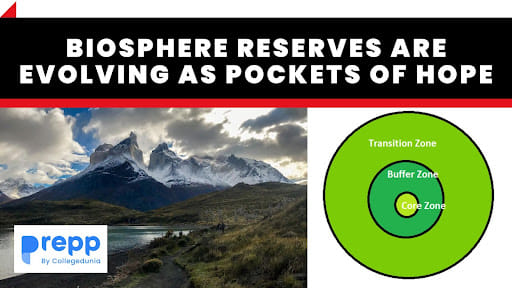
Zones of Biosphere Reserves
Biosphere Reserves are typically divided into three zones:
- Core Area: This is strictly protected and undisturbed by human activities, primarily for the conservation of biodiversity.
- Buffer Zone: Surrounding or adjoining the core areas, this zone is used for activities compatible with ecological practices that can reinforce scientific research, monitoring, training, and education.
- Transition Area: This is the outermost part of a Biosphere Reserve where sustainable resource management practices are promoted and local communities, management agencies, scientists, NGOs, cultural groups, and other stakeholders work together.
Important Stats Related to Biosphere Reserves
|
Local Conservation Efforts
- Reduction of Single-Use Plastic: In the Island of Principe Biosphere Reserve, a practical step has been taken by providing schoolchildren with stainless steel water bottles to mitigate the use of single-use plastic bottles.
- Community Engagement: The local communities in the Sundarban Biosphere Reserve in India are participating in the management of mangrove forests and protection of regional biodiversity.
- Women and Youth Involvement: In the Gulf of Mannar Biosphere Reserve in India, women are forming self-help groups to contribute to conservation efforts, and the youth are engaging in eco-tourism as a sustainable economic activity.
- Plastic Checkpoints: The Gulf of Mannar Biosphere Reserve Trust has initiated 'plastic checkpoints' to check vehicles and tourists for plastic waste, which is then collected, recycled, and repurposed for road construction.
UNESCO Michel Batisse Award for Biosphere Reserve Management 2023
|
Biosphere Reserves – SACAM Meeting
- The South and Central Asian Biosphere Reserve Network Meeting (SACAM) is a significant event specifically focusing on the conservation and sustainable use of biosphere reserves within the South and Central Asia region.
- The 10th SACAM meeting took place in Chennai, India, from November 1-3.
- The meeting was a collaborative effort between UNESCO, the Ministry of Environment, Forests and Climate Change of India, and the National Centre for Sustainable Coastal Management.
- The theme for this meeting was “Ridge to Reef,” reflecting a comprehensive approach to environmental management that connects land, freshwater, and marine ecosystems, indicating a holistic view of conservation that addresses diverse ecosystems and their interconnections.
- The SACAM served as a platform for exchanging knowledge and fostering collaborations among participants.
- The meeting aligns with the goals of UNESCO’s Man and the Biosphere (MAB) programme, which aims to improve the relationship between humans and the environment by integrating natural and social sciences for the betterment of people’s livelihoods and the safeguarding of ecosystems.
UNESCO’s Man and the Biosphere (MAB) Programme
|
Significance of Biosphere Reserves
1) Conservation of Biodiversity
- They help in preserving the genetic diversity of plants, animals, and other organisms.
- Offer a sanctuary for species, including endangered and rare ones, allowing them to live and reproduce in a natural habitat.
- Maintain ecosystems that provide valuable services such as water filtration, flood prevention, and carbon storage.
2) Sustainable Development
- They promote sustainable livelihood practices that are economically viable and culturally acceptable.
- Encourage the sustainable use of natural resources, ensuring that they are used in a way that is equitable and does not compromise the needs of future generations.
- Boost local economies through sustainable tourism, agriculture, and forestry.
3) Research and Monitoring
- Serve as sites for long-term ecological research, monitoring climate change, and studying human impact.
- Provide a living laboratory for education and training for environmental management and sustainable development.
4) Cultural Values
- Protect the cultural diversity and traditional knowledge of the local and indigenous communities.
- Promote a balanced relationship between humans and the environment, encouraging respect and understanding of natural resources.
5) Global and Regional Collaboration
- Foster international peace and collaboration by sharing best practices and knowledge across borders.
- Facilitate the formation of networks for the exchange of information and experience among different regions and cultures.
6) Climate Change Mitigation and Adaptation
- Act as natural carbon sinks, helping to mitigate the effects of climate change.
- Develop strategies for adaptation to environmental changes, including climate change.
7) Implementing Sustainable Practices
- Test and demonstrate innovative approaches to sustainable living and environmental conservation.
- Influence national and international policy in favour of environmental sustainability.
Challenges Related to Biosphere Reserves
1) Environmental Challenges
- Altered weather patterns and extreme weather events affect the integrity of ecosystems within biosphere reserves.
- The spread of non-native species can disrupt local biodiversity and ecological balance.
- Water, soil, and air pollution from nearby urban, agricultural, or industrial sources can damage delicate ecosystems.
2) Socioeconomic Challenges
- Increasing population in and around biosphere reserves can lead to overuse of natural resources.
- There is often a conflict between conservation efforts and the economic interests of communities and businesses.
- Local communities may depend on the reserves for resources, leading to unsustainable harvesting practices if alternative livelihoods are not provided.
3) Management and Institutional Challenges
- Adequate and sustained funding is required for management, research, and monitoring, which is often lacking.
- Biosphere reserves may not be fully integrated into national and regional planning, which can lead to conflicting land-use policies.
- Limited resources and capacity can lead to poor enforcement of regulations and management plans.
4) Policy and Governance Challenges
- Biosphere reserves often span areas governed by different jurisdictions, leading to complex governance issues.
- In some countries, the legal status of biosphere reserves is not strong enough to ensure their protection.
5) Scientific and Technical Challenges
- There is a need for ongoing scientific research and monitoring to inform management decisions, which requires expertise and resources.
- Developing strategies to adapt to climate change is complex and requires in-depth understanding and long-term planning.
6) Global Environmental Change
- Global declines in biodiversity can affect the species and habitats that biosphere reserves aim to protect.
- Urbanization, agriculture expansion, and infrastructure development can fragment habitats and reduce the efficacy of conservation efforts.
Conclusion
Biosphere reserves serve as critical refuges in the fight against environmental challenges, fostering a harmonious coexistence between nature and humans. Local initiatives and international collaborations are crucial for the protection and sustainable management of these reserves.
(*Click this link to read prelims specific weekly current affairs articles)
FAQs
Question: Who won the UNESCO Michel Batisse Award for Biosphere Reserve Management 2023?
Answer:
In 2023, this prestigious award was presented to the Gulf of Mannar Biosphere Reserve Trust. This recognition was in part due to the Trust's innovative approach to managing environmental challenges, specifically their initiative of 'plastic checkpoints'. These checkpoints are aimed at reducing plastic pollution by inspecting vehicles and tourists for plastic waste. The collected plastic is then recycled and used constructively, such as in road construction.
Question: What are biosphere reserves?
Answer:
Biosphere Reserves are areas of terrestrial and coastal ecosystems that are internationally recognized under UNESCO's Man and the Biosphere (MAB) Programme. They are designated to promote and demonstrate a balanced relationship between humans and the biosphere. They help to protect genetic resources, species, ecosystems, and landscapes.
Question: What is Man and the Biosphere (MAB) Programme?
Answer:
UNESCO’s Man and the Biosphere (MAB) programme is an intergovernmental scientific endeavour initiated in 1971 to improve relations between people and their environments. The MAB programme aims to establish a scientific basis for improving the global relationship between people and the environment, ensuring sustainable use and conservation of biodiversity.
UPSC Mains Practice Question:
|
MCQs
Question: Consider the following statements: (UPSC 2023)
- In India, the Biodiversity Management Committees are key to the realization of the objectives of the Nagoya Protocol.
- The Biodiversity Management Committees have important functions in determining access and benefit sharing, including the power to levy collection fees on the access of biological resources within its jurisdiction.
Which of the statements given above is/are correct?
(a) 1 only
(b) 2 only
(c) Both 1 and
(d) Neither 1 nor 2
Answer: (c) See the Explanation
BMCs are local-level committees constituted under the Biological Diversity Act, 2002, with the goal of conserving India's biodiversity and ensuring fair sharing of the benefits derived from its utilization.
BMCs are made up of representatives from local communities, Panchayati Raj Institutions (PRIs), and other stakeholders. Members with understanding of traditional customs, biodiversity conservation, and sustainable resource management are often included.
BMCs play an important role in facilitating access and benefit sharing in accordance with the principles of the Nagoya Protocol, an international agreement on biodiversity conservation and sustainable use. They establish fair and equitable benefit sharing agreements for biological resources and associated traditional knowledge. Hence, statement 1 is correct.
BMCs have the power to charge collection fees for the use and access to biological resources under their jurisdiction. These fees are used to assist biodiversity conservation, sustainable livelihoods, and community development. Hence, statement 2 is correct.
Therefore, option (c) is the correct answer.
Question: With reference to an initiative called “The Economics of Ecosystems and Biodiversity (TEEB)” which of the following statements is/are correct? (UPSC 2016)
- It is an initiative hosted by UNEP, IMF and World Economic Forum.
- It is a global initiative that focuses on drawing attention to the economic benefits of biodiversity.
- It presents an approach that can help decision-makers recognize, demonstrate and capture the value of ecosystems and biodiversity.
Select the correct answer using the code given below:
(a) 1 and 2 only
(b) 3 only
(c) 2 and 3 only
(d) 1, 2 and 3
Answer: (c) See the Explanation
The Economics of Ecosystems and Biodiversity is a global initiative that highlights the global economic advantages of biodiversity. Hence, statement 2 is correct.
Germany and the European Commission began the TEEB study in response to a suggestion made by the G8+5 Environment Ministers in Potsdam, Germany, in 2007. Its goal was to provide a global analysis of the economics of biodiversity loss. It is not hosted by the UNEP, the IMF, or the World Economic Forum. Hence, statement 1 is incorrect.
It aims to achieve this goal by using a structured approach to valuation that assists decisionmakers in recognizing the wide range of benefits provided by ecosystems and biodiversity, demonstrating their economic values, and suggesting how to capture those values in decision-making where appropriate. Hence, statement 3 is correct.
Therefore, option (c) is the correct answer.
Question: The most important strategy for the conservation of biodiversity together with traditional human life is the establishment of (UPSC 2014)
(a) biosphere reserves
(b) botanical gardens
(c) national parks
(d) wildlife sanctuaries
Answer: (a) See the Explanation
The development of biosphere reserves is the most significant strategy for the conservation of biodiversity as well as traditional human life. These reserves safeguard larger sections of natural habitat than a conventional national park or animal sanctuary.
The site must have a protected and lightly altered core area of conservation value. Reserve development is based on the efforts of the local community. It encompasses ecosystems on land, at sea, and along the shore. In India, there are 18 biosphere reserves.
Therefore, option (a) is the correct answer.
Download the PREPP App and attempt FREE IAS Exam Mock Tests and get complete study material!

Full Test - 04: UPSC CSE Prelims CSAT (Paper-II)
Full Test - 03: UPSC CSE Prelims CSAT (Paper-II)
UPSC CSE Prelims 2026 GS Paper 1 Question Paper (24-May-2026)
UPSC CSE Prelims 2026 CSAT Paper 2 Question Paper (24-May-2026)

17 February 2025 | The Hindu Must Read Articles | Current Affairs

16 February 2026 | The Hindu Must Read Articles | Current Affairs

13 February 2026 | The Hindu Must Read Articles | Current Affairs









Comments