Biometrics – Science & Technology Notes
Biometrics refer to physical human characteristics that can be used to digitally identify a person in order to gain access to systems, devices, or data. Fingerprints, facial patterns, voice, and typing cadence are examples of biometric identifiers. Each of these identifiers is considered unique to the individual, and they can be used in conjunction to improve identification accuracy. In this article, we will discuss regarding Biometrics, including its features, benefits and overall status which will be helpful for UPSC exam preparation.
| UPSC Mains Practice Question: |
Table of Contents
What is Biometrics?
- The term biometrics comes from the Greek words bio, which means "life," and metric, which means "to measure."
- Biometrics is the most practical method of reliably and quickly identifying and authenticating individuals based on unique biological characteristics.
- The measurement and statistical analysis of people's unique physical and behavioural characteristics is known as biometrics.
- The technology is primarily used for identification and access control, as well as identifying individuals who are being watched.
- The fundamental premise of biometric authentication is that each individual can be accurately identified by intrinsic physical or behavioural characteristics.
- Biometric authentication is becoming more common in corporate and public security systems, consumer electronics, and point-of-sale applications.
- In addition to security, convenience has been a driving force behind biometric verification, as there are no passwords to remember or security tokens to carry.
- Biometric device components include the following:
- a reader or scanning device for recording the biometric factor being authenticated;
- software for converting the scanned biometric data into a standardised digital format and comparing match points of observed data with stored data; and
- a database for securely storing biometric data for comparison.
| Other Relevant Links | |
|---|---|
| NASA: Asteroid impact and deflection assessment mission | Commercial use of Lithium-Ionbattery technology |
| Hyperspectral imaging satellite | Water propulsion system in CUBESAT |
| Neutrino Observatory | Indian Space Vision-2025 |
| Major Policy Initiatives National Optical Fibre network | Spectrum Management |
| Cyber Law | Internet, Types of Network and e- Governance |
| Spectrum Policy in India | Mobile Spectrum |
| Cloud Computing | Big Data |
| Encryption | Virtual Reality |
Types of Biometrics
There are two types of biometrics:
1) Physiological
- Fingerprints, hand shape, finger vein pattern, eye (iris and retina), and face shape are the most common morphological identifiers.
- Medical teams and police forensics may use DNA, blood, saliva, or urine for biological analyses.
2) Behavioural
- Voice recognition, signature dynamics (pen speed, accelerations, pressure exerted, inclination), keystroke dynamics, how we use objects, gait, step sound, gestures, and so on.
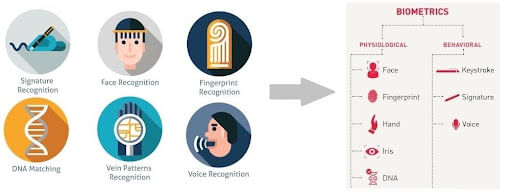
Types of Biometric
Applications of Biometric Technology
Airport Security
- For several years, biometric technology has been used to verify passenger identities in several large international airports, and the technology is quickly spreading to other locations around the world.
Workforce Attendance
- Workforce management is another field where biometrics are being used more frequently.
- Employee time and attendance fraud is a common occurrence in organisations around the world.
- Even government organisations are turning to biometrics to ensure staff attendance and accurate payroll calculations.
Law Enforcement
- For years, organisations such as the CBI have used biometrics in criminal investigations. Biometrics is now widely used by law enforcement agencies all over the world to identify criminals.
Banking
- Biometrics in banking has grown significantly in recent years and is now being used by banks all over the world.
- Banks are implementing biometric technology to improve customer and employee identity management in an effort to combat fraud, increase transaction security, and improve customer convenience as global financial entities become more digitally based.
Healthcare
- Biometrics introduces an improved model in the field of healthcare. Medical records are some of the most important personal documents.
- It also aids in timely and accurate diagnosis by utilising biometric linked information.
Mobile technology
- Mobile technology incorporates one or more biometric terms for authentication or identification and makes use of smartphones, tablets, other types of handhelds, wearable technology, and the Internet of things for versatile deployment capabilities.
Duplicate checking
- It is another biometric process used to determine whether individuals are represented in a database more than once.
- This could be done to detect fraud, such as when an individual enrols in a social benefits programme multiple times.
Aadhaar
Biometrics are used in Aadhaar to prove an individual's identity. It makes use of an iris scan and fingerprints.
Challenges Associated with Biometric Technology
Invasion of Privacy
- The technology threatens the privacy of users' data. In the absence of regulations, data would be vulnerable to cybercriminals.
- Because companies are not regulated, they may sell biometric data that could be used for political purposes.
State surveillance
- It is the most serious risk associated with the use of technology.
- One such example is China's reported use of facial recognition technologies for surveillance in Xinjiang. This raises concerns because it could be manipulated for political purposes.
Inaccuracy
- Biometrics technology is inherently inaccurate. Evidence suggests that the technology is not without flaws. For example, multiple studies have shown that the technology is inaccurate at identifying people of colour, particularly black women.
Predatory marketing
- Some businesses may use software that analyses biometrics to prey on vulnerable customers.
- This could be accomplished by segmenting extreme emotions like distress and tailoring their products and services to these people.
Stalking
- Tools such as reverse image searches can provide stalkers with additional information about their victims.
- This is dangerous, especially for women, who can be tracked, stalked, and possibly assaulted if information obtained is misused.
Identity theft
- Identity theft can be committed by criminals who have obtained enough personal information about an individual.
- This could have a major impact on your personal life, including your finances.
- Fake ID, for example, can be created by utilising information obtained from a person's associated biometric information.
- Photo morphing crime can pose a threat. Photo morphing is a crime that can jeopardise an individual's identity.
Dark activities
- There is a risk of misusing biometric information for illicit activities and markets such as drug sales and the sale of weapons.
- By using stolen ids and Aadhar information, the risk of being used in various terrorist activities across the border increases.
Conclusion
Biometric identification management systems provide increased security, convenience, accountability, and accurate audit trails, all of which encourage businesses to investigate and implement the technology for their own use. We believe that as time passes, the use of biometric technology will expand and be used in even more areas that affect our lives.
| Other Relevant Links | |
|---|---|
| Science & Technology Policy in India | Scientific Policy Resolution 1958 |
| Science & Technology Policy of 1983 | Science & Technology Policy of 2003 |
| Science, Technology and Innovation Policy 2013 | New Initiatives Aligned with the National Agenda |
| India and World collaboration in science projects | Technology Vision Document 2035 |
FAQs
Question. What is biometrics?
Answer: Biometrics refers to the measurement and statistical analysis of people's unique physical and behavioral characteristics. It is primarily used for identification and access control, such as fingerprint scanning or facial recognition.
Question. How does fingerprint recognition work in biometrics?
Answer: Fingerprint recognition works by capturing and analyzing the unique patterns of ridges and valleys found on an individual’s fingertips. This biometric data is then stored and compared for identification.
Question. What are the different types of biometric systems?
Answer: Common types of biometric systems include fingerprint recognition, facial recognition, iris scanning, voice recognition, and hand geometry recognition. Each of these systems uses different physiological or behavioral traits for identification.
Question. What are the security concerns related to biometrics?
Answer: While biometrics provides high security, concerns include the possibility of data breaches, misuse of biometric data, and privacy issues. Once biometric data is stolen or compromised, it cannot be changed like a password.
Question. How are biometrics used in modern technology?
Answer: Biometrics is used in various applications, including smartphones (fingerprint and facial recognition), security systems (access control), banking (ATM identification), and government services (e.g., Aadhaar in India).
MCQs
- Which of the following is not a type of biometric identification?
A) Fingerprint recognition
B) Iris scanning
C) Voice recognition
D) DNA typing
Answer: (D) See the Explanation
While DNA typing is a method of identification, it is not commonly used for biometric identification systems. Fingerprint, iris scanning, and voice recognition are typical biometric methods.
- What is the main advantage of biometric systems over traditional password systems?
A) Faster processing
B) Reduced hardware requirements
C) Higher security and ease of use
D) No need for internet connection
Answer: (C) See the Explanation
Biometrics provide a higher level of security because they rely on unique physical traits that are difficult to replicate, making them more secure than traditional passwords. Additionally, they are more user-friendly.
- Which of the following is a commonly used biometric technology in smartphones?
A) Retina scanning
B) Fingerprint recognition
C) Hand geometry
D) DNA recognition
Answer: (B) See the Explanation
Fingerprint recognition is commonly used in smartphones for unlocking devices and performing authentication. This technology is widely adopted because of its ease of use and speed.
- What does "liveness detection" refer to in biometric systems?
A) The system’s ability to recognize different biometric traits
B) The process of ensuring the biometric data is not fake or altered
C) The system’s ability to process data quickly
D) The use of biometric data for international travel
Answer: (B) See the Explanation
Liveness detection is used to ensure that the biometric data being captured is from a live person and not from a photo, video, or replica. This prevents spoofing attacks.
- Which country introduced the first nationwide biometric ID system (Aadhaar)?
A) United States
B) China
C) India
D) Germany
Answer: (C) See the Explanation
India introduced the Aadhaar system, a biometric-based identification system, to provide a unique identification number to residents for accessing various services. It uses fingerprint and iris scan data.
GS Mains Questions and Model Answers
Q1: Examine the significance of biometric systems in enhancing national security. What challenges are associated with their widespread implementation?
Answer: Biometric systems have the potential to greatly enhance national security by providing highly accurate identification and access control mechanisms. Technologies such as fingerprint recognition, iris scanning, and facial recognition can prevent identity theft, secure borders, and authenticate individuals for sensitive services such as banking and government welfare programs. However, challenges include concerns over privacy, data protection, and the risk of unauthorized access to biometric databases. Additionally, the accuracy of biometric systems can be affected by environmental factors or changes in an individual's physical traits over time, which may lead to false positives or negatives. These issues highlight the need for robust legal frameworks and international standards to address the security and ethical implications of biometric technologies.
Q2: Discuss the ethical concerns surrounding the use of biometrics in surveillance and law enforcement. How should governments address these concerns?
Answer: The use of biometric systems in surveillance and law enforcement raises several ethical concerns, particularly regarding privacy rights and the potential for mass surveillance. The collection and storage of biometric data, such as facial images or fingerprints, without consent can lead to violations of individual privacy. Additionally, the potential for misuse by governments or private organizations to track individuals' movements and activities raises fears of authoritarian control. To address these concerns, governments should implement clear and transparent data protection laws, ensuring that biometric data is collected only with informed consent and used solely for legitimate purposes. Independent oversight bodies should also be established to monitor the use of biometric systems to prevent abuse.
Q3: Analyze the role of biometrics in digital identity systems and their impact on social inclusion.
Answer: Biometrics plays a critical role in establishing digital identity systems, providing secure, unique, and easily accessible methods of identification. This can enhance social inclusion by offering individuals without traditional forms of identification (e.g., rural populations or the homeless) the ability to access essential services such as healthcare, banking, and education. Systems like Aadhaar in India have demonstrated how biometric technology can empower marginalized groups by linking their biometric data to social welfare schemes, ensuring they receive government benefits. However, challenges such as the exclusion of people due to technological limitations, lack of infrastructure, and issues related to data privacy must be addressed to ensure that biometric-based systems promote, rather than hinder, social inclusion.
Previous Year Questions on Biometrics
1. UPSC CSE 2017
Question: "Which of the following technologies is most commonly used for biometric authentication?"
Answer: A) Fingerprint recognition
2. UPSC CSE 2018
Question: "Discuss the implications of the increasing use of biometrics in identification and authentication systems. What are the privacy and security risks associated with biometric data?"
Answer: The widespread use of biometrics in identification and authentication offers enhanced security and convenience, but it also raises significant privacy and security concerns. The collection and storage of sensitive biometric data, such as fingerprints and facial recognition data, pose risks of data breaches, identity theft, and unauthorized surveillance. Ensuring robust data protection mechanisms, user consent, and transparency in the use of biometric data is essential to mitigate these risks. Legal frameworks should be developed to safeguard against misuse and to protect individuals’ privacy.
Download the PREPP App and attempt FREE IAS Exam Mock Tests and get complete study material!

Full Test - 04: UPSC CSE Prelims CSAT (Paper-II)
Full Test - 03: UPSC CSE Prelims CSAT (Paper-II)
UPSC CSE Prelims 2026 GS Paper 1 Question Paper (24-May-2026)
UPSC CSE Prelims 2026 CSAT Paper 2 Question Paper (24-May-2026)

17 February 2025 | The Hindu Must Read Articles | Current Affairs

16 February 2026 | The Hindu Must Read Articles | Current Affairs

13 February 2026 | The Hindu Must Read Articles | Current Affairs









Comments