Big Data – Science & Technology Notes
Big Data simply refers to large amounts of structured, semi-structured, or unstructured data. The data pool is so large that using traditional databases and software techniques to manage and process it becomes difficult. As a result, big data refers not only to the massive amount of available data, but also to the entire process of gathering, storing, and analysing that data. In this article, we will discuss in detail regarding Big Data which will be helpful for UPSC exam preparation.
Table of Contents
What is Big Data?
- "Big Data" refers to "high-volume, high-velocity, or high-variety information assets that necessitate novel processing methods to enable improved decision making, insight discovery, and process optimisation."
- It is a collection of massive data sets that conventional computing techniques cannot handle.
- The term encompasses not only the data but also the various frameworks, tools, and techniques involved.
- Big data is a collection of structured, semi-structured, and unstructured data collected by organisations and used in machine learning projects, predictive modelling, and other advanced analytics applications.
- Big data processing and storage systems, in conjunction with tools that support big data analytics, have become a common component of data management architectures in organisations.
- The three V's of big data are frequently used to describe it:
- the large volume of data in many environments;
- the wide variety of data types commonly stored in big data systems;
- the velocity at which much of the data is generated, collected, and processed.
- Recently, several other V's, such as veracity, value, and variability, have been added to various descriptions of big data.
- Although big data does not have a specific volume, big data deployments frequently involve terabytes, petabytes, and even exabytes of data created and collected over time.
- The entire world had only five billion gigabytes of data from the beginning of time until 2003. In 2011, the same amount of data was generated in only two days. This volume was generated every ten minutes by 2013. As a result, it is not surprising that 90% of the world's data has been generated in the last few years.
| Other Relevant Links | |
|---|---|
| NASA: Asteroid impact and deflection assessment mission | Commercial use of Lithium-Ionbattery technology |
| Hyperspectral imaging satellite | Water propulsion system in CUBESAT |
| Neutrino Observatory | Indian Space Vision-2025 |
| Major Policy Initiatives National Optical Fibre network | Spectrum Management |
| Cyber Law | Internet, Types of Network and e- Governance |
| Spectrum Policy in India | Mobile Spectrum |
| Cloud Computing | Encryption |
| Biometrics | Virtual Reality |
How Does Big Data Work?
Data Collecting
- Every business takes a unique approach to data collection. Businesses can now collect unstructured and structured data from a variety of sources, including cloud storage, mobile apps, in-store IoT sensors, and more, thanks to advances in technology.
Organizing Data
- Data must be properly organised once gathered and stored for analytical queries to yield correct answers, especially if the data is large and unstructured.
Clean Data
- To improve data quality and produce more robust findings, all data, regardless of size, must be scrubbed.
- Duplicate or unnecessary data must be eliminated or accounted for, and all data must be properly structured.
- Dirty data can conceal and deceive, resulting in incorrect conclusions.
Analysis of Data
- It takes time to convert massive amounts of data into usable information.
- Once available, advanced analytics techniques can transform massive amounts of data into significant insights.
- These large data analysis techniques include:
- Data mining sifts through massive datasets to find patterns and linkages by detecting anomalies and forming data clusters.
- Predictive analytics examines future projections using historical data from a business to identify potential hazards and opportunities.
- Deep learning algorithms use layers of algorithms to uncover patterns in even the most complex abstract data, emulating human learning patterns.
Examples of Big Data
- Transaction processing systems, customer databases, documents, emails, medical records, internet clickstream logs, mobile apps, and social networks are just a few examples.
- Machine-generated data, such as network and server log files, as well as data from sensors on manufacturing machines, industrial equipment, and internet of things devices, are also included.
- Big data environments frequently include external data on consumers, financial markets, weather and traffic conditions, geographic information, scientific research, and other topics in addition to data from internal systems.
- Big data also includes images, videos, and audio files, and many big data applications involve streaming data that is processed and collected on a continuous basis.
Types of Big Data
Structured
- A 'structured' data is any data that can be stored, accessed, and processed in a fixed format.
- Over time, computer science talent has achieved greater success in developing techniques for working with such data (where the format is well known in advance) and deriving value from it.
- However, we are now anticipating problems as the size of such data grows to enormous proportions, with typical sizes reaching multiple zettabytes.
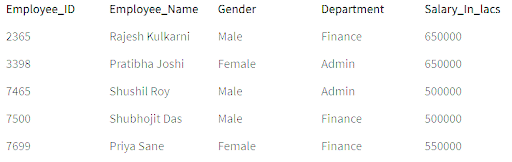
Employee Table in Database is an example of Structured Data
Unstructured
- Unstructured data is defined as any data with an unknown form or structure.
- Aside from its massive size, unstructured data presents a number of challenges in terms of processing and extracting value from it.
- A heterogeneous data source containing a mix of simple text files, images, videos, and so on is an example of unstructured data.
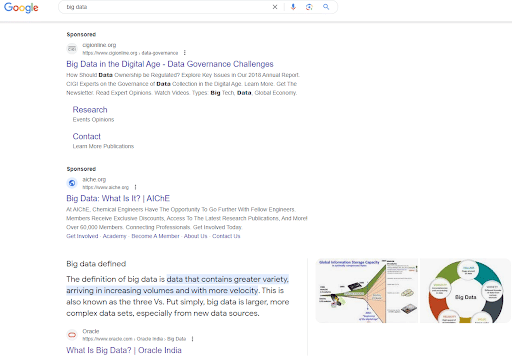
Output Returned by Google is an example of Unstructured Data
Semi-structured
- Semi-structured data can contain both types of information.
- Semi-structured data appears to be structured, but it is not defined in the same way that a table definition in a relational DBMS is.
- A data representation in an XML file is an example of semi-structured data.
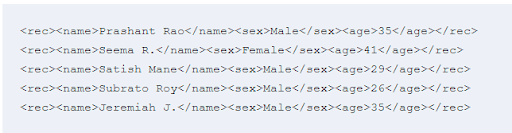
Personal Data stored in XML file is an example of Semi-structured Data
Characteristics of Big Data
Volume
- The term "Big Data" refers to a massive amount of information. The size of the data is very important in determining the value of the data.
- Furthermore, whether a particular data set can be considered Big Data or not is determined by the volume of data.
- As a result, 'Volume' is one characteristic that must be considered when dealing with Big Data solutions.
Variety
- Variety refers to a wide range of data sources and data types, both structured and unstructured.
- Previously, spreadsheets and databases were the only data sources considered by most applications.
- Data in the form of emails, photos, videos, monitoring devices, PDFs, audio, and so on are now considered in analysis applications.
- This variety of unstructured data raises concerns about data storage, mining, and analysis.
Velocity
- The term 'velocity' refers to the rate at which data is generated.
- The true potential of the data is determined by how quickly it is generated and processed to meet the demands.
- Big Data Velocity is concerned with the rate at which data flows in from various sources such as business processes, application logs, networks, social media sites, sensors, mobile devices, and so on.
Variability
- This refers to the inconsistency that data can exhibit at times, impeding the process of effectively handling and managing data.
Veracity
- The degree of accuracy and trustworthiness of data sets is referred to as veracity.
- Raw data gathered from various sources can result in data quality issues that are difficult to identify.
- Bad data leads to analysis errors that can undermine the value of business analytics initiatives if they are not corrected through data cleansing processes.
- Data management and analytics teams must also ensure that they have enough accurate data to generate valid results.
Value
- Some data scientists and consultants contribute to the list of big data characteristics as well.
- Not all collected data has real business value or benefits.
- As a result, organisations must ensure that data is relevant to relevant business issues before using it in big data analytics projects.
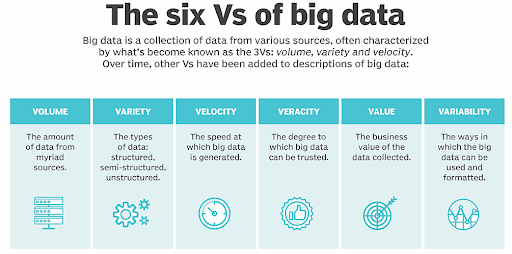
Six Vs of Big Data
Benefits and Uses of Big Data
| Product Development |
|
| Predictive Maintenance |
|
| Customer Experience |
|
| Fraud and Compliance |
|
| Machine Learning |
|
| Operational Efficiency |
|
| Drive Innovation |
|
| Data Driven Decisions |
|
Challenges Related to Big Data
- Despite the development of new data storage technologies, data volumes are doubling every two years. Organisations continue to struggle to keep up with their data and find effective ways to store it.
- To be valuable, data must be used, which is dependent on curation. Clean data, or data that is relevant to the client and organised in a way that allows for meaningful analysis, necessitates a significant amount of effort. Before data can be used, data scientists spend 50 to 80 percent of their time curating and preparing it.
- Data variety has become a significant challenge. Social media and the Internet of Things added semi-structured and unstructured data to the mix, in addition to traditional structured data.
- As a result, businesses had to figure out how to efficiently process and analyse these various data types, which was another task for which traditional tools were inadequate.
- Another challenge is deciding on the best Big Data tool. There are numerous Big Data tools available; however, selecting the incorrect one can result in wasted effort, time, and money.
- The security of Big Data is another challenge. Often, organisations are so focused on understanding and analysing data that they neglect data security, and unprotected data eventually becomes a breeding ground for hackers.
Government Initiatives Related to Big Data
- NITI Aayog has developed a plan with private sector partners to create the 'National Data & Analytics Platform,' which will serve as a single source of sectoral data for citizens, policymakers, and researchers.
- The CAG-drafted 'Big Data Management Policy' for auditing large chunks of data generated by the public sector in the states and union territories is a great start.
- The Ministry of Statistics and Programme Implementation has proposed establishing a "National Data Warehouse on Official Statistics," which will leverage technology and big data analytical tools to improve the quality of macroeconomic aggregates.
- The use of Direct Benefit Transfer in MGNREGA and Aadhaar for authentication and benefit distribution aids in the identification of ghost beneficiaries.
- The Ministry of Agriculture has signed an agreement with the ISRO to map agricultural assets using satellites.
- The Smart City Mission, Digital India, BHIM app, among others, are important government initiatives that use Big Data to achieve good governance in the country.
Conclusion
Big data has numerous applications, which explains why there is so much buzz surrounding it. It is significant because of how an organisation uses it, not because of how much of it they have collected. Its analysis can be completed quickly and efficiently using big data solutions. In almost every industry vertical, these Big Data solutions are used to benefit from massive amounts of data.
| Other Relevant Links | |
|---|---|
| Science & Technology Policy in India | Scientific Policy Resolution 1958 |
| Science & Technology Policy of 1983 | Science & Technology Policy of 2003 |
| Science, Technology and Innovation Policy 2013 | New Initiatives Aligned with the National Agenda |
| India and World collaboration in science projects | Technology Vision Document 2035 |
FAQs
Question: What is Big Data?
Answer: Big Data refers to large volumes of data that cannot be processed by traditional data processing methods. It involves high-volume, high-velocity, and high-variety data that require advanced tools for analysis and interpretation.
Question: Why is Big Data important?
Answer: Big Data is important because it allows organizations to analyze vast amounts of data to uncover hidden patterns, trends, and associations. This can help businesses make informed decisions, improve customer experiences, and drive innovation.
Question: What are the challenges of working with Big Data?
Answer: The challenges of Big Data include data privacy concerns, high storage requirements, data security, and the need for specialized software and hardware to manage and process the data effectively.
Question: How is Big Data used in different industries?
Answer: Big Data is used across various industries such as healthcare for patient data analysis, retail for customer behavior analysis, finance for fraud detection, and manufacturing for supply chain optimization and predictive maintenance.
Question: What tools are commonly used to analyze Big Data?
Answer: Some common tools used to analyze Big Data include Apache Hadoop, Apache Spark, NoSQL databases, and machine learning algorithms, which help in processing and analyzing large datasets efficiently.
MCQs
1. What is the primary characteristic of Big Data?
A) Small size of data
B) High volume, velocity, and variety of data
C) High cost of storage
D) Easy to analyze
Answer: (B) See the Explanation
Explanation: Big Data is characterized by the three Vs: high volume, high velocity, and high variety, which make it difficult to process using traditional data management tools.
2. Which of the following is a tool used for analyzing Big Data?
A) SQL
B) Apache Hadoop
C) Microsoft Excel
D) Oracle Database
Answer: (B) See the Explanation
Explanation: Apache Hadoop is a widely used tool for processing and analyzing large datasets, especially in Big Data environments.
3. What type of data does Big Data typically deal with?
A) Structured data only
B) Unstructured data only
C) Structured, unstructured, and semi-structured data
D) Static data
Answer: (C) See the Explanation
Explanation: Big Data involves structured, unstructured, and semi-structured data, which makes it complex to store, process, and analyze using traditional methods.
4. What is one of the key challenges of Big Data?
A) Data privacy
B) Low data volume
C) Easy to manage
D) Insufficient data storage
Answer: (A) See the Explanation
Explanation: Data privacy is one of the key challenges of Big Data, as the large volume of sensitive information requires strict controls and compliance with privacy regulations.
5. Which industry uses Big Data for fraud detection?
A) Healthcare
B) Retail
C) Finance
D) Education
Answer: (C) See the Explanation
Explanation: The finance industry uses Big Data to detect fraudulent activities by analyzing patterns and behaviors in transaction data to identify anomalies.
GS Mains Questions and Model Answers
Q1: Discuss the challenges associated with Big Data and the technologies developed to overcome these challenges.
Answer: Big Data presents several challenges, including the volume of data, security concerns, and the complexity of data integration. With large volumes of data, storage becomes a significant issue. Data privacy and security are critical concerns due to the vast amount of personal information being stored and analyzed. Furthermore, the variety of data formats makes it difficult to standardize and integrate data. To overcome these challenges, technologies such as Apache Hadoop, Apache Spark, and machine learning algorithms have been developed to process, store, and analyze Big Data efficiently. Cloud computing also offers scalable solutions for data storage and processing, allowing businesses to handle Big Data more effectively.
Q2: How does Big Data impact decision-making processes in organizations?
Answer: Big Data enables organizations to make data-driven decisions by analyzing large datasets to uncover patterns and trends. In businesses, this allows for better forecasting, customer segmentation, and market analysis. Big Data analytics can also help in real-time decision-making, enabling organizations to respond swiftly to changes in customer behavior, market conditions, or operational issues. By leveraging insights from Big Data, companies can optimize processes, reduce costs, enhance customer satisfaction, and identify new growth opportunities, thus improving overall decision-making and business performance.
Q3: How does Big Data contribute to research and development in the healthcare sector?
Answer: Big Data plays a crucial role in healthcare by enabling researchers and healthcare providers to analyze vast amounts of medical data, including patient records, clinical trials, and genomic data. By analyzing this data, healthcare professionals can identify patterns and correlations that were previously unnoticed, improving diagnoses and treatments. Big Data also supports personalized medicine, where treatments are tailored to individual patients based on genetic information. Additionally, Big Data helps in drug discovery, epidemiology studies, and disease prevention by analyzing historical health data and predicting potential outbreaks or health trends.
Previous Year Questions on Big Data
1. UPSC CSE Mains 2018 (GS Paper 3):
Question: "Discuss the impact of Big Data analytics on business decision-making and its potential to transform industries."
Answer: Big Data analytics plays a transformative role in business decision-making by providing insights derived from analyzing large and complex datasets. It allows businesses to make informed decisions based on data patterns and trends rather than intuition or experience. This leads to more accurate forecasts, improved customer satisfaction, and operational efficiencies. For industries like healthcare, finance, and retail, Big Data has revolutionized their operations by enabling better risk management, personalized services, and optimized supply chains.
2. UPSC CSE Mains 2020 (GS Paper 3):
Question: "Analyze the challenges associated with the handling of Big Data and how new technologies are addressing these challenges."
Answer: Big Data comes with several challenges, including data privacy, integration of diverse data types, and the requirement for significant computational power to process and analyze data. Privacy concerns arise from the vast amount of personal information being processed, while integration issues stem from combining structured, semi-structured, and unstructured data. To address these challenges, technologies like Hadoop and Spark provide scalable platforms for storing and analyzing large datasets. Advanced machine learning algorithms help in extracting insights from Big Data, while cloud computing solutions offer cost-effective, scalable storage and processing options, alleviating some of the resource-intensive challenges of Big Data.
Download the PREPP App and attempt FREE IAS Exam Mock Tests and get complete study material!

Full Test - 04: UPSC CSE Prelims CSAT (Paper-II)
Full Test - 03: UPSC CSE Prelims CSAT (Paper-II)
UPSC CSE Prelims 2026 GS Paper 1 Question Paper (24-May-2026)
UPSC CSE Prelims 2026 CSAT Paper 2 Question Paper (24-May-2026)

17 February 2025 | The Hindu Must Read Articles | Current Affairs

16 February 2026 | The Hindu Must Read Articles | Current Affairs

13 February 2026 | The Hindu Must Read Articles | Current Affairs









Comments