Bhangar - Geography Notes
Bhangar is a region that is located beyond the floodplains, has a higher upland, and contains older alluvial soil with a higher sandy loam component. In India, the Bhangar plain is found in the south of the Bhabar and Terai Plains.ie., the northern and central part of Uttar Pradesh. Bangar land is less prone to flooding, although they are often drier and less fertile. Bhangar region is also called Bangar or Bangad. This article will explain to you about Bhangar which will be helpful in Geography preparation for the UPSC Civil service exam.
|
Table of Contents |
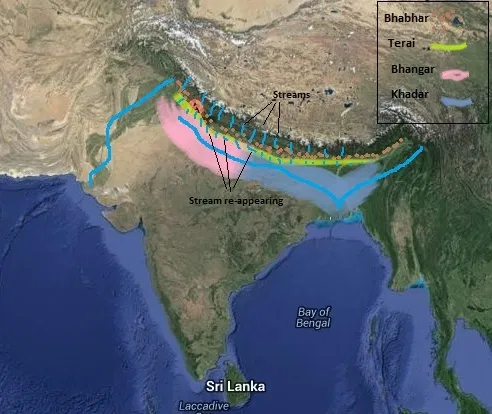
Distribution of Bhangar (Pink-coloured illustration) in Northern Plains in India
What is Bhangar?
- Bhangar is the older alluvium that forms terraces above the floodplain along river beds.
- It's dark in colour, humus-rich, and fertile.
- The soil has lime modules and is clayey in nature (called kankar)
- They are found in doabs (inter-fluve areas)
- Regional variations of Bhangar include the 'Barind plains' in Bengal's deltaic region and the 'bhur formations' in the middle Ganga and Yamuna doab.
- Small tracts of salty and alkaline efflorescence known as ' Reh,' 'Kallar,' or 'Bhur' can be found in relatively dry sections of the Bhangar.
- With more irrigation, reh regions have spread in recent years (capillary action brings salts to the surface).
- It's possible to find fossilised remains of extinct flora and animals.
|
|
|
|---|---|
| Tarai | Khadar |
| Bhabar | Sunderbans Delta |
|
Bhur Formation
Bhur Formation
|
Significance of Bhangar
- Bhangar lands are well-drained, making them ideal for farming.
- This location is generally above the floodplains of the nearby rivers.
- The soil is humus-rich and produces a high yield due to the abundance of minerals and humus.
- In the Ganges basin, they help to retain a large supply of groundwater, ensuring irrigation and helping to make the plain the country's most agriculturally productive region.
Conclusion
Unlike the Bhabar Plains, which are unsuitable for farming or cultivation due to the presence of sediments, the Bhangar Plains are appropriate for farming and cultivation due to their well-drained nature and the availability of alluvial soil.
FAQs
Question: What is Bhangar?
Answer: Bhangar refers to the older alluvial soil found in the northern plains of India. It is characterized by a higher concentration of calcareous deposits called 'kankar' and is less fertile compared to the newer alluvial soil known as Khadar. Bhangar soil is found at higher elevations and is generally coarser in texture.
Question: How is Bhangar different from Khadar?
Answer: Bhangar differs from Khadar in several ways. Bhangar is the older alluvium found at higher elevations, containing more kankar and being coarser and less fertile. In contrast, Khadar is the newer alluvial soil, found in low-lying areas closer to riverbanks, and is more fertile and finer in texture due to regular deposition of silt by river floods.
Question: What crops are typically grown in Bhangar soil?
Answer: Crops that are generally grown in Bhangar soil include wheat, maize, pulses, and other dry crops. While Bhangar soil is not as fertile as Khadar, it can support crops that do not require high moisture content and can tolerate coarser soil.
Question: What are kankar deposits in Bhangar soil?
Answer: Kankar deposits in Bhangar soil are small, nodular accumulations of calcium carbonate. These deposits make the soil coarser and reduce its overall fertility. Kankar is a typical feature of older alluvial soils, contributing to their hard, compact nature.
Question: In which regions of India is Bhangar soil predominantly found?
Answer: Bhangar soil is predominantly found in the northern plains of India, particularly in states like Punjab, Haryana, and parts of Uttar Pradesh and Bihar. These areas have extensive tracts of older alluvial deposits forming part of the larger Indo-Gangetic Plain.
MCQs
1. What is Bhangar soil primarily known for?
A) High fertility
B) High concentration of kankar deposits
C) Rich in organic matter
D) Always found in coastal areas
Answer: (B) See the Explanation
Explanation: Bhangar soil is known for its higher concentration of kankar (calcium carbonate) deposits, which make it coarser and less fertile than the newer alluvial soil (Khadar).
2. Which type of soil is considered younger and more fertile than Bhangar?
A) Black soil
B) Khadar soil
C) Laterite soil
D) Red soil
Answer: (B) See the Explanation
Explanation: Khadar soil is the younger alluvial soil, found closer to riverbanks and renewed annually by floods. It is more fertile and finer in texture than Bhangar soil.
3. What is a significant characteristic of Bhangar soil?
A) High organic content
B) Presence of kankar nodules
C) Found in coastal areas
D) Rich clay texture
Answer: (B) See the Explanation
Explanation: A significant characteristic of Bhangar soil is the presence of kankar nodules, which are calcium carbonate deposits that make the soil coarse and less fertile.
4. In which Indian states is Bhangar soil most commonly found?
A) Kerala and Tamil Nadu
B) Punjab, Haryana, and Uttar Pradesh
C) Rajasthan and Gujarat
D) Assam and West Bengal
Answer: (B) See the Explanation
Explanation: Bhangar soil is most commonly found in the northern plains of India, particularly in states such as Punjab, Haryana, and Uttar Pradesh.
5. What type of crops can typically grow in Bhangar soil?
A) Rice and jute
B) Wheat, maize, and pulses
C) Sugarcane and cotton
D) Tea and coffee
Answer: (B) See the Explanation
Explanation: Crops such as wheat, maize, and pulses can typically grow in Bhangar soil, which is suitable for crops that do not require high moisture levels.
GS Mains Questions and Model Answers
Q1: Explain the formation and characteristics of Bhangar soil in India. How does it differ from Khadar soil?
Answer: Bhangar soil is formed from older alluvial deposits found in the higher areas of the northern plains of India. It is characterized by a coarser texture and the presence of kankar nodules, which are calcium carbonate deposits. These features make Bhangar soil less fertile compared to Khadar soil. Khadar soil, on the other hand, is the younger alluvium deposited by rivers during floods and is found in lower-lying areas. It is finer, more fertile, and supports a wider variety of crops. The distinction between the two types of soil is crucial for understanding agricultural practices and productivity in different regions of India.
Q2: Analyze the agricultural implications of Bhangar soil on crop productivity. What measures can be taken to improve its fertility?
Answer: Bhangar soil, due to its coarser texture and kankar content, is less fertile than Khadar soil, which affects crop productivity. Crops such as wheat, maize, and pulses, which do not require high water content, can be cultivated in Bhangar soil. To improve its fertility, measures such as the application of organic manure, balanced fertilizers, and irrigation techniques can be implemented. Soil conditioning with gypsum and other amendments can help reduce the impact of kankar and improve water retention. Additionally, crop rotation and the inclusion of leguminous plants can enhance the nutrient content and productivity of Bhangar soil.
Q3: Discuss the geographic distribution of Bhangar soil in India and its significance for regional agriculture. How does it contribute to the diversity of agricultural practices?
Answer: Bhangar soil is predominantly found in the northern plains of India, covering parts of Punjab, Haryana, Uttar Pradesh, and Bihar. Its distribution contributes to the diversity of agricultural practices in these regions. While less fertile than Khadar soil, Bhangar supports crops that are suited to drier conditions and coarser soil. This allows farmers to cultivate wheat, maize, and pulses, promoting regional agricultural variation. The presence of Bhangar soil encourages adaptation and the use of specific agricultural techniques tailored to local soil characteristics. Understanding the distribution and properties of Bhangar soil is essential for developing region-specific agricultural policies and ensuring sustainable farming practices.
Previous Year Questions on Bhangar
1. UPSC CSE Prelims 2021:
Question: What is a distinguishing feature of Bhangar soil?
A) High organic content
B) Presence of kankar nodules
C) Rich in nitrogen
D) Always found near riverbanks
Answer: (B)
Explanation: A distinguishing feature of Bhangar soil is the presence of kankar, or calcium carbonate nodules, which make it coarser and less fertile compared to younger alluvial soils like Khadar.
2. UPSC CSE Mains 2020 (GS Paper 1):
Question: "Compare and contrast the characteristics of Bhangar and Khadar soils. Discuss their impact on agriculture in the Indo-Gangetic plains."
Answer: Bhangar and Khadar are both types of alluvial soils found in the Indo-Gangetic plains but differ in age, texture, and fertility. Bhangar is the older alluvium, found at higher elevations and characterized by a coarser texture and kankar deposits, making it less fertile. In contrast, Khadar is the newer alluvium deposited by rivers during floods, found in low-lying areas and more fertile due to its fine texture and regular replenishment of nutrients. Bhangar soil supports crops that require less water, such as wheat and pulses, while Khadar supports more water-intensive crops like rice and sugarcane. The differences in these soils influence the types of crops cultivated and the agricultural practices used in the region.
Download the PREPP App and attempt FREE IAS Exam Mock Tests and get complete study material!

Full Test - 04: UPSC CSE Prelims CSAT (Paper-II)
Full Test - 03: UPSC CSE Prelims CSAT (Paper-II)
UPSC CSE Prelims 2026 GS Paper 1 Question Paper (24-May-2026)
UPSC CSE Prelims 2026 CSAT Paper 2 Question Paper (24-May-2026)

17 February 2025 | The Hindu Must Read Articles | Current Affairs

16 February 2026 | The Hindu Must Read Articles | Current Affairs

13 February 2026 | The Hindu Must Read Articles | Current Affairs









Comments