Beas - Sutlej Link Canal - Geography Notes
The Beas-Sutlej link project includes diverting some water from the river Beas into the Satluj via two tunnels and an open channel in order to generate power and increase the storage capacity of the Bhakra reservoir (Gobindsagar). The preliminary investigations for the Beas Sutlej Link Project began in 1956, leading to the preparation of a preliminary Project report by the Project Organization of the Punjab Irrigation Branch in November 1957. This article will explain to you Beas- Sutlej Link Canal which will be helpful in Geography preparation for the UPSC Civil service exam.
|
Table of Contents |
Beas - Sutlej Link Canal
- In November 1957, the Project Organization of the Punjab Irrigation Branch produced a preliminary Project report as a result of the initial investigations for the Beas Sutlej Link Project that had been started in 1956.
- It was regarded as a component of the master plan and was built to harness the water of the three eastern rivers, the Satluj, Beas, and Ravi, for irrigation and integrated power generation.
- The water from Satluj was completely utilized after the Bhakra-Nangal Project was built.
- The Beas dam at Pong and the Bhakra Dam assist India in using about 92% of the average inflow of water from the three eastern rivers thanks to the support of the existing Madhopur-Beas link, which carry-over on about 2344 million cum (0.9 million acre feet) of water from the Ravi to the Beas.
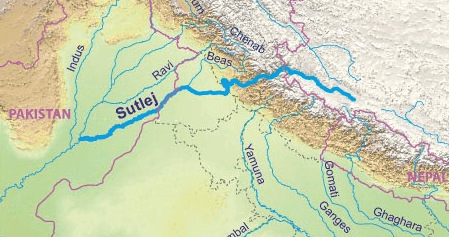
Beas and Sutlej rivers - Tributaries of Indus river system
|
|
|
|---|---|
| Periyar Diversion Scheme | Ganga- Cauvery Link Canal |
| Indira Gandhi Canal Project | Kurnool- Cuddapah Canal |
Beas- Sutlej Link Canal - Project Features
- The investigation work was started by the Project Circle of Punjab Irrigation in 1956, and the Project Administration of the Irrigation Branch subsequently prepared a Project Report with a restricted scope for providing irrigation to Southern Punjab.
- The project from 1957 called for a link with a 254.85 cumec capacity that included the Diversion Dam at Pandoh.
- In January 1960, a new proposal for the Beas Satluj Link was created.
- On the right bank of the Satluj River, a power plant with a 1200 MW installed capacity was proposed.
- Pandoh Dam, Pandoh Spillway, Pandoh Baggi Tunnel, Sundernagar Hydel Channel, Sundernagar Balancing Reservoir, and Sundernagar Satluj Tunnel are among the features of the final construction plan as proposed.
Conclusion
Dr. A.N. Khosla, a brilliant engineer and dynamic leader in the field who was a close and trusted confidant of Jawaharlal Nehru, came up with the idea of the Beas-Satluj link to divert some water of the river Beas into the Satluj through two tunnels and an open channel in order to generate power and to increase the storage capacity of Bhakra reservoir (Gobindsagar). In order to provide irrigation to Southern Punjab, the Project Administration of the Irrigation Branch subsequently created a Project Report with a limited scope.
|
|
|
|---|---|
| Geography Notes | Physical Geography |
| Water Resources in India | River Basins in India |
| India's Physiographic Divisions | Major Lakes in India |
| River Systems in Peninsular India | River Systems of Himalayan Drainage |
| Smaller Rivers of India flowing towards West | Smaller Rivers of India flowing towards East |
| Indian Drainage Systems | River Interlinking Project in India |
| Climatology | Geomorphology |
FAQs
Question: What is the purpose of the Beas-Sutlej Link Canal?
Answer: The purpose of the Beas-Sutlej Link Canal is to divert water from the Beas River to the Sutlej River, enhancing irrigation facilities and agricultural productivity in Punjab.
Question: When was the Beas-Sutlej Link Canal constructed?
Answer: The canal was constructed in the 1950s, primarily as a response to water management challenges following the partition of India.
Question: How long is the Beas-Sutlej Link Canal?
Answer: The canal stretches approximately 85 kilometers.
Question: Which districts benefit from the Beas-Sutlej Link Canal?
Answer: The canal primarily benefits districts such as Fatehgarh Sahib and Patiala by improving irrigation in these agricultural regions.
Question: What are some environmental considerations associated with the canal?
Answer: Environmental considerations include managing the local ecology and hydrology to mitigate potential adverse impacts from the diversion of river water.
MCQs
1. What is the main function of the Beas-Sutlej Link Canal?
A) Power generation
B) Navigation
C) Irrigation
D) Industrial use
Answer: (C) See the Explanation
Explanation: The main function of the Beas-Sutlej Link Canal is irrigation, facilitating agricultural productivity in Punjab.
2. In which decade was the Beas-Sutlej Link Canal constructed?
A) 1940s
B) 1950s
C) 1960s
D) 1970s
Answer: (B) See the Explanation
Explanation: The canal was constructed in the 1950s to improve water resource management post-partition.
3. What is the approximate length of the Beas-Sutlej Link Canal?
A) 50 km
B) 70 km
C) 85 km
D) 100 km
Answer: (C) See the Explanation
Explanation: The Beas-Sutlej Link Canal stretches approximately 85 kilometers.
4. Which river does the Beas-Sutlej Link Canal divert water from?
A) Yamuna
B) Ravi
C) Beas
D) Sutlej
Answer: (C) See the Explanation
Explanation: The canal diverts water from the Beas River to the Sutlej River.
5. What is one of the main challenges associated with the Beas-Sutlej Link Canal?
A) High construction costs
B) Environmental impact
C) Limited water supply
D) Inadequate irrigation
Answer: (B) See the Explanation
Explanation: The canal has environmental impacts that need careful management to prevent adverse effects on local ecology.
GS Mains Questions and Model Answers
Q1: Analyze the significance of the Beas-Sutlej Link Canal in the context of Punjab's agricultural development.
Answer: The Beas-Sutlej Link Canal plays a crucial role in enhancing agricultural development in Punjab by providing a reliable source of irrigation. The canal facilitates the diversion of water from the Beas River to the Sutlej, allowing farmers to cultivate crops throughout the year, thus increasing agricultural productivity. By improving irrigation facilities, the canal contributes to higher yields and supports the livelihoods of many farmers in the region. Additionally, the canal helps to address water scarcity issues, particularly in areas prone to drought, ensuring food security and economic stability for the agrarian community. Overall, the Beas-Sutlej Link Canal is a vital infrastructure project that underpins Punjab's agricultural economy.
Q2: Discuss the environmental challenges posed by the Beas-Sutlej Link Canal and potential mitigation strategies.
Answer: The Beas-Sutlej Link Canal presents several environmental challenges, including alteration of local hydrology, potential impacts on aquatic ecosystems, and soil salinization due to changes in water flow patterns. Mitigation strategies include conducting thorough environmental impact assessments before any modifications, implementing sustainable water management practices, and ensuring the preservation of natural habitats along the canal's path. Regular monitoring of water quality and ecosystem health is essential to address any adverse effects promptly. Engaging local communities in conservation efforts can also enhance the sustainability of the canal while balancing agricultural needs with environmental protection.
Q3: Evaluate the role of the Beas-Sutlej Link Canal in the larger framework of India's water management strategies.
Answer: The Beas-Sutlej Link Canal is integral to India's broader water management strategies, particularly in the context of ensuring efficient water use in agriculture. As a part of the canal network, it reflects India's efforts to optimize water resources to meet the demands of a growing population and agricultural sector. The canal contributes to reducing reliance on groundwater, thus addressing issues of over-extraction and depletion. Furthermore, the Beas-Sutlej Link Canal exemplifies the need for integrated water resource management, balancing agricultural, domestic, and environmental needs. In this regard, it plays a pivotal role in promoting sustainable practices and enhancing resilience against water scarcity challenges faced by the agricultural sector in India.
Previous Year Questions on Beas-Sutlej Link Canal
1. UPSC CSE Prelims 2021:
Question: The Beas-Sutlej Link Canal primarily serves to:
A) Generate hydroelectric power
B) Divert water for irrigation
C) Facilitate shipping
D) Supply drinking water
Answer: (B)
Explanation: The primary function of the Beas-Sutlej Link Canal is to divert water for irrigation purposes.
2. UPSC CSE Mains 2019 (GS Paper 1):
Question: "Analyze the impact of canal irrigation on agriculture in Punjab, using the Beas-Sutlej Link Canal as a case study."
Answer: Canal irrigation through projects like the Beas-Sutlej Link Canal has significantly transformed agriculture in Punjab. By providing a consistent and reliable source of water, the canal has enabled farmers to engage in multiple cropping, enhancing productivity and income. The shift from rain-fed to canal irrigation has reduced vulnerability to climatic variations and improved food security in the region. However, challenges such as water management, salinization, and ecological impacts require ongoing attention to ensure the long-term sustainability of agricultural practices dependent on canal irrigation.
Download the PREPP App and attempt FREE IAS Exam Mock Tests and get complete study material!

Full Test - 04: UPSC CSE Prelims CSAT (Paper-II)
Full Test - 03: UPSC CSE Prelims CSAT (Paper-II)
UPSC CSE Prelims 2026 GS Paper 1 Question Paper (24-May-2026)
UPSC CSE Prelims 2026 CSAT Paper 2 Question Paper (24-May-2026)

17 February 2025 | The Hindu Must Read Articles | Current Affairs

16 February 2026 | The Hindu Must Read Articles | Current Affairs

13 February 2026 | The Hindu Must Read Articles | Current Affairs









Comments