Astrosat – Science & Technology Notes
Astrosat, a remarkable achievement by the Indian Space Research Organisation (ISRO), represents India's strides in the realm of space exploration. Launched in September 2015, Astrosat is India's first dedicated multi-wavelength space observatory. With its innovative instrumentation and versatile capabilities, this satellite has significantly expanded our understanding of the universe. In this article, we will discuss in detail regarding Astrosat which will be helpful for UPSC exam preparation.
Table of Contents
What is Astrosat?
- ISRO's Astrosat satellite is a mission to observe celestial sources simultaneously in the X-Ray, Optical, and UV Spectral bands.
- The Astrosat satellite was launched on September 28, 2015 from Satish Dhawan Space Centre (SDSC) or Sriharikota Range (SHAR), Andhra Pradesh.
- The satellite was launched with the Polar Satellite Launch Vehicle (PSLV) C-30.
- The mission was scheduled to last five years.
- Astrosat's unique ability to capture celestial bodies across various wavelengths has significantly contributed to our understanding of the universe, offering insights into phenomena ranging from black holes to neutron stars and galaxies.
| Other Relevant Links | |
|---|---|
| Space Organisations | Space race/Space junk |
| South Asia Satellite: Significance | Solar Mission- ADITYA |
| Spitzer Space Telescope | Chandra X-Ray Observatory |
| Multi Application Solar Telescope | Thirty Metre Telescope |
| Resourcesat-2A | Sunspot |
| Magnetars | Neutron stars |
| Air-breathing propulsion system | Space Junk |
| Graveyard Orbit | Supercluster of galaxies known as “Saraswati” |
Astrosat – Scientific Objectives
- To understand high energy processes in binary star systems containing neutron stars and black holes.
- Estimate magnetic fields of neutron stars.
- Study star birth regions and high energy processes in star systems lying beyond our galaxy.
- Detect new briefly bright X-ray sources in the sky.
- Perform a limited deep field survey of the Universe in the Ultraviolet region.
Astrosat – Payloads / Instruments
- UltraViolet Imaging Telescope (UVIT): UVIT captures ultraviolet (UV) images of celestial objects, enabling the study of hot stars, galaxies, and other cosmic phenomena emitting UV radiation.
- Soft X-ray Telescope (SXT): SXT specializes in observing celestial bodies emitting soft X-rays. It offers valuable insights into high-temperature phenomena such as neutron stars and supernova remnants.
- Large Area X-ray Proportional Counter (LAXPC): LAXPC focuses on the observation of cosmic X-ray sources. This instrument aids in understanding binary star systems, active galactic nuclei, and other X-ray-emitting celestial objects.
- Cadmium Zinc Telluride Imager (CZTI): CZTI detects high-energy X-rays, contributing to the study of black holes, gamma-ray bursts, and other high-energy cosmic events.
- Scanning Sky Monitor (SSM): It is made up of three one-dimensional position-sensitive proportional counters with coded masks. The assembly is mounted on a rotating platform that scans the available sky every six hours for transient X-ray sources.
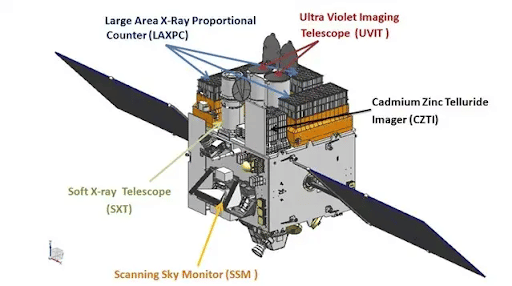
Payloads of Astrosat
Astrosat – Key Achievements
- Stellar Variability: Astrosat's observations have shed light on the variability in the brightness of stars, providing insights into their evolution and behaviour over time.
- Black Hole Insights: The observatory's detection of high-energy X-rays from binary star systems has led to significant discoveries regarding black holes. These observations have illuminated the behaviour of these enigmatic cosmic entities and their interaction with surrounding matter.
- Unraveling Galaxy Clusters: Astrosat's observations of galaxy clusters have provided invaluable data on their intricate dynamics, gravitational interactions, and the distribution of hot gases within these colossal cosmic structures.
Significance of Astrosat
- Astrosat's successful operation underscores ISRO's technical prowess in designing, launching, and managing intricate space missions.
- Astrosat has fostered international collaborations, with data-sharing agreements benefiting the global scientific community and enhancing India's position as a significant player in space research.
- In 2019, Astrosat's mission life was extended, allowing for prolonged observations and the study of new celestial phenomena across multiple wavelengths.
- Inspired by the success of Astrosat, ISRO is poised to develop more advanced space observatories that will contribute to our evolving understanding of the universe.
Conclusion
Astrosat represents India's commitment to pushing the boundaries of space research. With its range of instruments and versatile capabilities, the observatory has made significant contributions to our understanding of the cosmos. Its journey serves as an inspiration for India's burgeoning space research community, demonstrating the nation's prowess in the field of space exploration.
| Other Relevant Links | |
|---|---|
| Science & Technology Policy in India | Scientific Policy Resolution 1958 |
| Science & Technology Policy of 1983 | Science & Technology Policy of 2003 |
| Science, Technology and Innovation Policy 2013 | New Initiatives Aligned with the National Agenda |
| India and World collaboration in science projects | Technology Vision Document 2035 |
FAQs
Question: What is Astrosat?
Answer: Astrosat is India's first dedicated multi-wavelength space observatory launched by ISRO. It is designed to observe celestial sources in different wavelengths, including X-rays, ultraviolet, and optical wavelengths, contributing to astronomy and space science research.
Question: When was Astrosat launched?
Answer: Astrosat was launched on September 28, 2015, by the Indian Space Research Organisation (ISRO) from the Satish Dhawan Space Centre in Sriharikota, India.
Question: What are the primary objectives of Astrosat?
Answer: The primary objectives of Astrosat include observing celestial objects in various wavelengths, understanding cosmic phenomena, studying the structure of the universe, and performing high-resolution imaging of space objects.
Question: How does Astrosat contribute to astronomy?
Answer: Astrosat contributes to astronomy by providing detailed images and spectra of celestial objects in multiple wavelengths, helping scientists study cosmic phenomena such as black holes, supernovae, galaxies, and interstellar medium.
Question: What are the key instruments aboard Astrosat?
Answer: The key instruments aboard Astrosat include the Ultraviolet Imaging Telescope (UVIT), the Visible Emission Line Coronagraph (VELC), the Large Area X-ray Proportional Counter (LAXPC), and the Soft X-ray Telescope (SXT), which collectively enable multi-wavelength observations.
MCQs
1. What is the main purpose of the Astrosat mission?
A) To monitor weather conditions on Earth
B) To study celestial objects in multiple wavelengths
C) To improve satellite communication
D) To develop weather satellites for space
Answer: (B) See the Explanation
Explanation: Astrosat's primary purpose is to study celestial objects in multiple wavelengths, including X-rays, ultraviolet, and optical light, which helps astronomers understand the universe.
2. Which organization launched Astrosat?
A) NASA
B) ISRO
C) Roscosmos
D) European Space Agency (ESA)
Answer: (B) See the Explanation
Explanation: Astrosat was launched by the Indian Space Research Organisation (ISRO), India’s space agency, on September 28, 2015.
3. Which of the following is a key instrument on Astrosat?
A) Ultraviolet Imaging Telescope (UVIT)
B) Space Shuttle Imaging Camera
C) Optical Interferometer for Space
D) Hubble Space Telescope
Answer: (A) See the Explanation
Explanation: The Ultraviolet Imaging Telescope (UVIT) is one of the key instruments on Astrosat that allows for observations in the ultraviolet spectrum, helping to study cosmic sources.
4. What does Astrosat aim to achieve in the field of astronomy?
A) To build the world's largest telescope
B) To observe celestial bodies in multiple wavelengths
C) To create a new space station
D) To monitor solar activities only
Answer: (B) See the Explanation
Explanation: Astrosat aims to observe celestial bodies in multiple wavelengths, including X-rays, ultraviolet, and optical, to enhance the study of the universe's structure and phenomena.
5. When was Astrosat launched?
A) 2010
B) 2013
C) 2015
D) 2017
Answer: (C) See the Explanation
Explanation: Astrosat was launched on September 28, 2015, by ISRO from the Satish Dhawan Space Centre.
GS Mains Questions and Model Answers
Q1: Discuss the significance of the Astrosat mission for India’s space exploration and its contribution to global astronomy.
Answer: The Astrosat mission is significant for India’s space exploration as it is India’s first dedicated multi-wavelength space observatory. It enables India to contribute to global astronomy by providing detailed data from celestial bodies in the ultraviolet, optical, and X-ray spectrums. Astrosat’s findings offer valuable insights into cosmic phenomena such as the study of black holes, supernovae, galaxies, and the interstellar medium. This mission enhances India’s capabilities in space science and contributes to the global understanding of the universe, thereby positioning India as a key player in the field of space-based astronomy.
Q2: What are the major scientific findings expected from the Astrosat mission, and how will they benefit scientific research?
Answer: Astrosat is expected to provide crucial data on various cosmic phenomena, including the structure and evolution of galaxies, the behavior of black holes, and the nature of cosmic rays. It will also help improve our understanding of stellar life cycles and interstellar medium. These scientific findings will benefit research by offering new insights into the fundamental workings of the universe, leading to advancements in astrophysics, cosmology, and space science. Additionally, Astrosat’s data will assist in developing more accurate models of cosmic evolution, which could lead to breakthroughs in space exploration and technology.
Q3: Evaluate the challenges faced by India in launching Astrosat and its importance in advancing India’s space technology.
Answer: The launch of Astrosat was a major milestone for India, but it came with challenges such as the complexity of developing the multi-wavelength instruments, the need for precision in orbit placement, and ensuring that the observatory functioned correctly in the harsh space environment. Despite these challenges, the successful launch of Astrosat demonstrates India’s growing expertise in space technology, particularly in the field of astronomy. It signifies the country’s advancement in building and operating sophisticated space observatories, positioning India as an emerging leader in space exploration and scientific research on a global scale.
Previous Year Questions on Astrosat
1. UPSC CSE Mains 2017 (GS Paper 3):
Question: "Discuss the contribution of India’s Astrosat mission to the field of space-based astronomy."
Answer: India’s Astrosat mission has significantly contributed to space-based astronomy by providing high-resolution data from multiple wavelengths, including ultraviolet and X-rays. Astrosat’s unique capability to observe celestial objects across these wavelengths has enriched global astronomical research and expanded our understanding of cosmic phenomena such as black holes, supernovae, and galaxies. The mission has also marked India’s entry into the domain of advanced space-based scientific missions, showcasing its technological capabilities and enhancing international collaboration in space science.
2. UPSC CSE Mains 2020 (GS Paper 3):
Question: "What are the potential scientific benefits of multi-wavelength observations in space-based astronomy? Discuss with reference to the Astrosat mission."
Answer: Multi-wavelength observations provide a comprehensive view of celestial objects, enabling the study of phenomena that cannot be observed in a single spectrum. The Astrosat mission, with its ability to observe in X-ray, ultraviolet, and optical wavelengths, allows scientists to gain deeper insights into cosmic phenomena such as the life cycle of stars, the structure of galaxies, and the properties of black holes. This multi-faceted approach enriches the understanding of the universe, making Astrosat a valuable asset in the field of space-based astronomy and helping to unlock mysteries that have previously been inaccessible.
Download the PREPP App and attempt FREE IAS Exam Mock Tests and get complete study material!

Full Test - 04: UPSC CSE Prelims CSAT (Paper-II)
Full Test - 03: UPSC CSE Prelims CSAT (Paper-II)
UPSC CSE Prelims 2026 GS Paper 1 Question Paper (24-May-2026)
UPSC CSE Prelims 2026 CSAT Paper 2 Question Paper (24-May-2026)

17 February 2025 | The Hindu Must Read Articles | Current Affairs

16 February 2026 | The Hindu Must Read Articles | Current Affairs

13 February 2026 | The Hindu Must Read Articles | Current Affairs









Comments