Asteroid Impact and Deflection Assessment (AIDA) Mission – Science & Technology Notes
ESA and NASA collaborated on the Asteroid Impact & Deflection Assessment (AIDA) mission. It is a technological demonstration of the kinetic impactor concept to deflect and characterise a small asteroid. It began in 2011 as a collaborative project between John Hopkins University (Applied Physics Laboratory), NASA, the Côte d'Azur Observatory (OCA, Nice, France), and DLR (Germany). In this article, we will discuss in detail regarding Asteroid Impact and Deflection Assessment Mission (AIDA) which will be helpful for UPSC exam preparation.
Table of Contents
AIDA – Background
- Asteroid impact is widely regarded as one of the most likely of all possible causes of the extinction of life on Earth.
- There are two general approaches to planetary defence against an asteroid.
- Blowing it up before it reaches Earth
- Deflecting the asteroid off its course by hitting it with a spacecraft
- The Asteroid Impact Deflection Assessment (AIDA) project aims to investigate the deflection defence mechanism.
| Other Relevant Links | |
|---|---|
| Commercial use of Lithium-Ion battery technology | Hyperspectral imaging satellite |
| Water propulsion system in CUBESAT | Neutrino Observatory |
| Indian Space Vision-2025 | Major Policy Initiatives National Optical Fibre network |
| Spectrum Management | Cyber Law |
| Internet, Types of Network and e- Governance | Spectrum Policy in India |
| Mobile Spectrum | Cloud Computing |
| Big Data | Encryption |
| Biometrics | Virtual Reality |
What is the AIDA Mission?
- The Asteroid Impact & Deflection Assessment (AIDA) mission will be the first to investigate a binary near-Earth asteroid (NEA) and demonstrate asteroid impact hazard mitigation using a kinetic impactor.
- AIDA is a collaborative project between ESA and NASA that includes the ESA Asteroid Impact Mission (AIM) rendezvous spacecraft and the NASA Double Asteroid Redirection Test (DART) mission.
- AIDA's primary objectives are as follows:
- to investigate the binary NEA (65803) Didymos;
- to test our ability to impact its moon with a hypervelocity projectile; and
- to measure and characterise the impact deflection from both space and ground-based observatories using AIM.
- The two concepts (DART projectile and AIM orbiter) are being developed as separate missions.
- By combining the two missions, it will be possible to perform an impact (DART) in order to deflect the smaller component of the asteroid binary system, as well as observe the impact crater and derive collision and impact properties (AIM).
What are Near Earth Asteroids (NEAs)?
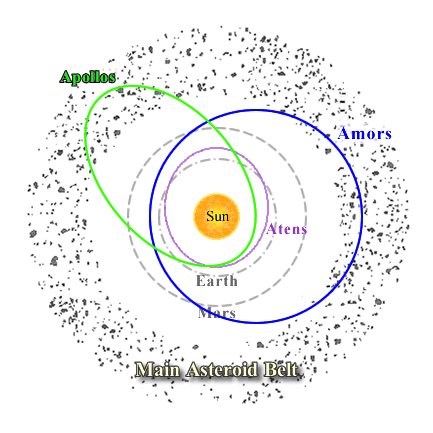 Near Earth Asteroids
|
What is the target of AIDA Mission?
- The target of the AIDA mission is the smaller of two bodies in the "double Didymos asteroids". These are in orbit around the Earth and Mars.
- Didymos is a system of near-Earth asteroids.
- Its main body is about 780 metres across, and the smaller body is a "moonlet" about 160 metres across.
- The project's goal is to deflect the orbit of the smaller body using a single spacecraft's impact.
- For this, NASA is developing the Double Asteroid Impact Test (DART) spacecraft.
- Then, a second spacecraft will survey the crash site and collect as much information as possible about the impact of this collision.
- The European Space Agency's contribution is a mission called Hera, which will conduct a close-up survey of the post-impact asteroid.
- Hera will also launch two CubeSats to conduct close-up asteroid surveys. This would allow researchers to simulate the collision's efficiency.
- LICIACube, an Italian-made miniature CubeSat, will fly alongside DART to record the moment of impact.
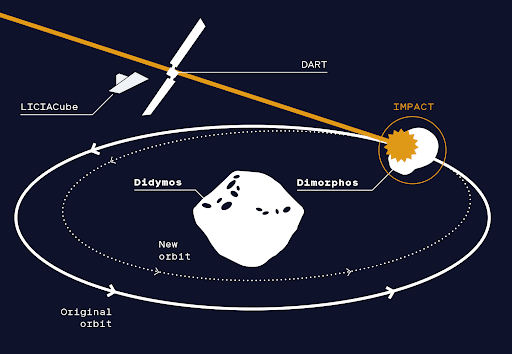
AIDA Mission
What is Asteroid Impact Mission (AIM)?
- AIM is a rendezvous mission that focuses on monitoring aspects, such as the ability to determine key properties of Didymos' satellite used as the target of the deflection test in real time.
- AIM will also provide access to the detailed conditions of the DART impact and its outcome, providing a complete picture of such an event for the first time, a better interpretation of the deflection measurement, and the ability to compare with numerical modelling predictions.
- The following remote sensing and in-situ instruments are included in AIM's baseline payloads:
- a Visual Imaging System
- a lander (based on DLR MASCOT heritage)
- a thermal infrared imager
- a high frequency (decimeter-wave) radar, and
- a low frequency (60 MHz) radar
- These instruments will help to measure Didymos surface and sub-surface physical properties and to study internal structures.
- AIM also includes a demonstration of optical communication that can be used as a laser altimeter and CubeSat payloads.
- AIM is not intended to be a purely scientific mission, but rather to demonstrate technology.
- However, AIM will vastly improve our scientific understanding of small asteroids in areas critical to Solar System science, such as asteroid geophysics, granular mechanics, impact processes, and thermal effects/properties.
What is Double Asteroid Redirection Test (DART)?
- DART is a NASA space probe designed to demonstrate the kinetic effects of crashing an impactor spacecraft into an asteroid moon for purposes of planetary defence.
- The mission's goal is to see if a spacecraft collision can successfully deflect an asteroid on a collision course with Earth.
- A demonstration of asteroid deflection is a critical test that NASA and other agencies want to perform before the need for planetary protection becomes apparent.
- DART is a joint project of NASA and JHU/APL (John Hopkins University/ Applied Physics Laboratory).
- DART's primary objectives are to
- demonstrate a hypervelocity spacecraft impact on a small near-Earth asteroid (NEA)
- measure and comprehend the deflection caused by the impact.
- The DART mission includes optical and radar observations of Didymos before and after the kinetic impact experiment, as well as modelling and simulation programmes.
- DART's secondary goal is to learn how to mitigate an asteroid threat through kinetic impact, as well as to develop and validate models for momentum transfer in asteroid impacts.
- AIM will conduct additional detailed measurements of the DART impact and outcome.
Significance of AIDA Mission
- The AIDA mission, comprised of the DART and AIM missions, will provide fundamental new information on a binary system, its mechanical response, the impact cratering process, and, as a result, the collisional evolution of asteroids, with implications for planetary defence, human spaceflight, and Solar System science.
- AIDA mission research includes a variety of scientific activities such as binary dynamics and impact modelling, asteroid geophysics, and observations.
- AIDA will be the first fully documented asteroid impact experiment, allowing numerical codes to be tested and used at those scales for similar and other scientific applications.
Conclusion
The AIDA mission, comprised of the ESA's AIM spacecraft and NASA's DART impactor, has the potential to provide a wealth of data relevant to the science and planetary defence of NEAs. This mission to investigate the binary asteroid Didymos, on the other hand, can provide critical insights into small body strategic knowledge gaps and contribute to the overall success of human exploration missions to asteroids.
| Other Relevant Links | |
|---|---|
| Science & Technology Policy in India | Scientific Policy Resolution 1958 |
| Science & Technology Policy of 1983 | Science & Technology Policy of 2003 |
| Science, Technology and Innovation Policy 2013 | New Initiatives Aligned with the National Agenda |
| India and World collaboration in science projects | Technology Vision Document 2035 |
FAQs
Question: What is the objective of the AIDA mission?
Answer: The primary objective of the AIDA mission is to assess asteroid deflection techniques by colliding a spacecraft with a binary asteroid system. It aims to understand the effectiveness of using kinetic impactors to alter the trajectory of asteroids that may pose a threat to Earth.
Question: What are the two main components of the AIDA mission?
Answer: The AIDA mission consists of two main components: the NASA's Double Asteroid Redirection Test (DART) spacecraft, which will impact the smaller body of the binary asteroid system, and ESA's Hera spacecraft, which will study the impact and post-impact effects.
Question: Which asteroid system is the AIDA mission targeting?
Answer: The AIDA mission targets the Didymos binary asteroid system, consisting of a larger asteroid (Didymos) and its moonlet (Didymoon or Didymos B), with a specific focus on the smaller moonlet, which will be impacted by the DART spacecraft.
Question: Why is asteroid deflection important for Earth’s defense?
Answer: Asteroid deflection is important for Earth’s defense because large asteroids can cause devastating impacts on Earth. By developing technologies to alter the trajectories of these objects, we can prevent potential collisions with our planet and protect human life and infrastructure.
Question: What are the key scientific benefits of the AIDA mission?
Answer: The AIDA mission will provide valuable data on asteroid composition, structure, and the effectiveness of kinetic impactors in altering their trajectories. It will also help refine models for future planetary defense strategies against potential asteroid threats.
MCQs
1. What is the primary objective of the AIDA mission?
A) To discover new asteroids
B) To study asteroid composition
C) To assess asteroid deflection techniques
D) To mine asteroids for resources
Answer: (C) See the Explanation
The primary objective of the AIDA mission is to assess asteroid deflection techniques by impacting a spacecraft with an asteroid in order to understand how kinetic impactors can be used to prevent asteroid collisions with Earth.
2. Which asteroid system is targeted by the AIDA mission?
A) Apophis
B) Didymos
C) Bennu
D) Vesta
Answer: (B) See the Explanation
The AIDA mission targets the Didymos binary asteroid system, which consists of a larger asteroid, Didymos, and its moonlet, Didymoon (or Didymos B), where the impact will be carried out by NASA's DART spacecraft.
3. Which spacecraft is responsible for carrying out the impact in the AIDA mission?
A) Hera
B) DART
C) Lucy
D) Juno
Answer: (B) See the Explanation
The DART (Double Asteroid Redirection Test) spacecraft is responsible for carrying out the kinetic impact on the smaller moonlet (Didymoon) in the Didymos binary asteroid system as part of the AIDA mission.
4. What is the role of ESA’s Hera spacecraft in the AIDA mission?
A) To track the asteroid impact
B) To deliver the kinetic impact
C) To study the post-impact effects
D) To launch a deflection technique
Answer: (C) See the Explanation
ESA’s Hera spacecraft plays the role of studying the post-impact effects of the DART mission on the Didymoon. It will collect data on the asteroid’s composition and structure to better understand the effectiveness of the deflection technique.
5. Why is asteroid deflection research important for planetary defense?
A) To prevent asteroid mining
B) To avoid a collision with Earth
C) To track asteroids in space
D) To establish human colonies on asteroids
Answer: (B) See the Explanation
Asteroid deflection research is vital for planetary defense because it helps develop technologies that can prevent hazardous asteroids from colliding with Earth, potentially saving lives and preventing significant damage to the planet.
GS Mains Questions and Model Answers
Q1: Discuss the significance of the AIDA mission in advancing planetary defense technologies.
Answer: The AIDA mission is a significant step in planetary defense, specifically in developing techniques for asteroid deflection. The mission will assess the effectiveness of kinetic impactors, such as NASA’s DART spacecraft, in altering the trajectory of potentially hazardous asteroids. By targeting the Didymos binary asteroid system, AIDA provides invaluable data on how an asteroid’s composition and structure influence the success of deflection efforts. In the future, such technologies could be used to prevent asteroid collisions with Earth, ensuring the protection of life and infrastructure from catastrophic events. The collaboration between NASA and ESA also highlights the importance of international cooperation in tackling global threats.
Q2: How can the study of asteroid deflection techniques enhance our ability to prevent future asteroid impacts on Earth?
Answer: The study of asteroid deflection techniques, like those being tested in the AIDA mission, is critical for enhancing our ability to prevent asteroid impacts on Earth. Asteroids pose a significant threat due to their potential to cause large-scale destruction. By using kinetic impactors to alter their trajectories, we can prevent collisions with Earth. The AIDA mission’s assessment of how the impact of DART on Didymoon affects its orbit will inform future planetary defense strategies. Moreover, it helps scientists refine the models predicting asteroid behavior, ensuring that more precise and timely deflection methods are developed. This research will be crucial for protecting Earth in the event that a large asteroid threatens our planet.
Q3: Explain the role of international collaboration in advancing asteroid deflection research, with reference to the AIDA mission.
Answer: The AIDA mission underscores the importance of international collaboration in advancing asteroid deflection research. NASA and ESA have come together for this mission, with NASA providing the DART spacecraft to impact the asteroid and ESA contributing the Hera spacecraft to study the aftermath. This collaboration allows both agencies to pool their expertise, resources, and technologies, maximizing the scientific and practical outcomes of the mission. International cooperation is essential for planetary defense, as asteroid threats are global, and solutions to mitigate them must involve shared efforts and data. The success of the AIDA mission could lead to broader collaborations, ensuring that the world is better prepared to address the risks posed by potentially hazardous asteroids.
Previous Year Questions on Asteroid Deflection
1. UPSC CSE Prelims 2019:
Question: The Double Asteroid Redirection Test (DART) mission, launched by NASA, is related to:
A) Investigating Mars' moons
B) Studying the impact of asteroids on Earth
C) Deflecting an asteroid to assess planetary defense
D) Mapping the asteroids in the asteroid belt
Answer: (C) See the Explanation
The DART mission is part of the AIDA project, which aims to deflect an asteroid as part of an experiment to assess planetary defense techniques. It is not concerned with mapping asteroids or studying Mars' moons.
2. UPSC CSE Mains 2020 (GS Paper 3):
Question: “What are the key technologies involved in planetary defense, and how do missions like AIDA help enhance our understanding of these technologies?”
Answer: Planetary defense technologies mainly involve methods like asteroid deflection, early detection, and impact mitigation. The AIDA mission plays a crucial role in studying the feasibility of deflecting asteroids using kinetic impactors. Through the impact of NASA's DART spacecraft on the Didymoon asteroid, scientists aim to assess how altering the trajectory of an asteroid can prevent a collision with Earth. By using data from the Hera spacecraft, which will study the post-impact effects, the mission provides critical insights into the potential for asteroid deflection as a planetary defense strategy. This knowledge will be essential in developing more effective defense mechanisms to protect Earth from future asteroid threats.
Download the PREPP App and attempt FREE IAS Exam Mock Tests and get complete study material!

Full Test - 04: UPSC CSE Prelims CSAT (Paper-II)
Full Test - 03: UPSC CSE Prelims CSAT (Paper-II)
UPSC CSE Prelims 2026 GS Paper 1 Question Paper (24-May-2026)
UPSC CSE Prelims 2026 CSAT Paper 2 Question Paper (24-May-2026)

17 February 2025 | The Hindu Must Read Articles | Current Affairs

16 February 2026 | The Hindu Must Read Articles | Current Affairs

13 February 2026 | The Hindu Must Read Articles | Current Affairs









Comments