ASEAN India Grassroots Innovation Forum (AIGIF)
Relevance: GS2 - India and its neighborhood- relations, Bilateral, regional and global groupings and agreements involving India and/or affecting India’s interests.
(Source: Department of Science and Technology, 12/01/2023)
Click here for Daily Current Affairs
Why in the news?
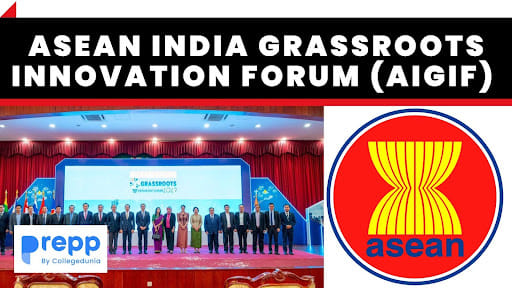
- Recently, India participated in the 4th edition of the ASEAN India Grassroots Innovation Forum (AIGIF) held in Langkawi, Malaysia on 28th November 2023.
- The AIGIF is an annual forum that aims to strengthen the cooperation between India and the ASEAN in the fields of Science, Technology, and Innovation.
Table of Contents
What is the ASEAN India Grassroots Innovation Forum?
- The ASEAN India Grassroots Investment Forum is an annual forum to strengthen the cooperation between India and the ASEAN in the fields of Science, Technology, and Innovation.
- Objective: Provide exposure to social innovation
- Strengthen governance in the grassroots innovation ecosystem.
- Organizers:
- The ASEAN Committee on Science, Technology, and Innovation (COSTI)
- Department of Science & Technology (DST), GoI
- India’s National Innovation Foundation (NIF)
- Host nation’s Science and Technology Ministry of the host nation - Ministry of Science, Technology and Innovation, Malaysia (MOSTI) (2023)
- The Yayasan Inovasi Malaysia (YIM), an agency under MOSTI was responsible for executing the 2023 edition of the AIGIF.
- Previous editions:
- 1st edition: Jakarta, Indonesia (2018)
- 2nd edition: Davao, Philippines (2019)
- 3rd edition: Phnom Penh, Cambodia (2022)
- Participants from India:
- Representatives from the Department of Science and Technology, Government of India; staff members of the NIF, and 17 student innovators and grassroots innovators.
Highlights of the 2023 edition
- According to the Malaysian Minister of Science, Technology, and Innovation, YB Chang Lih Kang, annual flagship programmes like the AIGIF were a dynamic platform to showcase and promote innovations with the potential to impact the lives of citizens at the grassroots level.
- Countries were urged to continue their commitment to social innovation and ensure a better tomorrow for the global population.
- Steps to help improve innovation and technological capability, resilience of entrepreneurs, and sustainability include
- Support cross-border mechanisms
- Share information about best practices
- Networking of ASEAN linkages to global and regional networks.
- The Secretary of the Department of Science and Technology, Government of India, highlighted the importance of innovators for the world’s future.
- Therefore, steps must be taken to support them to make the world a better place.
- He underlined the need to define cooperation involving emerging possibilities in the broader Asian region such as
- Joint Technology and Product Development
- Cross Border Technology Licensing opportunities
- Sharing infrastructure with countries that do not have access to it
- Dissemination and social diffusion of emerging technologies.
- The High Commissioner of India to Malaysia emphasized India’s key contributions to the startup ecosystem in different parts of the world, including unicorns rooted in India and operating in Malaysia.
- He claimed that the AIGIF could help students and the grassroots population in the participating countries and ensure greater cooperation between India and the ASEAN member states.
- He also urged the industry to connect with grassroots innovation to ensure sustainable solutions.
- Participants at the AIGIF 2023 reiterated their commitment to tackling societal challenges through improved participation and collaboration.
What is the National Innovation Foundation?
- The National Innovation Foundation is an autonomous body of the Department of Science and Technology (DST), Government of India.
- It was established in 2000 in Ahmedabad with the aim of providing institutional support to sustain and scale up the grassroots innovations ecosystem in the country.
- It aims to strengthen grassroots technological innovations and traditional knowledge by making India a creative and knowledge-based society.
- It will work towards expanding policy and institutional space for grassroots technological innovators in the country.
Initiatives of the NIF
- The NIF has a pooled database of 3,25,000 technological ideas, innovations, and traditional knowledge practices.
- It has collaborated with various research & development (R&D) and academic institutions and universities.
- NIF has filed over 1274 patent applications, including eight filed in the USA and 28 Patent Cooperation Treaty (PCT) applications, on behalf of the innovators and outstanding traditional knowledge holders.
- It has also been successful in commercializing products in numerous countries.
- Awards: It has recognized 1093 grassroots innovators and school students at the national level through the National Biennial Grassroots Innovation Award and Dr A P J Abdul Kalam Ignite Children Awards.
- Grassroots Innovations Design Studio (GRIDS): It has been set up to facilitate formal design inputs to grassroots innovations at premier institutes.
- Students' Club for Augmenting Innovations (SCAI): It is a nationwide student movement providing product development, mentoring, and monitoring support to innovators and traditional knowledge holders at the grassroots level.
- Fab Lab: It has established an augmented Fabrication Laboratory (Fab Lab) for product development and strengthening in-house research.
- Micro Venture Innovation Fund (MVIF): It has provided risk capital support to numerous innovation-based enterprises with support the from Small Industries Development Bank of India (SIDBI).
ASEAN
Objectives
ASEAN Forums
To know more, click the link |
(*Click this link to read prelims specific weekly current affairs articles)
FAQs
Question: What is the creative economy?
Answer:
The creative economy is based on the interplay between human creativity and ideas and intellectual property, knowledge and technology. It is also known as the orange economy. It covers sectors such as advertising, architecture, arts and crafts, design, fashion, film, video, photography, music, etc.
Question: What is SIDBI?
Answer:
The Small Industries Development Bank of India (SIDBI) is an independent financial institution that was established with the aim of aiding the growth and development of MSMEs. It is a statutory body that was set up under an act of the Indian Parliament in 1990 and is regulated by the Reserve Bank of India.
UPSC Mains Practice Question:
|
MCQs
Question: Which of the following statements is/are correct regarding National Innovation Foundation-India (NIF)? (UPSC CSE 2015)
- NIF is an autonomous body of the Department of Science and Technology under the Central Government.
- NIF is an initiative to strengthen the highly advanced scientific research in India’s premier scientific institutions in collaboration with highly advanced foreign scientific institutions.
Select the correct answer using the code given below:
(a) 1 only
(b) 2 only
(c) Both 1 and 2
(d) Neither 1 nor 2
Answer: (a) See the Explanation
- The NIF is an autonomous body of the Department of Science and Technology under the Central Government. Hence statement 1 is correct.
- The NIF is not an initiative to strengthen highly advanced scientific research in India but its focus is on identifying and promoting grassroots innovations and traditional knowledge practices. Hence statement 2 is incorrect.
Therefore, option (a) is the correct answer.
Question: Consider the following infrastructure sectors:
- Affordable housing
- Mass rapid transport
- Health rare
- Renewable energy
On how many of the above does UNOPS Sustainable Investments in Infrastructure and Innovation (S3i) initiative focus for its investments? (UPSC CSE 2023)
(a) Only one
(b) Only two
(c) Only three
(d) All four
Answer: (c) See the Explanation
- The UNOPSC was established in 1973 as a component of the United Nations Development Programme (UNDP) to promote sustainable implementation practices in development, humanitarian aid, and peacebuilding.
- The UNOPS S3i initiative prioritizes affordable housing to provide significant support for affordable housing initiatives targeting the middle-income and lower-middle-income groups of the population. Hence statement 1 is correct.
- Mass Rapid Transport is not included in the UNOPS S3i initiative. Hence statement 2 is incorrect.
- UNOPS S3i initiative prioritizes enhancing the quality of healthcare in the specified countries by providing support for healthcare infrastructure projects. Hence statement 3 is correct.
- UNOPS S3i initiative prioritizes renewable energy by investing in infrastructure projects related to renewable energy sources such as solar, hydro, wind, biomass, and hydrogen, especially in eligible emerging markets and developing nations. Hence statement 4 is correct.
Therefore, option (c) is the correct answer.
Question: India is a member of which among the following?
- Asia-Pacific Economic Cooperation (APEC)
- Association of South-East Asian Nations
- East Asia Summit
Which of the above is/are correct? (UPSC CSE 2015)
(a) 1 and 2 only
(b) 3 only
(c) 1, 2 and 3
(d) India is a member of none of them
Answer: (b) See the Explanation
- The Asia-Pacific Economic Cooperation (APEC) is an inter-governmental forum of countries in the Pacific Rim region.
- India is not a member of APEC.
- Members of APEC: Australia; Brunei Darussalam; Canada; Chile; People's Republic of China; Hong Kong, China; Indonesia; Japan; Republic of Korea; Malaysia; Mexico; New Zealand; Papua New Guinea; Peru; The Philippines; The Russian Federation; Singapore; Chinese Taipei; Thailand; United States of America; Viet Nam. Hence statement 1 is incorrect.
- ASEAN is a regional association of Southeast Asian countries including Brunei Darussalam, Burma, Cambodia, Indonesia, Laos, Malaysia, Philippines, Singapore, Thailand, and Vietnam.
- India is not a member of ASEAN. Hence statement 2 is incorrect.
- The East Asia Summit is an ASEAN-led initiative for security, economic, and political cooperation among member countries. ‘
- Its members include the ten ASEAN countries and 8 partners i.e. Australia, China, India, Japan, New Zealand, the Republic of Korea, Russia and the United States. Hence statement 3 is correct.
Therefore, option (b) is the correct answer.
Download the PREPP App and attempt FREE IAS Exam Mock Tests and get complete study material!

Full Test - 04: UPSC CSE Prelims CSAT (Paper-II)
Full Test - 03: UPSC CSE Prelims CSAT (Paper-II)
UPSC CSE Prelims 2026 GS Paper 1 Question Paper (24-May-2026)
UPSC CSE Prelims 2026 CSAT Paper 2 Question Paper (24-May-2026)

17 February 2025 | The Hindu Must Read Articles | Current Affairs

16 February 2026 | The Hindu Must Read Articles | Current Affairs

13 February 2026 | The Hindu Must Read Articles | Current Affairs









Comments