Are El Niño-La Niña Weather Patterns Changing? (UPSC Current Affairs)
Relevance: GS 1 - Important Geophysical phenomena such as earthquakes, Tsunami, Volcanic activity, cyclones etc.
(Source: The Hindu, 11/24/2022)
Click here for Daily Current Affairs
Why in the news?
A new study projects that climate change will significantly impact El Niño-La Niña weather patterns approximately by 2030 — a decade before what was earlier predicted. This is bound to result in further global climate disruptions.
What are the Findings of the study?
- According to the study, published in the Nature Communications journal, increased Sea Surface Temperature (SST) variability from ENSO in the eastern Equatorial Pacific (EP) will emerge around 2030 (error margin of +/- 6 years), more than a decade earlier than that of the central Pacific (CP) ENSO.
- If the Central Pacific and Equatorial Pacific are not separated, SST variability from ENSO will occur almost four decades earlier than previously suggested.
- Changes in the equatorial Pacific will be visible first due to a stronger increase in the Equatorial Pacific- ENSO rainfall response, leading to increased SST variability.
What is the El Niño phenomenon?
- Every few years, a phenomenon known as El Nio causes the sea water in the central-east Equatorial Pacific to warm.
- Surface temperatures in the equatorial Pacific rise during El Nino, while the east-west trade winds that blow close to the equator weaken.
- Typically, trade winds from the Americas move eastward towards Asia.
- Because of El Nio, trade winds diverge and alter the course to become westerlies, carrying warm water from the western Pacific to the Americas.
- El Nio reduces the phenomenon of upwelling, in which nutrient-rich waters rise to the surface.
- The result is a decrease in phytoplankton. As a result, fish that consume phytoplankton are impacted, then organisms further up the food chain.
- Additionally, tropical animals are transported by warm waters to cooler regions, upsetting numerous ecosystems.
- The Pacific Ocean makes up about one-third of the earth's surface, therefore variations in its temperature and ensuing changes to its wind patterns have an impact on the planet's overall weather patterns.
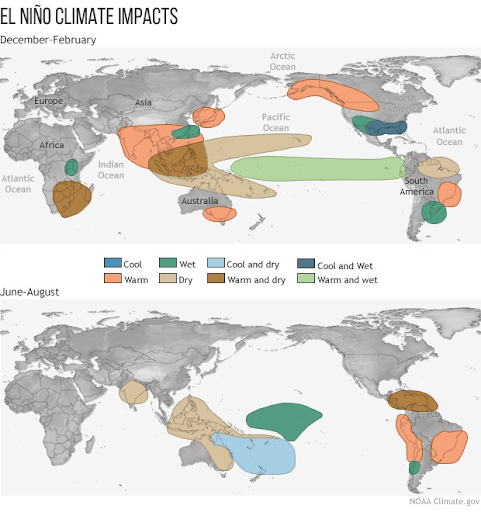
- El Nino brings about a dry, warm winter on the North American continent and Canada and raises the risk of floods along the Gulf Coast and in the Southeast. Additionally, it delivers drought to Australia and Indonesia.
What is the La Niña phenomenon?
- La Niña is the reverse phenomenon of El Niño. Sea surface temperature (SST) is lower than typical during La Nia in the equatorial Pacific. Stronger than average trade winds are driving warmer water toward Asia.
- Upwelling increases throughout the west coast of the United States, bringing nutrient-rich water to the surface.
- Jet streams, which are narrow bands of powerful winds in the upper atmosphere, are forced northward by Pacific cold waters near to the Americas.
- This causes the Southern United States to become drier and Canada to have considerable rains.
- Heavy floods in Australia have also been linked to La Niña. Intense flooding and substantial destruction were brought on by two consecutive La Niña episodes in Australia during the past two years.
El Niño Southern Oscillations (ENSO)
- El Niño Southern Oscillations (ENSO) are a phenomenon that causes the equatorial Pacific Ocean's surface waters to periodically warm and cool .
- The ENSO is the result of the interaction between El Nio, La Nia, and the neutral state between the two opposing effects.
- Large-scale variations in sea level pressure in the tropical Pacific region are known as southern oscillations.
- It is well recognized for causing significant changes in the atmosphere and has a significant impact on regional weather patterns, particularly the Indian monsoon.
What are the impacts of El Niño and La Niña?
El Niño
- El Nino affects local weather patterns from Australia to South America and beyond. It also affects ocean temperatures, ocean current strength and speed, the condition of coastal fisheries, and other factors.
- South America's rainfall dramatically increases, which causes erosion and coastal flooding.
- Natural disaster-ravaged areas, such as those affected by flooding in South America or drought in India, Australia and Indonesia, are ideal breeding grounds for diseases.
- El Nino-related floods have been associated in some parts of the world to an increase in cholera, dengue fever, and malaria, but dryness can lead to wildfires that cause respiratory problems.
- Australia and Indonesia experience drought due to El Nino, which brings rain to South America.
- Due to fewer cold air surges from the Arctic caused by a broad area of lower pressure centered on the Gulf of Alaska/North Pacific Ocean, El Nio is linked to milder winters in north-western Canada and Alaska.
La Niña
- No spring season in India: La Nina typically brings chilly, wet winters and springs to India, but this year much of the country did not see any sign of spring.
- India may suffer a lengthy monsoon season: India in 2022 is experiencing La Nina effect for the third consecutive year, along with increased floods incidents.
- Drought conditions in other regions of the world: Due to the continuing of the La Nina, it is probable that the ongoing drought conditions across 40% of the United States, the Horn of Africa, and southern South America will also continue and intensify.
- Hurricanes: There is a 65 percent chance that the Atlantic Ocean will have an above-average hurricane season.
- Heat waves and wildfires: This state might have disastrous and unforeseen effects on India and many other regions of the world, especially through more intense heat waves, drought, and the risk of wildfires that go along with it.
How are the monsoons in India affected?
- La Nia amplifies rainfall across South Asia, especially in India's northwest and Bangladesh during the monsoon, while El Nino causes poor rainfall and increased heat in India.
- Like the rest of the world, India is currently experiencing a prolonged "triple dip" La Nia.
- This is in part the cause of India's unusually heavy rainfall in September, the month when the monsoon generally retreats.
Implication of study for India:
- As per the findings of the study, increased SST variability by 2030 means that there will be more El Nino and La Nina incidents. This will cause more variability in Monsoon in India.
- Subsequently, it will increase the incidence of El Nino and La Nina and their intensity will also increase. Causing more number oof events of Drought and floods in India.
(*Click this link to read prelims specific weekly current affairs articles)
Some Important FAQs
Question: What is El Nino?
Answer:
El Niño is a climate pattern that describes the unusual warming of surface waters in the eastern tropical Pacific Ocean. El Nino is the “warm phase” of a larger phenomenon called the El Nino-Southern Oscillation (ENSO).
Question: What is the difference between an El Nino and a La Niña?
Answer:
El Niño events are associated with a warming of the central and eastern tropical Pacific, while La Niña events are the reverse, with a sustained cooling of these same areas. These changes in the Pacific Ocean and its overlying atmosphere occur in a cycle known as the El Niño–Southern Oscillation (ENSO).
Question: How many times has India faced El Nino?
Answer:
Ten of India's 13 droughts since 1950 have occurred during El Nino years, with one occurring during a La Nina year. This is because an El Nino typically results in India receiving less rain than usual.
MCQs
Question: Consider the following statements about La Nina
- It is an Oceanic phenomenon occurring in the Eastern tropical Pacific Ocean, which affects global weather conditions.
- In the La Nina, sea surface temperatures (SSTs) along the central and equatorial Pacific Ocean are colder than normal.
Which of the above statements is/are correct?
(a) 1 only
(b) 2 only
(c) Both 1 and 2
(d) Neither 1 nor 2
Answer: (c) See the Explanation
- La Nina is an Oceanic phenomenon occurring in the Eastern tropical Pacific Ocean, which affects global weather conditions. Hence, statement 1 is correct.
- La Nina means ‘little girl’ in Spanish. It is also called El Viejo or ‘cold event’. In the La Nina, sea surface temperatures (SSTs) along the central and equatorial Pacific Ocean are colder than normal. Hence, statement 2 is correct.
- During a normal year, La Nina coupled with Indian Monsoon- results in more than above average annual rainfall in India.
Therefore, option (c) is the correct answer.
Download the PREPP App and attempt FREE IAS Exam Mock Tests and get complete study material!

Full Test - 04: UPSC CSE Prelims CSAT (Paper-II)
Full Test - 03: UPSC CSE Prelims CSAT (Paper-II)
UPSC CSE Prelims 2026 GS Paper 1 Question Paper (24-May-2026)
UPSC CSE Prelims 2026 CSAT Paper 2 Question Paper (24-May-2026)

17 February 2025 | The Hindu Must Read Articles | Current Affairs

16 February 2026 | The Hindu Must Read Articles | Current Affairs

13 February 2026 | The Hindu Must Read Articles | Current Affairs









Comments