Arctic Report Card 2022: The Arctic Is Getting Rainier, Seasons Are Shifting, With Broad Disturbances For People, Ecosystems (UPSC Current Affairs)
Relevance: GS3 - Conservation, Environmental Pollution and degradation, GS2 - Bilateral and regional groupings involving India
(Source: Down To Earth, 12/31/2022)
Click here for Daily Current Affairs
Why in the news?
- Recently, the Arctic Report Card had been released on 13th December by the National Oceanic and Atmospheric Administration (NOAA).
- The report had found that the Arctic ecosystem is changing, with wide-ranging effects on humans, animals, vegetation, and industry in the region.
What is the Arctic Report Card?
- The Arctic Report Card is an annually updated peer-reviewed publication about observations on the recent changes in the Arctic ecosystem as compared with historical records.
- It has been presented annually every year since 2006 by the National Oceanic and Atmospheric Administration (NOAA).
- The 2022 report saw the participation of 11 countries and 150 experts.
What has the 2022 report mentioned?
Rise in precipitation
- The report had found that there had been a shift in seasonal patterns in the Arctic with precipitation rising throughout the year. The majority of the precipitation had fallen as rain, even in the frozen winter.
- As a result, roads had become icier and the risk of flooding had increased. Traditional reindeer herds have struggled to find vegetation to feed on under the increased ice.
- In December 2021. The Arctic had received 1.4 inches of freezing rain, creating a thick layer of ice which caused the uprooting of trees, displacement of communities, and starvation and death among animal herds.
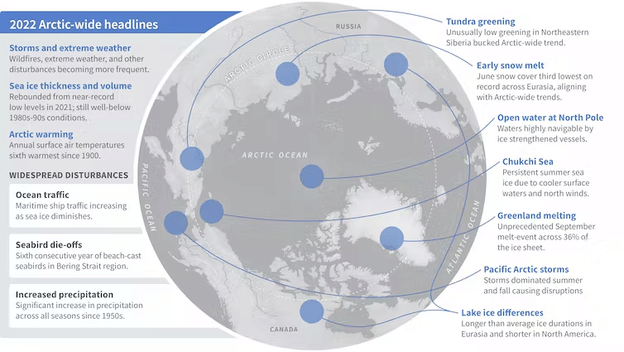
- The increased melting of Arctic ice had led to rising sea levels, exposing more moisture for evaporation. Arctic sea ice has reduced by more than 40% over the 44-year average.
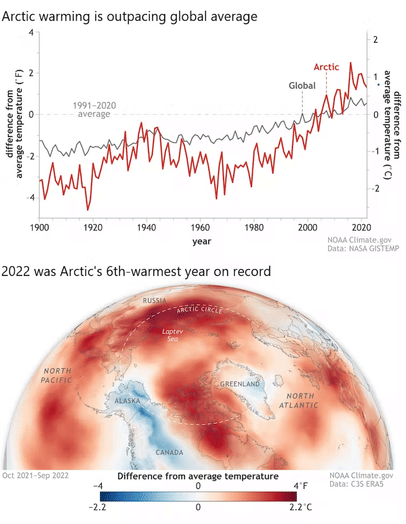
- The Arctic air is warming two times faster than the rest of the world, which increases its capacity to hold moisture. This process is called Arctic Amplification.
- Underground, the wetter ice has increased the rate at which the permafrost has melted.
- This has impacted the infrastructure of the region like buildings, roads, and coastlines. Sinkholes have increased in frequency as well.
- Wetter ice also reduces the formation of snowpacks and river ice, which affects the indigenous communities' harvesting and food collection.
- Typhoon Merbok which had caused infrastructural and humanitarian damage across the Bering Sea coast in September 2022, was caused by rising temperatures in the Pacific.
Arctic Melting
- Snow which is critical to the Arctic way of life is shrinking.
- The snow helps cool the Arctic by reflecting a majority of the sunlight back to the atmosphere rather than it being absorbed by the darker ground. This effect is called albedo.
- Melting of snow reduces albedo and contributes to further warming of the region and instability of the region through permafrost shrinking.
- The presence of the snow helps the ground and lakes retain moisture through the Spring season, which reduces the risk of wildfires.
- The snow is also a means of transportation for Arctic communities as well as a means of protection for animals.
- Despite there being no sun during the 6-month winter, temperature rises had been recorded.
- This has resulted in thinning of the ice, leading to fatal accidents.
Global effects
- In 2022, the Arctic ice sheet had lost ice for the 25th consecutive year increasing the threat of flooding and storms faced by coastal Arctic communities.
- Warming ocean waters have led to out-of-season ice melts with September 2022 having witnessed melting across 36% of the ice surface. NASA’s Ocean Melting Greenland Report had confirmed the loss of ice due to ocean warming.
Human influence on the Arctic ice
- The present geological age has been termed the Anthropocene era due to the influence of human activities on nature, the climate and life.
- Increased ship traffic in the region has contributed to temperature rises.
- Geopolitical uncertainties in Russia and Ukraine have added to the stress on Arctic communities, ecosystems, and the climate.
- Partnerships between scientists and indigenous knowledge holders are necessary to ensure the continuity of the Arctic way of life.
- Cooperation and resilience building can help reduce risks, but global action on the governmental level is required to handle global warming.
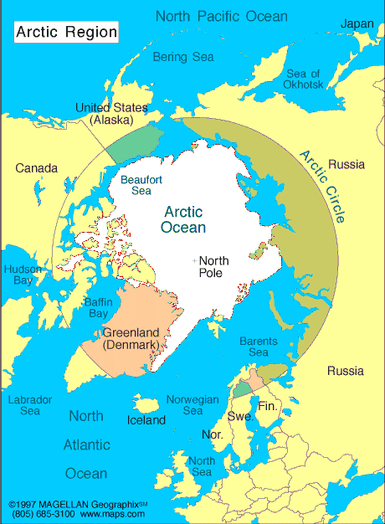
Arctic Region
India’s Arctic Policy
|
National Oceanic and Atmospheric Administration:
|
(*Click this link to read prelims specific weekly current affairs articles)
FAQs
Question. What is albedo?
Answer.
- Albedo is a measure of how well a surface reflects solar radiation and has no unit. Albedo ranges from 0 to 1. Albedo is a term used to describe how "white" a surface is, with 0 denoting black and 1 denoting white.
- A surface with a high albedo returns a large amount of solar radiation from the sun into space, whereas a surface with a low albedo reflects little solar radiation and absorbs it instead.
- Terrestrial Albedo is the term used to refer to the albedo of Earth.
- Earth's average terrestrial albedo is 0.31, or roughly two-thirds of the solar radiation that reaches the planet.
Question. What are sinkholes?
Answer.
When the layers of the Earth's surface begin to collapse into caverns, depressions in the ground called sinkholes are created. Due to the ability of the Earth's subsurface to remain stable for a while until the voids grow too large, they can happen unexpectedly and without notice. Sinkholes can develop as a result of both natural and manmade activities.
MCQ
Question. Consider the following statements about the Arctic Report Card 2022.
- The report details the changes in the climate in the Arctic region compared to available historical records.
- The report found increased precipitation and lowered temperatures in the winter.
Which of the following statements is/are true?
(a) 1 only
(b) 2 only
(c) 1 and 2
(d) None of the above
Answer: (a) See the Explanation
- The Arctic Report Card 2022, released by the NOAA is an annual report highlighting changes in the Arctic region versus available data of the past.
- The report found that despite the region experiencing a 6-month long sunless winter, temperatures had risen in the region even during winter. Precipitation had also risen as a result contributing to climate adverse events.
Therefore (a) is the correct answer.
Download the PREPP App and attempt FREE IAS Exam Mock Tests and get complete study material!

Full Test - 04: UPSC CSE Prelims CSAT (Paper-II)
Full Test - 03: UPSC CSE Prelims CSAT (Paper-II)
UPSC CSE Prelims 2026 GS Paper 1 Question Paper (24-May-2026)
UPSC CSE Prelims 2026 CSAT Paper 2 Question Paper (24-May-2026)

17 February 2025 | The Hindu Must Read Articles | Current Affairs

16 February 2026 | The Hindu Must Read Articles | Current Affairs

13 February 2026 | The Hindu Must Read Articles | Current Affairs









Comments