Antarctic Treaty and Operation Gangotri
Relevance: GS2 - Bilateral, regional and global groupings and agreements involving India and/or affecting India’s interests.
(Source: Indian Express, 12/02/2023)
Click here for Daily Current Affairs
Why in the news?
This article discusses the Antarctic Treaty signed on 1st December 1959 and India’s historic expedition to the Antarctic in 1981 codenamed Operation Gangotri.
Table of Contents
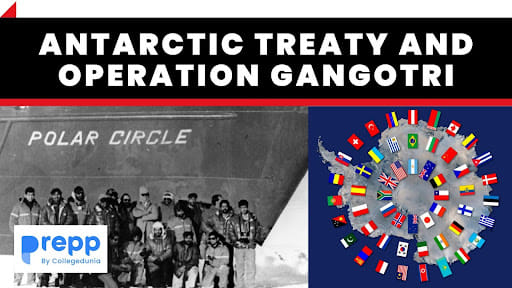
What is the Antarctic Treaty?
- The Antarctic Treaty is an agreement between 12 nations to demilitarize the Antarctic and prepare it for scientific research.
- It is part of the Antarctic Treaty system which governs international relations related to Antarctica.
- It entered into force in 1961 with its headquarters and Secretariat in Buenos Aires, Argentina.
- The Secretariat aims to assist the Antarctic Treaty Consultative Meeting (ATCM) and the Committee for Environmental Protection (CEP) in performing their functions, strengthen the Antarctic Treaty system and ensure that all activities in Antarctica are consistent with the principles of the treaty.
- Members: It has 56 members at present.
- Argentina, Australia, Belgium, Chile, France, Japan, New Zealand, Norway, South Africa, the Union of Soviet Socialist Republics, the UK and the US were the original signatories.
- India joined the treaty in 1983.
- Key provisions:
- Promote freedom of scientific research and ensure that findings are shared freely among members
- Demilitarization and use of the continent by the country only for peaceful purposes.
- Prohibition of military activities including stationing of personnel and testing of weapons
- Ban on nuclear testing and the dumping of radioactive waste.
- Mineral resources cannot be mined except for scientific research.
- Protection of the environment and natural flora and fauna of Antarctica
- Neutralizing territorial sovereignty and territorial claims
- All signatories must provide information about expeditions, and ship or military movements to Antarctica which can be inspected by designated inspectors.
- However, the Treaty only applies to ice shelves and land, not the sea.
- The Treaty has evolved over time through the addition of conventions and legal protocols dealing with the conservation of marine living resources, mining bans, and the adoption of comprehensive environmental protection mechanisms.
- The expanded Treaty framework which comprises these additional conventions and protocols is known as the Antarctic Treaty System.
- Although the treaty aims that no nation or people should claim Antarctic territory, it recognizes claims before 1961.
Antarctic Treaty System
- The Antarctic Treaty System refers to the entire framework of arrangements that aim to regulate relations among the states in the Antarctic.
- Aim: Ensure that Antarctica shall continue to be used exclusively for peaceful purposes and not become an arena of international discord.
- The agreements are legally binding and tailored to suit the geographical, environmental, and political characteristics of the Antarctic.
- Major International Agreements of the Treaty System:
- The Antarctic Treaty (1959).
- The Convention for the Conservation of Antarctic Seals (1972).
- The Convention on the Conservation of Antarctic Marine Living Resources (1982).
- The Protocol on Environmental Protection to the Antarctic Treaty(1991).
- Upcoming meetings under the Treaty:
- The Forty-sixth Antarctic Treaty Consultative Meeting (ATCM)- Twenty-sixth Meeting of the Committee for Environmental Protection is scheduled to be held in Kochi in 2024.
|
What is Operation Gangotri?
- India’s first scientific expedition to Antarctica was codenamed Operation Gangotri and ended with the Indian team setting foot on Antarctica and hoisting the Indian flag on January 9th 1982.
- The Operation was conceived by a department of ocean development, under the Prime Minister, in July 1981.
- The Mission was conducted as a top secret as Indian experts were afraid of sabotage and pressure from other international actors, particularly members of the Antarctica Treaty.
- The expedition was conducted using the Polar Circle, a 5,000-tonne polar vessel registered in Canada, under the Norwegian firm - G. Reiber & Company.
- Team: It consisted of 21 people from seven different organizations including eight Navy personnel and 13 scientists (8 oceanographers).
- According to reports, Operation Gangotri cost the Indian Government only around ₹1.8 crore by the time it was completed.
Why are Antarctic expeditions significant for India?
- Strategic interest: There are only a few islands between India and Antarctica which makes Antarctica a significant element in India’s attempts to build a foothold in the Indian Ocean.
- Scientific interest: India has strived to become a world leader in oceanography and exploration of the seas.
- Expeditions to the Antarctic will help collect information and conduct research that will help India implement projects in this sector successfully.
- For example, the planned Samudrayaan Mission.
Indian Antarctic Bill, 2022
|
Antarctica
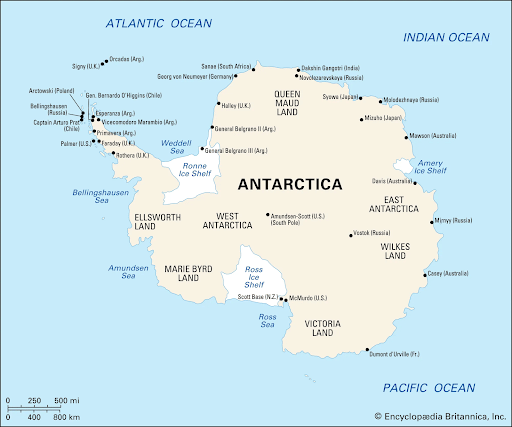
- Antarctica is the fifth largest continent in terms of total land area.
- It is a cold and remote region, located entirely in the southern hemisphere. It is separated from the other continents by the Southern Ocean.
- The Antarctic ice sheet is the single largest sheet of ice in the world that extends between three million (summer) and 12 million square kilometers (winter).
- Climate: Antarctica has an extremely cold and dry climate with temperatures ranging between -10° to -30°C in the winter and 0 - 9°C in the summer.
- Mountains: Antarctica has several mountains including the Transantarctic Mountains and the Ellsworth mountain range, which includes Vinson Massif -the highest peak on the continent.
- The prominent ice shelves of Antarctica include the Ross ice shelf in the south, the Ronne ice shelf in the north, and the Larsen ice shelf in the west.
- Antarctica is surrounded by the Weddell Sea on the northwest, the Bellingshausen Sea on the west, the Amundsen Sea on the southwest, and the Ross Sea on the South.
- Deposits: Antarctica is considered to be a region rich in deposits of gold, platinum, copper, nickel, and petroleum.
- Flora: The typical vegetation in Antarctica includes mosses, lichens, and terrestrial algae. Vegetation is mostly found in the outer region while it is scarce in the interior of the continent.
- Fauna: Species like krill, plankton, fish, sperm whales, leopard seals, and penguins are found on the continent.
- India has established three research centers in Antarctica - namely Dakshin Gangotri, Maitri, and Bharati.
- The Indian Antarctic programme is monitored by the National Centre for Polar and Ocean Research under the Ministry of Earth Sciences.
- Sagar Nidhi, an ice-class vessel, has been commissioned for research in Antarctica since 2008.
(*Click this link to read prelims specific weekly current affairs articles)
FAQs
Question: What is oceanography?
Answer:
Oceanography is the science of oceans which considers the physical, ecological, geomorphic, and dynamic properties of oceans. It covers all studies conducted on or connected to oceans, including its study on the biological, chemical, physical, and geological aspects of the oceans.
Question: What is demilitarization?
Answer:
Demilitarisation or demilitarization refers to the reduction of state armed forces in a particular region.
MCQs
Question: Which one of the following is the continent with the highest mean elevation in the world? (UPSC 1995)
(a) Antarctica
(b) North America
(c) Asia
(d) South America
Answer: (a) See the Explanation
Antarctica is the highest continent on the planet with an average elevation of 7,545 feet above sea level.
Therefore, option (a) is the correct answer.
Question: The formation of the Ozone hole in the Antarctic region has been a cause of concern. What could be the reason for the formation of this hole? (UPSC 2011)
(a) Presence of prominent tropospheric turbulence; and inflow of chlorofluorocarbons
(b) Presence of prominent polar front and stratospheric clouds; and inflow of chlorofluorocarbons
(c) Absence of polar front and stratospheric clouds; and inflow of methane and chlorofluorocarbons.
(d) Increased temperature at polar region due to global warming
Answer: (b) See the Explanation
- In the 1980s, atmospheric scientists working in Antarctica detected ozone layer depletion known as the ozone hole over the South Pole. The ozone hole was discovered to be caused by a unique set of variables. In the summer, nitrogen dioxide and methane mix with chlorine monoxide and chlorine atoms to produce chlorine sinks, avoiding significant ozone depletion, whereas in the winter, polar stratospheric clouds accumulate over Antarctica. These polar stratospheric clouds provide a surface for the hydrolysis of chlorine nitrate to create hypochlorous acid. It also interacts with the hydrogen chloride to make molecular chlorine. When sunlight returns to Antarctica in the spring, the warmth of the sun breaks apart the clouds and photolysis HOCl and Cl2. As previously established, the chlorine radicals generated commence the chain reaction for ozone depletion.
Therefore, option (b) is the correct answer.
Question: Consider the following statements about the Antarctic Treaty:
- India is not a party to the Antarctic Treaty.
- It prohibits all forms of military testing and mining on Antarctica.
Which of the above statements is/are correct?
(a) 1 only
(b) 2 only
(c) Both 1 and 2
(d) None of the above
Answer: (d) See the Explanation
- India has been a party to the Antarctic Treaty since 1983. Hence statement 1 is incorrect.
- The Antarctic Treaty prohibits military testing on Antarctica. Mining is also prohibited except for research purposes. Hence statement 2 is incorrect
Therefore, option (d) is the correct answer.
Download the PREPP App and attempt FREE IAS Exam Mock Tests and get complete study material!

Full Test - 04: UPSC CSE Prelims CSAT (Paper-II)
Full Test - 03: UPSC CSE Prelims CSAT (Paper-II)
UPSC CSE Prelims 2026 GS Paper 1 Question Paper (24-May-2026)
UPSC CSE Prelims 2026 CSAT Paper 2 Question Paper (24-May-2026)

17 February 2025 | The Hindu Must Read Articles | Current Affairs

16 February 2026 | The Hindu Must Read Articles | Current Affairs

13 February 2026 | The Hindu Must Read Articles | Current Affairs









Comments