Alarming Surge in PM2.5 Levels and Child Cancer Rates in Delhi: A Toxic Link?
Relevance: GS3 – Environmental Pollution and Degradation, Air Pollution, Types of Pollution & Pollutants, Impact of Pollution & Degradation, Causes/Sources of Pollution & Degradation, Prevention & Control of Pollution & Degradation, National Environment Agencies, Legislations and Policies, International Environment Agencies & Agreements, Air quality index, Cancer in Children, Delhi, North India
Why in the news?
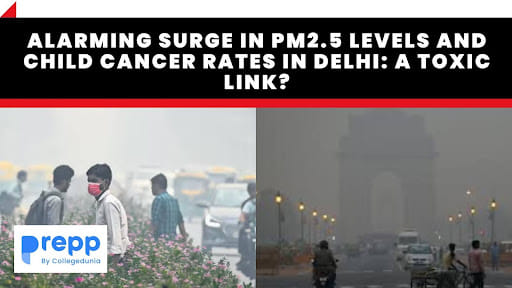
- Delhi experienced a major increase in PM2.5 pollution, with a 68% rise in a single day. This was the first 'severe+' level of PM2.5 this season, exceeding 300 µg/m³.
- Delhi has the highest rate of childhood cancers among Indian cities according to the National Cancer Registry Programme data from 2012 to 2016.
Table of Contents
Key Facts About Pollution in Delhi
- PM2.5 Spike: Delhi witnessed a 68% rise in PM2.5 levels within a single day, crossing the 'severe+' category mark with more than 300 µg/m3.
- Early Increase: Unlike the pattern over the past five years where PM2.5 levels rose from October, in 2023 the rise began in mid-September.
- Stubble Burning Contribution: The contribution of stubble burning from neighboring states like Punjab and Haryana to Delhi’s PM2.5 was over 25% and is expected to increase.
- Combustion Sources: The current pollution is majorly due to combustion, with PM2.5 making up over 50% of PM10 levels, indicating a higher impact from sources like vehicles, industry, and open burning.
- NO2 Levels: There is a significant rise in NO2 levels, with some areas in Delhi recording levels three to four times higher than the 24-hour standard.
- System of Air Quality and Weather Forecasting and Research (SAFAR): This initiative provides real-time, location-specific air quality information.
Pollution Hotspots in Delhi & NCR
|
What is Air Pollution’s Role in Cancer?
- Airborne pollutants have been implicated in various forms of adult-onset cancers, often due to long-term exposure.
- Children are more susceptible to the effects of air pollution for several reasons:
- They breathe more rapidly than adults, which means they can take in more pollutants over the same period.
- They are smaller and closer to the ground, where some pollutants like heavy metals and particles tend to concentrate.
- Their organs and immune systems are still developing, potentially making them less capable of detoxifying and managing the harmful effects of pollutants.
- Studies have shown that exposure to air pollution is associated with specific types of cancers in children, such as acute myeloid leukemia (AML) and non-Hodgkin lymphoma.
- Certain pollutants have been identified as being particularly harmful:
- Benzene: A well-known carcinogen often found in vehicle exhaust and industrial emissions.
- Nitrogen oxides (NOx): Gases produced from vehicle emissions and industrial activities.
- Particulate matter (PM2.5): Tiny particles in the air that can penetrate deep into lung tissue and even enter the bloodstream.
- A study published in 2023 highlighted a link between the exposure to PM2.5 and an increased risk of Acute lymphoblastic leukemia (ALL) among children, underscoring the potential role of air quality in pediatric health outcomes.
Statistical Insights into Childhood Cancers and Air Pollution Concerns in DelhiChildhood Cancer Statistics
Comparative Statistics
Important Statistics Regarding Specific Cancers
Impact of Air Pollution on Unborn Babies
|
System of Air Quality and Weather Forecasting and Research (SAFAR)
- The System of Air Quality and Weather Forecasting and Research (SAFAR) is a project initiated by the Ministry of Earth Sciences (MoES), Government of India, to measure the air quality of a metropolitan city and to forecast the air quality 1-3 days in advance.
- It was first launched during the Commonwealth Games in Delhi in 2010 and subsequently extended to other cities.
- SAFAR is designed to provide a science-based decision support system to achieve the objectives of public awareness of air quality and help in mitigating severe air pollution events well in advance.
- It is crucial for urban health planning and implementation of air pollution mitigation policies and measures.
- The system has been made operational in several Indian cities including Delhi, Pune, Mumbai, and Ahmedabad.
Role & Responsibilities of SAFAR
- Monitoring Air Quality: SAFAR provides a real-time monitoring and forecasting system for air quality which is location-specific.
- It measures overall pollution levels and the presence of various pollutants, including particulate matter (PM2.5 and PM10), nitrogen oxides, sulfur dioxide, carbon monoxide, ozone, VOCs (Volatile Organic Compounds), and benzene, among others.
- Advanced Forecasting: The system uses advanced scientific models for forecasting air quality, and it also provides UV Index, heat index, and solar radiation information.
- This forecasting helps in alerting residents about the air quality, and this information can be particularly useful for vulnerable groups, like the elderly, children, and those with chronic health conditions.
- Public Awareness: SAFAR aims to increase public awareness by providing information on the quality of air, the pollutants, and their potential health impacts.
- Disaster Management Support: The system can also provide information on the dispersion of airborne pollutants in the event of chemical, biological, or radiological disasters, thus aiding in disaster management.
- Research and Development: SAFAR also contributes to research and offers a platform for testing and validation of new technologies related to air quality forecasting.
- Policy Facilitation: The data and findings from SAFAR play a crucial role in creating policy decisions regarding air pollution and mitigation strategies.
Factors Causing Rise in Pollution Levels in Delhi
- Stubble Burning: Every year during the post-harvest season in neighboring states like Punjab and Haryana, farmers burn the crop residue to prepare the field for the next sowing season. This stubble burning contributes significantly to the PM2.5 levels in Delhi, especially during the months of October and November.
- Vehicle Emissions: Delhi has a high number of vehicles on its roads, and emissions from these vehicles contribute to both PM2.5 and nitrogen dioxide levels.
- Industrial Pollution: Emissions from industries in and around Delhi add to the air pollution levels. Many of these industries still rely on fossil fuels which are significant sources of air pollutants.
- Construction Activities: Construction dust is another major source of particulate matter in the air.
- Waste Burning: Open burning of waste, including leaves, plastic, and other materials, especially in the colder season, adds to the concentration of PM2.5 and other toxic pollutants.
- Meteorological Factors: Meteorological conditions such as temperature inversion, low wind speed, and absence of rain lead to the trapping of pollutants close to the ground, exacerbating the air quality issues.
- Fossil Fuel-based Power Plants: The power plants around Delhi, which mostly run on coal, contribute to the NOx and particulate matter levels in the air.
- Regional Contributions: The air quality in Delhi is not only influenced by local sources but also by pollution that is carried by winds from other regions.
Mitigation Measure to be Implemented
Stubble Management
- Providing farmers with alternatives to stubble burning, such as subsidized machinery for in-situ management of crop residue (like happy seeders, super straw management system), or setting up biomass plants that can use stubble as raw material for energy production.
Vehicle Emission Control
- Promote public transport and non-motorized transport.
- Implement stricter vehicular emission norms, like BS-VI standards.
- Phasing out old, polluting vehicles and promoting electric vehicles (EVs).
- Regular pollution under control (PUC) checks.
Industrial Emissions
- Shift industries towards cleaner fuels like PNG (Piped Natural Gas).
- Enforce strict industrial emission standards.
- Promote the adoption of pollution control technologies.
Construction and Demolition Regulations
- Enforce rules to control dust, such as covering construction sites and material, and sprinkling water.
- Regulate timings for construction activities to minimize dust during peak hours.
Waste Management
- Strengthen solid waste management practices to prevent open burning.
- Promote segregation at source and recycling.
- Incentivize waste-to-energy plants.
Legislation and Policy Strengthening
- Ensure enforcement of National Clean Air Programme (NCAP) guidelines.
- Implement and monitor action plans for ‘pollution hotspots’ in the city.
Energy Policy
- Decommission old coal-based power plants and promote renewable energy sources.
- Implement energy efficiency measures in both residential and industrial sectors.
Community Involvement
- Encourage citizen participation in monitoring and reporting pollution sources.
- Education and awareness programs on the health impacts of air pollution.
Conclusion
Despite past measures to control pollution, there is a need for more comprehensive actions to close policy gaps and meet clean air targets to prevent hazardous smog and protect public health. The data and research underscore a significant health crisis for children in Delhi, with implications for long-term health outcomes.
(*Click this link to read prelims specific weekly current affairs articles)
FAQs
Question: What is the System of Air Quality and Weather Forecasting and Research (SAFAR)?
Answer:
The System of Air Quality and Weather Forecasting and Research (SAFAR) is a project initiated by the Ministry of Earth Sciences (MoES), Government of India, to measure the air quality of a metropolitan city and to forecast the air quality 1-3 days in advance. It was first launched during the Commonwealth Games in Delhi in 2010 and subsequently extended to other cities. SAFAR is designed to provide a science-based decision support system to achieve the objectives of public awareness of air quality and help in mitigating severe air pollution events well in advance.
Question: What is the National Cancer Registry Programme?
Answer:
The National Cancer Registry Programme (NCRP) was established in 1981 by the Indian Council of Medical Research (ICMR) with the primary objective of collecting authentic information on the magnitude and patterns of cancer. The goal of the NCRP is to generate comprehensive data on cancer incidence and distribution across different demographic and geographic segments of India's population. This data is essential for assessing and formulating public health policies, planning and implementing strategies for cancer prevention, control, and management.
Question: How does air pollution potentially increase the risk of cancer in children in Delhi?
Answer:
Air pollution contains various carcinogens like benzene, nitrogen oxides (NOx), and particulate matter. Children are particularly vulnerable because they breathe more rapidly than adults, which can lead to a higher dose of pollutants per unit of body weight. Additionally, their closer proximity to the ground can expose them to higher concentrations of pollutants that settle low in the air.
UPSC Mains Practice Question:
|
MCQs
Question: In the context of WHO consider the Air Quality Guidelines, consider the following statements: (UPSC 2022)
- The 24-hour mean of PM2.5 should not exceed 15 ug/m³ and annual mean of PM 2.5 should not exceed 5 μg/m³.
- In a year, the highest levels of ozone pollution occur during the periods of inclement weather.
- PM10 can penetrate the lung barrier and enter the bloodstream.
- Excessive ozone in the air can trigger asthma.
Which of the statements given above are correct?
(a) 1, 3 and 4
(b) 1 and 4 only
(c) 2, 3 and 4
(d) 1 and 2 only
Answer: (b) See the Explanation
The WHO Air Quality Guidelines are a set of evidence-based recommendations for limit values for particular air pollutants developed to assist nations in achieving public health-protective air quality. The guidelines were initially published in 1987.
PM2.5 should not exceed 5 g/m3 annual mean or 15 g/m3 24-hour mean, and PM10 should not exceed 15 g/m3 annual mean or 45 g/m3 24-hour mean, according to the standards. Hence, statement 1 is correct.
PM10 particles (particles having a diameter of 10 micrometres or less) are small enough to pass through the throat and nose and into the lungs. These particles, when inhaled, can harm the heart and lungs and create major health problems. They can penetrate and lodge deep within the lungs.
PM2.5 particles (particles with a diameter of 2.5 micrometres or less) are so small that they can enter the lungs and bloodstream. They are considerably more hazardous to one's health. PM2.5 can pass through the pulmonary barrier and into the bloodstream. Hence, statement 3 is incorrect.
As ozone concentrations rise above the recommended threshold, health repercussions on the population grow more widespread and severe. Such impacts can occur in areas where concentrations are currently high owing to human activity or when temperatures are extremely high. Hence, statement 2 is incorrect.
Because it is particularly irritating to the lungs and airways, ozone causes asthma. It is commonly understood that ozone levels are closely associated to asthma attacks. Hence, statement 4 is correct.
Therefore, option (b) is the correct answer.
Question: How is the National Green Tribunal (NGT) different from the Central Pollution Control Board (CPCB)? (UPSC 2018)
- The NGT has been established by an Act whereas the CPCB has been created by an executive order of the Government.
- The NGT provides environmental justice and helps reduce the burden of litigation in the higher courts whereas the CPCB promotes cleanliness of streams and wells, and aims to improve the quality of air in the country.
Which of the statements given above is/are correct?
(a) 1 only
(b) 2 only
(c) Both 1 and 2
(d) Neither 1 nor 2
Answer: (b) See the Explanation
The National Green Tribunal (NGT) is a statutory organization formed by the National Green Tribunal Act in 2010. It was established to address and expedite disputes involving environmental issues.
The Tribunal shall be guided by natural justice principles rather than the method outlined in the Code of Civil method, 1908.
The Tribunal's principal venue of sitting is New Delhi, and the other four places of sitting are Bhopal, Pune, Kolkata, and Chennai.
The statutory institution, the Central Pollution Control Board (CPCB), was established in September 1974 under the Water (Prevention and Control of Pollution) Act of 1974. Hence, statement 1 is incorrect.
Furthermore, the CPCB was given powers and functions under the Air (Prevention and Control of Pollution) Act of 1981.
The CPCB's primary functions, as outlined in the Water (Prevention and Control of Pollution) Act of 1974 and the Air (Prevention and Control of Pollution) Act of 1981, are to promote the cleanliness of streams and wells in various areas of the States by preventing, controlling, and abating water pollution, and to improve air quality and prevent, control, or abate air pollution in the country. Hence, statement 2 is correct.
Therefore, option (b) is the correct answer.
Question: Acid rain is caused by the pollution of environment by (UPSC 2013)
(a) Carbon dioxide and nitrogen
(b) Carbon monoxide and carbon dioxide
(c) Ozone and carbon dioxide
(d) Nitrous oxide and sulphur dioxide
Answer: (d) See the Explanation
Acid Rain is defined as rain or any other form of precipitation with a higher level of hydrogen ions (i.e., a low pH of 5.6). Acid Rain is caused by sulphur and nitrogen oxides that are acidic in nature.
Sulphur dioxide and nitrogen oxides are produced as a result of human activities such as the combustion of fossil fuels, volcanic activity, and so on. Acid Rain is mostly caused by these oxides following oxidation and interaction with water.
Therefore, option (d) is the correct answer.
Download the PREPP App and attempt FREE IAS Exam Mock Tests and get complete study material!

Full Test - 04: UPSC CSE Prelims CSAT (Paper-II)
Full Test - 03: UPSC CSE Prelims CSAT (Paper-II)
UPSC CSE Prelims 2026 GS Paper 1 Question Paper (24-May-2026)
UPSC CSE Prelims 2026 CSAT Paper 2 Question Paper (24-May-2026)

17 February 2025 | The Hindu Must Read Articles | Current Affairs

16 February 2026 | The Hindu Must Read Articles | Current Affairs

13 February 2026 | The Hindu Must Read Articles | Current Affairs









Comments